Act I
“Sir, the line starts back there.”
Maria Keene pointed toward the soaked residents waiting across the school parking lot.
The storm had passed two days earlier, but its damage remained everywhere. Families stood beneath temporary lights with wet coats, damaged documents, and empty containers, waiting for water and food one household at a time.
The man at the front had not waited at all.
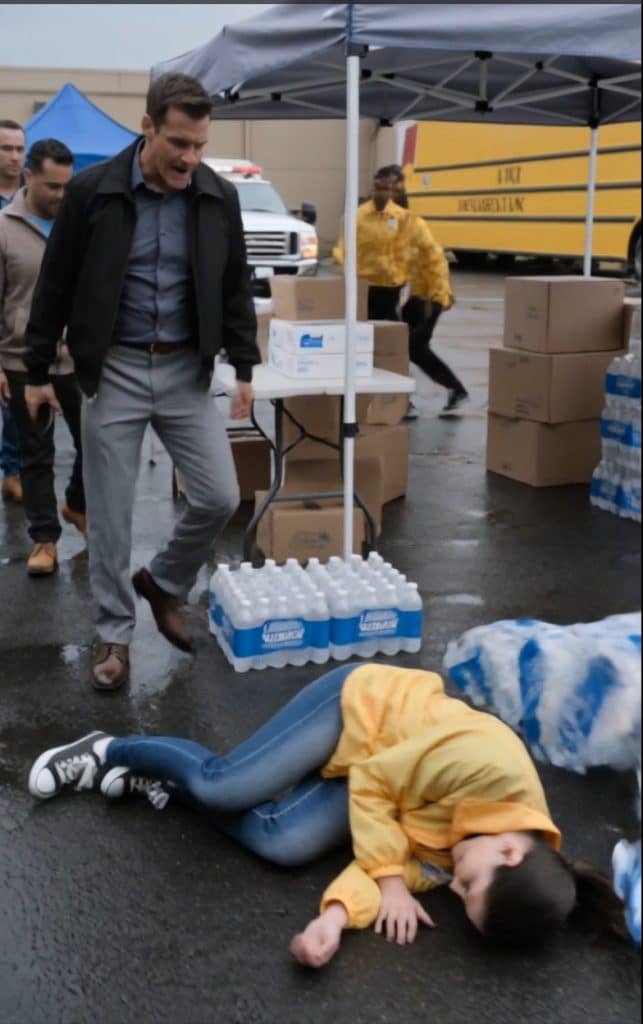
Ethan Carr had stepped out of a black luxury SUV, walked past nearly sixty people, and placed his expensive phone on the relief table as though the supplies had been reserved for him.
Maria was forty-eight and exhausted.
Her yellow relief windbreaker had dried and become wet again so many times that the fabric felt permanently cold. She had spent the day counting food boxes, organizing water pallets, and making sure elderly residents did not lose their places when they needed to sit down.
Ethan looked at the line behind him.
“Trash. I don’t wait like them.”
Maria did not move.
She knew some of the people waiting.
A retired mechanic had lost his roof. A mother near the back had been sleeping in her car with two children. An older couple had walked almost three miles because floodwater still blocked their street.
Ethan reached toward the nearest water box.
Maria placed herself between him and the table.
His response was immediate.
He drove a forceful kick into her chest, sending her backward into the stacked cartons. Boxes collapsed, bottles scattered over the wet asphalt, and Maria’s forearm struck a cardboard edge hard enough to leave a small red mark beneath her sleeve.
She tried to turn away.
Ethan stepped closer and struck her twice more while the crowd recoiled.
“Move before I make you move again.”
Brakes cut through the wind.
A relief command vehicle stopped beside the supply tents. The rear door opened, and Thomas Avery stepped out wearing a dark field coat and an emergency command badge.
He was fifty-eight, the head of the State Emergency Relief Agency, and every coordinator at the site recognized him.
Thomas saw Maria beside the fallen boxes.
“Get him away from her.”
Field officers moved at once.
Two shielded Maria while another placed himself between Ethan and the relief line. The volunteers stopped working, and the entire parking lot turned toward Thomas.
Ethan’s confidence collapsed.
“Who are you?”
Thomas did not answer.
One of the water boxes had split open when Maria fell. Beneath the torn outer carton, a second shipping label had become visible.
Then a third.
Then a fourth.
Each label named a different emergency supplier.
Each claimed ownership of the same pallet.
Thomas crouched beside it and read the original manufacturer’s stamp hidden underneath them all.
The water had been donated free of charge by a beverage company three days after the storm.
Yet the state had paid four separate vendors more than $38,000 for that single pallet.
And Ethan Carr controlled every one of them.
Act II
Maria normally worked in the school’s accounting office.
When the storm flooded several neighborhoods and damaged the municipal pumping station, the school parking lot became an emergency distribution point.
Maria volunteered because she understood inventory.
She knew how many cartons arrived, how many left, and how quickly a missing number could become a missing meal.
The official relief system was digital.
Every pallet carried a code. Drivers scanned it at arrival, volunteers confirmed the delivery, and software updated the state’s supply map.
Green meant completed.
Yellow meant partial.
Red meant waiting.
The dashboard showed the school site receiving far more supplies than Maria could find on the asphalt.
On the first evening, the system listed twenty water pallets.
Maria counted eleven.
The next morning, three additional pallets appeared in the records without arriving physically.
A logistics coordinator blamed delayed synchronization.
Maria accepted the explanation once.
Then food boxes began disappearing in the same way.
The system recorded full deliveries, but trucks arrived half-loaded. Drivers carried paperwork showing that every promised carton had been received at a warehouse before reaching the school.
Maria started keeping her own ledger.
She wrote truck numbers, seal colors, arrival times, driver names, and physical counts. When power failed, she used paper. When rain smeared the ink, she copied the pages again inside the school office.
Her records made one fact impossible to ignore.
Some pallets appeared at several relief sites on the same day.
One truck entered the school parking lot, paused near the scanner, and left without unloading. The state map still turned the location green.
Another vehicle delivered six food boxes while the digital record showed sixty.
Maria filed a discrepancy report.
The case closed automatically after the contractor uploaded a photograph of a full pallet.
She recognized the background.
The photograph had been taken at a different school.
A yellow goalpost stood behind the boxes. Maria’s school had no football field.
The contractor responsible for the system was Carr Emergency Logistics.
Ethan had built the company by financing small suppliers during disasters.
Emergency vendors often needed money immediately. They purchased food, water, fuel, tarps, and generators before governments processed payment.
Ethan’s company offered fast cash in exchange for the invoices.
The arrangement was known as invoice factoring.
A supplier sold its unpaid $100,000 government invoice to Carr Emergency Logistics for less than its full value. Ethan collected the entire payment later and kept the difference.
During ordinary business, the process could be legitimate.
During the storm, Ethan turned it into a machine.
His employees created dozens of supposedly independent vendors.
Some appeared to be local family businesses. Others claimed to be minority-owned suppliers, rural transport companies, or community emergency groups.
In reality, most shared bank accounts, office addresses, and directors connected to Ethan.
One shell company bought a pallet.
A second company claimed to transport it.
A third claimed to store it.
A fourth claimed to sell it to the state.
Carr Emergency Logistics purchased every invoice.
The same goods generated multiple debts before moving a single mile.
The donated water was especially profitable.
A beverage company had provided thousands of bottles at no cost.
Ethan’s network relabeled the pallets as commercially purchased emergency inventory. One shell company invoiced the state for the water, another added a scarcity surcharge, and another billed for climate-controlled storage.
The state paid market price several times for something it had already received free.
The labels beneath the torn box showed the full path.
Maria had been attacked beside a pallet that existed in four financial systems but only once in the physical world.
And there was a reason Ethan had rushed to the front of that particular line.
He had recognized the exposed corner of the original donation label.
Act III
Investigators secured the pallet before Ethan’s network could alter the records.
They collected Maria’s handwritten ledger, the digital scan history, truck entry footage, supplier invoices, and the overlapping labels from the damaged carton.
The original manufacturer’s code identified the water donation.
The beverage company had transferred the pallet directly to the state at no charge.
Carr Emergency Logistics then recorded a sale from River County Hydration Services for $7,800.
River County Hydration did not own a warehouse.
Its listed address belonged to an empty storefront.
The same pallet appeared two hours later in an invoice from Rapid Family Supply for $9,200.
Rapid Family Supply’s owner was an employee in Ethan’s finance department.
A third company charged $11,600 for emergency transportation.
The truck never moved.
The final vendor added a severe-weather handling fee and sold the pallet to the state again.
Each invoice remained below the threshold requiring a competitive emergency review.
Splitting one purchase into smaller claims allowed Ethan’s companies to avoid deeper scrutiny.
The software supported the deception.
A pallet became officially delivered when its code passed within range of a relief-site scanner.
The system did not require unloading.
Drivers could visit three parking lots with one truck, trigger three scans, and return to a private warehouse with the supplies still inside.
Each location turned green on the state map.
Each shell vendor generated another invoice.
Communities saw empty tables.
Officials saw completed deliveries.
Some pallets were later moved to media events.
Boxes were arranged behind officials announcing successful relief operations. After photographs were taken, the trucks carried the same supplies to another county.
One shipment appeared in six public announcements.
Only one site received the water.
The financial trail grew wider.
Ethan’s company sold the invoices to banks and private investment funds.
Because government emergency bills were considered reliable, lenders advanced money quickly.
But several funds unknowingly financed claims against the same pallet.
The donated water became collateral for multiple loans.
Carr Emergency Logistics collected cash immediately while taxpayers remained responsible for settling the overlapping claims.
Food boxes followed the same pattern.
A carton containing rice, canned beans, and powdered milk cost less than $30 to assemble.
Ethan’s vendors billed between $140 and $230 per box.
Storage fees accumulated even while the cartons sat inside trucks.
Emergency fuel surcharges appeared on electric vehicles.
Cold-chain fees appeared on shelf-stable food.
A company claimed overnight warehouse labor at a facility that had no electricity after the storm.
Maria’s records revealed what the invoices concealed.
She had counted every carton reaching the school.
The digital system claimed 4,800 food boxes.
Her ledger showed 1,930.
The state had paid for all 4,800.
The missing supplies were not merely numbers.
Families had been turned away because volunteers believed inventory was exhausted.
Older residents received half rations.
Medical shelters requested more water and were told nearby sites had already been fully stocked.
The money intended to fill those gaps had been absorbed by invoices describing deliveries that never occurred.
Then investigators examined the volunteer confirmations.
Maria’s identification number appeared on hundreds of completed receipts.
She had approved none of them.
Her relief badge had become a digital signature used across the entire county.
Act IV
The volunteer system required one local confirmation for every delivery.
Ethan’s software captured badge numbers whenever volunteers logged into the relief portal.
After that, supervisors could attach the number to any shipment assigned to the same region.
Maria appeared to approve truckloads she had never seen.
Other volunteers were used the same way.
One man supposedly confirmed deliveries while hospitalized after the storm.
A woman’s badge approved supplies two days after she left the state.
A retired teacher appeared at nine relief points during the same hour.
The false confirmations protected Carr Emergency Logistics.
Every missing pallet looked as though a trusted community volunteer had accepted it.
If a dispute arose, the company blamed poor local recordkeeping.
Volunteers began doubting themselves.
They were exhausted, working in rain and darkness, often without stable internet.
Ethan’s system turned ordinary confusion into cover.
Thomas’s agency had trusted the digital signatures.
The dashboard appeared precise and immediate. It showed routes, quantities, costs, volunteer approvals, and delivery times.
The state’s emergency command center projected it across a wall.
Officials celebrated every new green site.
No one asked why residents continued standing in longer lines.
No one compared the screen with school cafeterias, shelter storerooms, or Maria’s rain-damaged paper ledger.
The financial incentives rewarded appearance.
Relief contractors received performance bonuses for reaching sites quickly.
Agency leaders received public praise when distribution maps turned green.
Local governments became eligible for the next phase of recovery funding after supply needs were marked stabilized.
Everyone benefited when the first emergency phase appeared complete.
The residents waiting for water did not.
Thomas suspended Carr Emergency Logistics from controlling delivery verification, vendor registration, and invoice financing.
The relief operation continued under temporary public supervision.
Real suppliers were paid directly.
Volunteer confirmations could no longer be created from stored badge numbers. A shipment required physical receiving, a counted quantity, and verification from two people who did not work for the vendor.
One could be a volunteer.
The other had to be an independent site coordinator.
The state also prohibited vendors from splitting related purchases to avoid review.
Companies sharing owners, accounts, addresses, employees, or financing sources were treated as one supplier for emergency thresholds.
Shell companies could not become separate businesses simply because their names were different.
Donation records became part of the procurement system.
A free pallet could still generate legitimate transportation or storage costs.
It could not be sold to the state as newly purchased inventory.
Every invoice had to distinguish the value of the goods from the cost of moving them.
Invoice factoring remained legal, but emergency claims could not be sold to multiple lenders.
A central registry showed whether an invoice had already been financed.
Banks gained access to original purchase documents, delivery records, and vendor ownership information before advancing money.
The reforms slowed payment.
Small legitimate suppliers worried they would suffer because of Ethan’s fraud.
The state created direct emergency advances for verified local businesses so they did not have to depend on private financiers.
Speed remained necessary.
Secrecy did not.
Then investigators discovered that Carr Emergency Logistics had not merely inflated disaster invoices.
Ethan’s network had been buying the unpaid claims of storm-damaged families.
The same shortage he created was helping him acquire their property.
Act V
Families waiting for relief still had mortgages, insurance deductibles, repair bills, and temporary housing costs.
Many expected emergency grants to arrive quickly.
Delays pushed them toward private loans.
Ethan’s finance network offered immediate cash against future disaster payments.
The contracts carried high fees and broad security clauses.
Some allowed his companies to claim insurance proceeds.
Others gave liens against damaged homes.
The false supply invoices drained public relief budgets and slowed assistance.
The delay made families desperate.
Ethan’s companies then profited by lending them money.
He earned once when the state paid for supplies that did not arrive.
He earned again when the resulting shortage forced residents to borrow.
Properties near a planned commercial development received the most aggressive offers.
Ethan’s investment partners wanted the land surrounding the school and several damaged neighborhoods nearby.
Households that missed repayment deadlines faced liens, forced sales, or assignments of future insurance money.
The storm had created damage.
Ethan’s network turned delayed relief into leverage.
Maria’s neighborhood appeared on the acquisition map.
Her own house had lost part of its roof.
A Carr-affiliated lender had already mailed her an offer.
The paperwork described fast recovery assistance.
Hidden inside was an option allowing the lender to purchase the property if repayment failed within ninety days.
Maria had left the envelope unopened while volunteering at the school.
The man who attacked her for enforcing the line was also building a business model around making the line necessary.
Ethan Carr and participating executives faced consequences for assault, procurement fraud, identity misuse, false invoicing, and deceptive disaster lending.
Banks and investment funds were reviewed according to what information they had received and ignored.
Legitimate drivers, warehouse workers, and suppliers were not treated as conspirators merely because Ethan’s companies had used their names.
Several had preserved messages showing supervisors ordering trucks to scan sites without unloading.
Their evidence helped trace the pallets.
The state recovered disputed payments and canceled unsupported invoices.
Families did not lose aid because the agency had already paid fraudulent vendors.
Emergency budgets were replenished through reserve funds while recovery actions continued.
Relief sites received the supplies their dashboards had falsely promised.
The disaster loans entered independent review.
Liens tied to deceptive contracts were frozen.
Residents could choose corrected financing, direct grants, or legal assistance.
No one was required to surrender a home simply because public relief had arrived late.
Maria recovered and returned to the school several weeks later.
Thomas offered her a permanent position in relief logistics.
She accepted only after the role was defined as real oversight rather than symbolic recognition.
Her team compared physical counts, supplier ownership, payment status, and community complaints before a site could be marked complete.
Paper records remained available.
A system did not become modern by making human observation disposable.
Maria’s volunteer badge was replaced.
The new badge could confirm only the transaction occurring in front of her.
It could not approve future deliveries or be copied across sites.
Volunteers could review every confirmation attached to their identities and challenge it without losing access.
The school parking lot stayed open until the surrounding neighborhoods had stable water, food access, and safe roads.
The line shortened gradually.
Not because a dashboard changed color.
Because people received what had been promised.
One rainy afternoon, another well-dressed man approached the front table without noticing where the line ended.
Maria pointed toward the residents waiting behind him.
He walked to the back.
No command vehicle arrived.
No boxes collapsed.
No hidden label appeared.
That ordinary correction mattered more than Thomas’s authority.
Maria deserved safety before anyone discovered the duplicate invoices.
Her request had been fair before the pallet became evidence.
Ethan’s money did not make his time more valuable than the time of people who had lost roofs, cars, power, and clean water.
Disaster relief was not a reward for appearing important.
It was a shared promise that need would be answered without wealth purchasing the first place in line.
The state’s new supply dashboard looked less impressive.
Some sites remained yellow because deliveries were partial.
Some invoices stayed pending because ownership was unclear.
Officials could no longer make every problem disappear by entering a green status.
The system became slower to celebrate.
It became faster to correct.
Years later, Ethan remembered the parking lot through one final moment.
Maria stood beside the supply table in old sneakers and a yellow windbreaker.
She pointed toward the back of the line.
“Sir, the line starts back there.”
Ethan saw soaked residents and believed waiting beside them would reduce him.
“Trash. I don’t wait like them.”
Carr Emergency Logistics had been built on the same belief.
Real suppliers could wait for payment.
Volunteers could carry blame.
Residents could wait for water.
Families could wait for recovery.
Ethan alone would be paid first.
Then Maria fell into the cartons.
The water bottles rolled.
Four shipping labels tore open beneath one donated pallet.
And the supplies listed as purchased, transported, stored, and delivered by four different companies were revealed to have belonged to the public before Ethan charged them a single dollar.