Act I
“I’m sorry. This was preordered.”
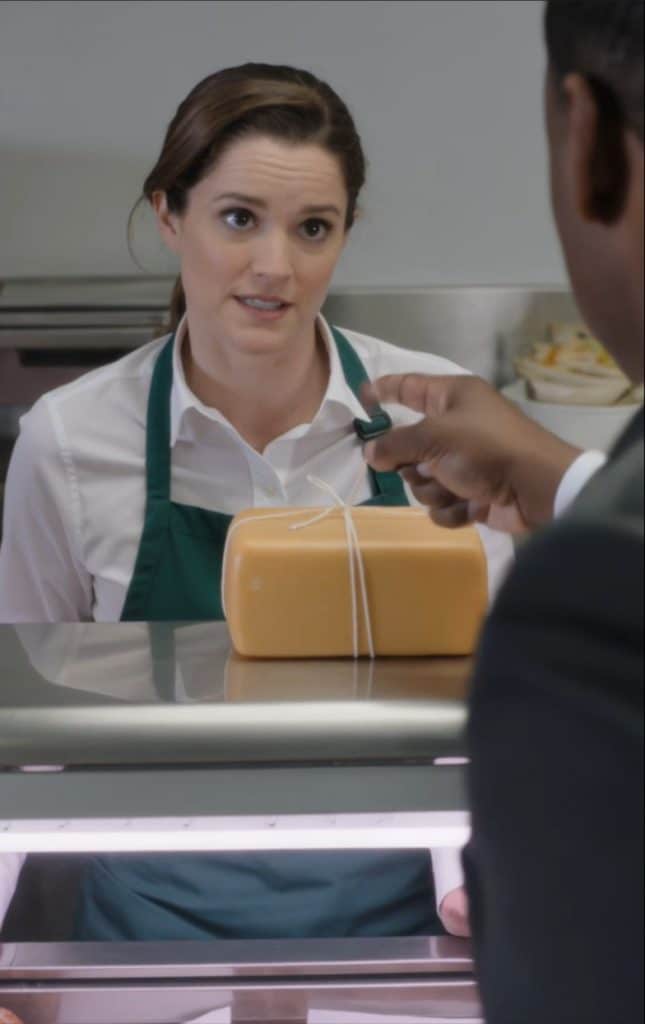
Nora Hayes kept one hand beside the package on the cold glass counter.
It was wrapped in cream deli paper and tied with green string. Beneath the knot, a small card identified the contents:
MAPLE RIDGE RESERVE — TOWN CENTER ORDER
The man across from her did not care.
Calvin Ross was forty-seven, dressed in an expensive wool coat and polished shoes that seemed out of place beside the shop’s worn tile floor.
He pointed through the glass.
“I want that cheese.”
“It’s the final wheel from this batch.”
“Then cut it for me.”
“The customer already paid.”
Calvin placed several hundred-dollar bills on the counter.
Nora slid them back.
“I have another aged cheddar you may like.”
“Trash. I’m standing here now.”
The regular customers waiting near the bread rack stopped talking.
Nora was forty-four and had been working since before sunrise. Her white shirt was neatly pressed beneath a green apron, but fatigue showed behind her careful smile.
“The preorder comes first.”
Calvin leaned closer.
“People like you serve whoever pays more.”
“No,” Nora said. “We serve whoever we promised.”
His expression changed.
Then he attacked her.
Nora fell behind the counter as deli paper unrolled across the floor and the spool of green string slipped from the worktable. Several customers recoiled in shock.
The violence was brief, deliberate, and terrifying enough to silence the entire shop.
Calvin stood over her.
Nora pulled herself toward the counter.
She did not ask him to spare her.
“Don’t let him cut that label off.”
Brakes sounded outside.
A convoy of SUVs stopped hard along the curb. The deli’s front door slammed open, freezing everyone inside.
A sixty-year-old man entered with several people from the town center behind him.
His name was Thomas Mercer.
The store manager from the neighboring market immediately stepped aside. A council aide lowered her head and cleared the entrance.
Thomas crossed directly to Nora, helped her first, and placed himself between her and Calvin.
“That preorder was for me.”
Calvin stared at the people behind Thomas.
“For you?”
Thomas did not answer.
He picked up the tied package and turned it over.
Printed on the underside was a creamery identification number:
MR-0416-H
Thomas had seen that number that morning on a regional food-development report.
According to the report, Calvin’s company had purchased the entire Maple Ridge harvest, distributed its cheese through luxury stores, and paid the farm a record premium.
But Nora held the farm’s real invoice.
Maple Ridge had sold the entire batch to her.
Calvin had never bought a single wheel.
And the public program praising his company had already paid him twice for delivering the cheese now sitting on Nora’s counter.
The preorder was not merely unavailable.
It was evidence.
Act II
Nora Hayes inherited the deli from her aunt.
The shop had operated in the same narrow building for thirty-eight years, selling handmade cheese, fresh bread, cured meats, preserves, and prepared lunches to people who knew one another by name.
Nothing arrived anonymously.
The goat cheese came from a family outside town.
The sourdough came from a bakery three streets away.
The smoked ham came from a processor whose owner still delivered orders himself on Fridays.
Nora wrote the farm or maker’s name on every package.
Customers trusted the label because she could tell them where the food came from and who had made it.
That trust became valuable when the town launched Local Table America.
The program promised to help small farms and food makers reach larger markets. Public grants supported refrigeration, transportation, packaging, and online ordering.
The goal sounded simple.
Keep local producers alive.
Calvin Ross entered as the program’s private distribution partner.
His company, Heritage Provision Group, offered farmers access to hotels, corporate cafeterias, airport shops, and luxury grocery chains.
Heritage would collect the products, manage branding, handle invoices, and return most of the sale price to the producer.
At first, farmers welcomed him.
Small dairies could not afford refrigerated trucks.
Independent shops lacked national marketing teams.
Heritage seemed to provide the bridge.
Then the labels began changing.
A cheese made at Maple Ridge Creamery appeared inside a black Heritage box under the name Highland Reserve.
A loaf from a neighborhood bakery became Artisan Hearth No. 8.
A family’s apple butter became Founders Orchard Preserve.
The original makers vanished from the front of the package.
Heritage called the practice brand unification.
Calvin said customers preferred one trusted luxury name.
The farmers received less recognition.
Then they received less money.
Heritage deducted transportation costs, handling fees, marketing charges, breakage reserves, temperature-control fees, and customer-acquisition expenses.
A farmer might sell cheese that brought forty dollars at retail and receive nine.
Nora refused to join the exclusive system.
She continued purchasing directly.
That made her deli a problem.
Customers could compare her price with Heritage’s.
They could see the real farm name.
They could ask why the farmer earned more from Nora’s small shop than from a national distributor.
Heritage approached Nora with a partnership offer.
The company would build her an online store, advertise the deli, and place her products in regional gift boxes.
The agreement contained a hidden clause transferring control of her customer list, product photographs, preorder system, and shop name.
Nora refused to sign.
Three weeks later, a Heritage Provision website appeared under the name Hayes Market Collection.
It used photographs taken inside her deli during a public food festival.
Customers could order “Nora’s hand-selected local cheeses” through the site.
Nora received none of the orders.
When she complained, Heritage’s lawyer claimed the website described a style of curation rather than her business.
Then her online payment service began failing.
Preorders disappeared from the system.
Customers were charged twice.
Some arrived to collect packages Nora had never received instructions to prepare.
The errors damaged her reputation.
Heritage offered to solve them if she joined its network.
Nora refused again.
The Maple Ridge preorder arrived during the program’s annual town-center banquet.
Thomas Mercer ordered the package personally.
He chaired the Regional Food and Main Street Trust, which funded Local Table America.
The package was meant for a public tasting where officials would decide whether to renew Heritage’s contract.
Thomas believed the cheese came through the program.
He placed the order online using a town-center account.
The payment entered Heritage’s platform.
But the order itself reached Nora directly through a backup email system she had installed after earlier failures.
Nora called Maple Ridge.
The creamery owner, Grace Dalton, confirmed something strange.
Heritage’s annual report claimed Maple Ridge supplied twelve thousand pounds of reserve cheese.
The farm produced less than two thousand.
Nora had purchased nearly all of it.
Grace had never signed a Heritage contract.
Yet the company’s report showed her signature.
The signature had been copied from a delivery receipt.
Nora asked Grace to send the original invoice and production records.
She placed copies beneath the preorder card.
Thomas was arriving to collect the package and review them quietly.
Calvin learned about the order through the platform.
He saw Thomas’s name.
He saw the Maple Ridge batch number.
Then he drove to Nora’s shop to take the package before the town-center convoy arrived.
He believed a few hundred dollars would solve the problem.
When Nora refused, he tried to make the shop look unstable, unsafe, and unworthy of a public contract.
But he did not know Nora had tied one more document beneath the string.
And that document connected Heritage Provision to dozens of farms that had never agreed to work with it.
Act III
Police secured the deli and preserved the security footage.
Calvin claimed Nora had threatened him with a carving knife and stolen company property.
The recording showed the knife resting on the cutting board throughout the confrontation.
It showed Nora offering another cheese.
It showed Calvin attacking only after she refused to surrender the preorder.
Thomas ordered copies stored outside the systems used by Heritage’s insurer and legal team.
Then he opened the package.
Inside were three wedges of Maple Ridge Reserve, the farm invoice, production records, and a list of Heritage sales using the same batch number.
The numbers were impossible.
Maple Ridge produced 1,860 pounds of reserve cheese that season.
Heritage claimed to sell more than 27,000 pounds under the farm’s identity.
The company had turned one small batch into a national product line.
Most of the cheese inside Heritage boxes came from industrial suppliers.
Industrial cheese was not automatically bad.
The fraud was selling it as the work of a specific family farm and charging customers extra for that story.
Auditors contacted Grace Dalton.
She had never received Heritage’s promised premium.
She had never approved the black packaging.
She had never authorized the company to use photographs of her barn or family.
A photographer visited during a public farm tour and asked to take pictures for a local-food article.
Those photographs later appeared in Heritage advertisements.
One showed Grace shaking Calvin’s hand beside an oversized ceremonial check.
The check was a prop.
She never received the amount printed on it.
Heritage recorded the photograph as proof that the company had invested in Maple Ridge.
The same method appeared across the region.
Heritage used real farms to support fictional supply chains.
A small amount of genuine product entered the warehouse.
The farm’s name then covered thousands of unrelated items.
One local bakery supposedly produced four million rolls in a building with two ovens.
A family smokehouse supposedly supplied more ham than its entire annual processing capacity.
An orchard reported destroyed by frost appeared as the exclusive source of a national apple spread.
The arithmetic should have exposed everything.
No one had done it.
Heritage’s reports looked professional.
They contained maps, photographs, percentages, and polished stories about generational craftsmanship.
Officials read the presentation.
They did not count the cheese.
Then investigators opened the payment records.
Local Table America reimbursed Heritage whenever the company helped a producer reach a new customer.
Thomas’s preorder had generated three separate claims.
Heritage billed for connecting Maple Ridge to the town center.
It billed for transporting the cheese.
It billed for providing online sales support to Nora’s deli.
None of those services occurred.
Nora bought directly from Grace.
Grace delivered the cheese herself.
Nora received the order through her own backup email.
Heritage collected public money for standing between people who had already found one another.
The company also took a percentage of the customer payment.
Thomas paid $180 for the tasting package.
Nora’s invoice showed $96.
Grace received $64.
Heritage kept the rest despite never touching the product.
Worse, the system showed Nora and Grace accepting the deductions.
Their approvals were generated automatically whenever a customer completed checkout.
Purchasing the food became proof that the people who made and sold it had accepted the platform terms.
Then auditors examined Heritage’s producer directory.
Hundreds of farms, bakeries, delis, and small processors appeared as active partners.
Many had never joined.
Their names had been copied from farmers-market applications, health permits, festival rosters, and grant records.
The company used public information to populate a private supplier network.
Once listed, each business supported Heritage’s applications for public funding.
A small shop could become an active partner without knowing it.
A family farm could become a national supplier without selling anything.
Heritage received workforce grants too.
It claimed to provide training, refrigeration equipment, packaging tools, and digital systems to independent producers.
Nora’s deli supposedly employed eight workers through the program.
She employed two.
The other six were ghost employees.
One identity belonged to Nora’s aunt, who had died four years earlier.
Heritage billed for training the dead woman in online order management.
It also claimed to install a new refrigerated display counter.
Nora’s counter was twenty-one years old.
The company used a photograph taken at another shop and reversed the image.
The missing equipment produced monthly maintenance fees.
Public money paid for repairs to a machine that did not exist.
Then investigators opened Heritage’s internal scoring system.
Businesses were ranked by resistance.
Owners with legal help received careful contracts.
Older farmers, immigrant families, and small shops with debt received low-defense scores.
Their signatures were easier to copy.
Their names were safer to use.
One note beside Nora’s shop read:
High local trust. Refuses platform. Pressure payment access.
Another appeared beside Maple Ridge:
Family image valuable. Limited capacity creates premium story.
Heritage did not see farms and shops as partners.
It saw credibility waiting to be harvested.
But the most damaging document remained tied beneath the preorder string.
It was a proposed sale agreement for Nora’s deli.
Heritage claimed she had accepted it the previous night.
The signature was hers.
The date was current.
The agreement transferred the shop name, customer list, equipment, recipes, and inventory for one dollar.
Nora had never seen it.
The signature had been lifted from the preorder invoice she sent to Thomas.
Calvin had not entered the deli only to take the cheese.
He intended to take the business.
Act IV
The town center opened its council chamber that evening.
Farmers, shop owners, customers, delivery workers, bakers, public officials, and food inspectors filled the room.
Nora sat beside Grace Dalton and the other producers named in Heritage’s records.
Thomas offered her a place at the main table.
She declined.
“The people whose names were used should sit together.”
Grace testified first.
Maple Ridge had struggled through a year of rising feed and energy costs.
Customers believed Heritage paid the farm a premium.
Local lenders saw the company’s reports and concluded the creamery was financially secure.
When Grace applied for emergency assistance, she was denied because private investment had supposedly already arrived.
The fictional support became a reason to withhold real support.
A baker named Luis Mendoza learned that Heritage had sold bread under his family’s name for two years.
Customers later complained to his actual bakery about quality problems.
He had never made the products.
A beekeeper described finding her face on honey jars sold in airports.
The company listed her as the supplier.
Her hives could not produce one percent of the volume.
A former Heritage driver testified that warehouses kept rolls of replacement farm labels near the loading docks.
When one local story became popular, employees applied that name to whatever product was available.
Warehouse managers called it continuity packaging.
The product changed.
The story remained.
Former account staff described the ghost partnerships.
Employees were instructed to treat publicly listed food businesses as provisional suppliers.
If an owner objected, the company removed the name from public search results but kept it inside grant reports until the funding period ended.
Complaints did not erase the false partnership.
They merely hid it better.
Calvin’s attorneys argued that Heritage had expanded public awareness of local food and helped some producers reach new markets.
Thomas agreed that some services had been real.
Fraud did not require every delivery to be imaginary.
A functioning truck could still carry stolen labels.
A legitimate grant could still hide ghost partners.
The question was whether producers controlled their own names, prices, and products.
The evidence showed they did not.
Nora looked toward Calvin.
“You didn’t sell local food.”
“You sold the word local.”
The room went silent.
Heritage had turned proximity into a luxury image.
Customers paid more because they believed money remained in the region.
Farmers received less while the distributor collected the premium created by their reputation.
Thomas then faced the officials who had renewed Heritage’s contract.
His own signature appeared on the previous year’s approval.
The trust had celebrated rising producer participation.
The number rose because Heritage added businesses without consent.
It celebrated high delivery completion.
Orders counted complete when money cleared, not when food reached the customer.
It celebrated equipment investment.
Photographs replaced physical inspections.
Nora met Thomas’s eyes.
“You counted partners.”
“Yes.”
“You did not ask if we joined.”
“No.”
“You counted payments.”
“Yes.”
“You did not ask who received them.”
“No.”
“You counted local products.”
“Yes.”
“You did not count what the farms could make.”
“No.”
Thomas did not defend himself.
He suspended Heritage Provision from every public contract and froze pending grant payments.
All claimed producer agreements entered independent review.
But Nora rejected his first private offer.
The trust proposed returning her shop immediately, reimbursing her losses, and designating the deli a protected town institution.
“Return it because the transfer was forged,” Nora said. “Do not protect only my shop because your package was involved.”
She wanted every producer contacted directly.
No distributor could certify its own partnerships.
Business names, farm photographs, and family stories required clear, separate permission.
A delivery signature could not become a marketing agreement.
A health permit could not become a supplier contract.
Product volume had to match verified production.
A small batch could not support a national line unless the label clearly disclosed blending and additional sources.
Public funding would go partly to producers directly.
A distributor could be paid for real transport, packaging, or sales work.
It could not collect money for connections that already existed.
Online preorder platforms had to disclose every deduction before the seller accepted the order.
Customer payment would not automatically prove vendor consent.
Equipment grants required physical verification by the recipient.
Ghost employees and dead workers could not release funds.
Then Nora added one final condition.
The preorder still belonged to Thomas.
“Even after this?” he asked.
“You paid for cheese.”
Thomas understood.
The package would be documented.
Then it would be delivered as promised.
Public authority did not move Thomas ahead of another customer.
It simply made him one.
Act V
Heritage Provision Group lost its local-food contracts and distribution licenses.
Investigators opened cases involving fraud, forged business transfers, identity misuse, stolen grant funds, and false origin labeling.
Calvin faced separate consequences for attacking Nora and attempting to remove evidence.
The expensive coat he wore that morning could not protect him from the records inside the deli paper.
Every Heritage product entered review.
Some labels were accurate.
Others named farms that supplied only tiny portions.
Many named producers who had supplied nothing.
Products that remained safe could still be sold under truthful descriptions.
Industrial cheese did not need to be destroyed because it was industrial.
It needed to stop pretending it came from Maple Ridge.
Customers who paid local-sourcing premiums received refunds where claims could not be verified.
Maple Ridge recovered compensation for unauthorized use of its name, photographs, and batch codes.
The creamery also regained access to emergency support denied because of Heritage’s fictional investment.
Grace used part of the funds to replace an aging cooling system.
She did not expand production beyond what the herd and staff could sustain.
When the next reserve batch sold out, it stayed sold out.
Luis Mendoza’s bakery name disappeared from Heritage packaging.
The beekeeper’s photograph was removed from airport shelves.
Families could choose future partnerships under contracts they understood.
Some signed new distribution agreements.
Others remained independent.
Local food did not require isolation.
It required consent.
Nora’s ownership record was corrected.
The forged one-dollar sale was marked invalid and preserved as evidence.
Her aunt’s identity was removed from the ghost training program.
The false equipment records disappeared from the deli’s public profile.
The old refrigerated counter remained.
Thomas’s trust offered to replace it.
Nora accepted only after the grant process became the same one available to other eligible shops.
An inspector visited.
Nora selected the model.
The invoice matched the machine delivered.
No photograph released payment before installation.
The new counter used less electricity and held a steadier temperature.
The improvement was ordinary.
That was what made it trustworthy.
The preorder system changed too.
Every seller could see the customer payment, platform fee, delivery charge, and final amount before accepting.
A completed checkout did not mean the shop had agreed.
The seller confirmed separately.
If the product was unavailable, the order remained unaccepted.
Public reports counted only confirmed transactions.
The numbers fell.
The partnerships became real.
Thomas collected his package the next morning.
He arrived without a convoy.
Nora had returned after receiving medical care but stayed seated while an employee worked the counter.
Thomas waited behind two regular customers.
When his turn came, Nora placed the tied package before him.
“The cheese should rest at room temperature for twenty minutes.”
He paid the exact listed amount.
No discount.
No ceremony.
Then he carried the package to the town center.
At the tasting, officials removed Heritage’s luxury placards.
Grace Dalton’s name appeared beside the cheese.
Nora’s deli appeared as the seller.
The card contained no invented family struggle, no exaggerated heritage, and no claim that a corporation had rescued either business.
It listed the farm, batch, date, and price paid.
The cheese did not taste better because the label was honest.
The honesty simply belonged beside it.
Months later, another wealthy customer entered Nora’s deli and pointed toward a package tied with green string.
“I’ll take that one.”
Nora checked the card.
“It was preordered.”
“I’ll pay more.”
“I have another wheel from a different farm.”
The customer considered it.
Then nodded.
No SUVs stopped outside.
No town officials entered.
No one needed to explain that a promise survived a larger offer.
That ordinary exchange mattered more than Calvin’s panic.
Thomas’s trust published its investigation report.
The first pages listed failures.
Ghost partners.
Impossible production volumes.
Forged transfers.
Equipment that never arrived.
Farm payments that remained inside consulting companies.
The report damaged the trust’s reputation.
Thomas released it unchanged.
An institution that hid embarrassment would rebuild the same conditions.
Nora trusted the new system because it allowed the numbers to look worse.
She joined a producer council for one year.
Farmers, shop owners, delivery workers, warehouse employees, customers, and food inspectors shared authority.
Meetings became longer.
Disagreements entered the minutes.
No distributor could erase the people whose work made its reports possible.
Calvin had told Nora that people like her served whoever paid more.
He misunderstood the business.
A deli did not merely exchange food for money.
It held promises.
A wheel of cheese reserved for one customer was unavailable to another.
A farm name belonged to the farm.
A signature belonged to the person who wrote it.
A public grant belonged to the work it funded.
Money could purchase a product.
It could not purchase the right to rewrite who made it.
Nora mattered before Thomas entered the shop.
She mattered when she appeared to be an exhausted owner in a green apron defending an ordinary preorder.
Thomas’s position did not make attacking her more wrong.
Grace mattered before her batch number became evidence.
The ghost workers mattered before the records were corrected.
Customers mattered before refunds admitted that origin influenced what they paid.
Every small producer mattered before polished reports called them partners.
Years later, Nora trained a new employee named Camille.
During Camille’s first weekend managing the counter alone, a customer asked for a package marked for pickup.
“I can pay twice the price.”
Camille checked the card.
“It belongs to someone else.”
“Can’t you replace it?”
“Not with the same batch.”
The customer selected a different cheese.
Nora heard the exchange from the back room.
She did not intervene.
The rule worked without her.
Near closing, she opened the deli archive.
Inside were the original Maple Ridge invoice, the forged sale agreement, the corrected ownership record, and a piece of green string from Thomas’s package.
One document showed a real transaction.
One showed theft.
One showed repair.
The string showed something simpler.
A package tied for one person had remained theirs.
Nora closed the folder and returned to the counter.
Bread cooled on the rack.
The new display case hummed softly.
Several preorders waited beneath handwritten cards.
Outside, cars moved through the town center.
Inside, every farm name matched the food beneath it.
And the final package from Maple Ridge stayed exactly where a promise had placed it.