Act I
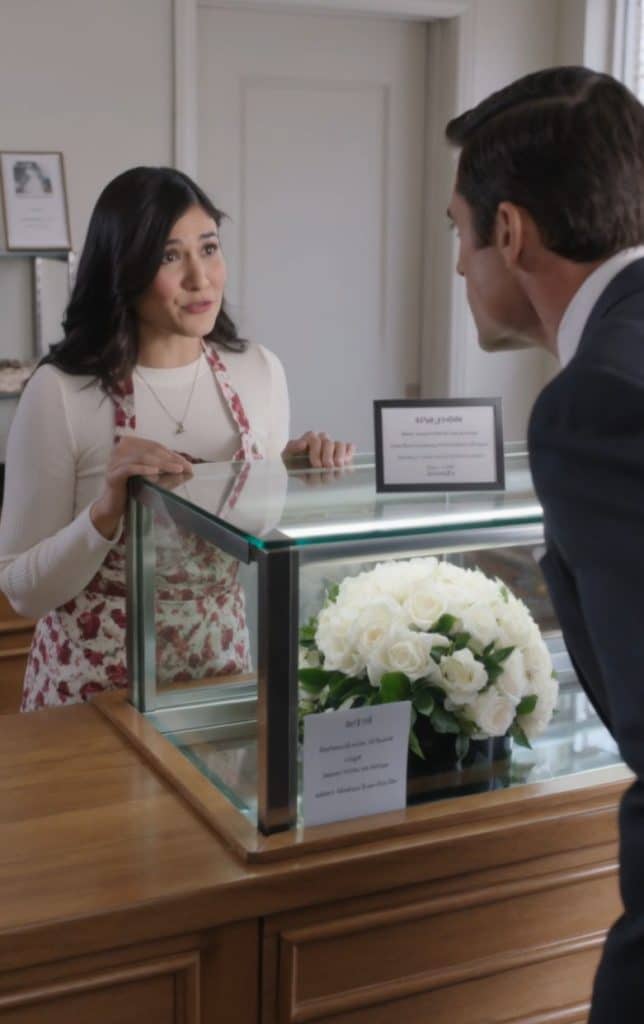
“I’m sorry. That bouquet is already reserved.”
Claire Dawson kept one hand on the glass display case.
Inside rested a white wedding bouquet wrapped in ivory ribbon. Garden roses opened between delicate ranunculus and small branches of jasmine, each flower positioned exactly where Claire had placed it before sunrise.
A reservation card lay beneath the vase.
GRACE MERCER — SATURDAY, 11:30 A.M.
The man across the counter barely looked at the name.
Victor Sloan looked only at the bouquet.
He was forty-five, dressed in an expensive charcoal suit with a luxury watch visible beneath one cuff. He had entered the florist shop ten minutes before a society wedding across town and announced that his client needed something “worthy of photographs.”
Claire offered three arrangements.
Victor rejected all of them.
Then he saw the white bouquet.
“I’ll take that one.”
“It belongs to a bride.”
“Make her another.”
“She is collecting it in less than an hour.”
Victor placed a black credit card on the wooden counter.
“Name the price.”
Claire slid the card back.
“It isn’t available.”
The quiet customers near the window stopped pretending not to listen.
Victor’s face hardened.
“Trash. Everything has a price.”
“Not another customer’s promise.”
He stepped closer.
Claire had been working since four that morning. Flour-soft pollen marked her floral apron, and exhaustion showed beneath her eyes, but her voice remained professional.
“I can build something similar if you give me twenty minutes.”
“My client is not receiving something similar.”
“Then I cannot help you.”
Victor attacked her.
Claire fell beside the counter as several loose stems slipped from a bucket and scattered across the floor. Her elbow struck the wood-patterned tile, leaving a small red scrape.
The violence that followed was brief, intentional, and terrifying enough to empty every sound from the shop.
Victor stood over her.
“Small shop people should learn who matters.”
Claire pulled herself closer to the counter.
She did not ask him to spare her.
She looked through the glass at the bouquet.
“Don’t touch those flowers.”
Brakes sounded outside.
Three black vehicles stopped sharply along the curb. The florist’s front door burst open hard enough to rattle the bell above it.
A fifty-five-year-old woman entered with an assistant and a bodyguard.
Her name was Eleanor Mercer.
People recognized her before Victor did.
The bank manager from next door lowered his head. A local council member near the window stepped aside immediately.
Eleanor crossed the shop and positioned herself between Victor and Claire.
“Do you know whose flowers those were?”
Victor looked at the bodyguard, the assistant, and the reservation card Eleanor had already seen.
His confidence collapsed.
“Who are you?”
Eleanor did not answer.
She knelt beside Claire first.
Then she looked through the display glass at the bouquet made for her daughter.
But the bride’s name was not what frightened Victor most.
Beneath Grace Mercer’s reservation card was a second document.
It showed that Victor’s company had already charged Eleanor $18,000 for the same bouquet.
Claire had been paid only $240.
And according to the contract, Claire Dawson’s florist shop no longer belonged to Claire at all.
Act II
Claire opened Dawson Flowers twelve years earlier with money left by her grandmother.
The shop occupied a narrow storefront between a bakery and an insurance office in a town too small for luxury branding and too proud to need it.
Claire knew which flowers survived long outdoor ceremonies.
She knew how to build bouquets for brides with allergies and centerpieces that would not block conversations across dinner tables.
She remembered anniversaries.
She delivered memorial arrangements without adding a delivery fee when families were already overwhelmed.
Her work was personal because flowers usually arrived when people felt something too large to explain directly.
A wedding.
A funeral.
An apology.
A birth.
A goodbye.
Claire never became wealthy.
The shop survived through reputation, long hours, and customers who trusted her not to replace expensive stems with cheaper ones after deposits were paid.
Then Victor Sloan entered the wedding industry.
His company, Crown & Vow Events, began as a planning service for wealthy clients. Within five years, it controlled venues, photography companies, rental warehouses, invitation printers, caterers, and floral distribution contracts across several states.
Victor told investors he was modernizing a fragmented industry.
Independent vendors heard a different message.
Join his preferred network or disappear from premium weddings.
Crown & Vow offered small florists access to large bookings. In exchange, the company controlled customer payments, delivery schedules, advertising rights, and dispute resolution.
At first, the arrangement helped Claire.
She received weddings she could never have reached alone.
Then the deductions began.
A six-thousand-dollar floral order became four thousand after platform fees.
Then three thousand after marketing charges.
Then twenty-six hundred after “brand consistency adjustments.”
Crown & Vow billed the couple six thousand.
Claire purchased the flowers, paid assistants, arranged every stem, delivered the work, and carried the risk.
Victor’s company kept more than half for moving numbers across a screen.
When Claire questioned the deductions, Crown & Vow offered her a new agreement.
It guaranteed volume.
The language also transferred commercial control of Dawson Flowers’ customer list, photographs, designs, and business name.
Claire refused to sign.
The contract appeared in the system anyway.
Her electronic signature was attached to the final page.
Soon afterward, Crown & Vow began advertising a florist called Dawson Atelier.
Its website used photographs from Claire’s shop.
Its biography described three generations of floral artistry.
Claire’s grandmother had repaired clocks.
The company story was invented.
Customers ordering from Dawson Atelier believed Claire would make their flowers.
Most arrangements came from a regional warehouse.
Workers followed digital recipes using whatever flowers were cheapest that week.
When complaints arrived, Crown & Vow blamed independent florists.
Claire’s real shop absorbed the damage caused by a counterfeit version of her name.
Then Victor introduced deposit management.
Couples paid Crown & Vow in advance. The company promised to protect their money and release funds to vendors as milestones were completed.
Instead, Crown & Vow delayed payments.
Florists borrowed money to purchase flowers.
Bakers used credit cards for ingredients.
Photographers covered travel themselves.
If a wedding was canceled, Crown & Vow kept portions of the deposit under vaguely defined planning fees.
Some couples received nothing.
Some vendors received nothing.
Victor’s company held both sides’ money while forcing them to blame each other.
Claire remained in the network because leaving triggered a contract penalty larger than her annual income.
The company also claimed it owned her future bookings for eighteen months.
She began accepting small local orders outside the platform to survive.
Grace Mercer’s wedding was one of them.
Grace entered the shop alone six months before the ceremony.
She wore jeans, carried a notebook, and never mentioned her family’s influence.
She wanted white garden roses like those her father once grew before he died.
Claire designed the bouquet around that memory.
Grace paid a modest deposit directly.
She asked for no special treatment.
Only honesty.
What Claire did not know was that Grace’s mother chaired the National Cooperative Commerce Board, an institution overseeing fair lending and small-business contracting.
Eleanor had spent two years investigating complaints against Crown & Vow.
Brides reported missing deposits.
Vendors reported forged agreements.
Lenders reported suspicious emergency loans issued to wedding businesses immediately after Crown & Vow delayed their payments.
The same company creating the cash shortage was referring vendors to the lenders profiting from it.
Eleanor arranged for Grace’s wedding payments to be monitored quietly.
Then Crown & Vow discovered the bride’s name in Claire’s schedule.
Victor added the wedding to his platform without permission.
He increased the floral price from $1,600 to $18,000.
He listed imported orchids, a design team of twelve, refrigerated transport, and custom installation insurance.
None existed.
Claire was making one bouquet and several simple table arrangements.
When Eleanor’s auditors requested invoices, Victor rushed to the shop.
He needed the bouquet for a Crown & Vow celebrity client whose order had failed that morning.
More importantly, he needed Grace Mercer’s reservation card removed before Eleanor saw that her daughter’s “luxury floral package” came from a small shop Victor claimed he had acquired.
But Claire had preserved every order.
And inside the bouquet box was the original contract Victor believed he had erased.
Act III
Police secured the shop after witnesses described the assault.
Victor claimed Claire had stolen Crown & Vow property and threatened him with floral shears.
The security camera showed the shears resting near the back sink throughout the confrontation.
It showed Claire offering alternatives.
It showed Victor attacking after she refused to surrender another customer’s bouquet.
Eleanor ordered the footage preserved outside Crown & Vow’s insurance network.
Then her assistant opened Grace’s digital wedding account.
The floral section contained eleven invoices.
Claire had submitted one.
The others came from Crown & Vow subsidiaries.
One invoice charged for climate-controlled transport from an airport.
The flowers had come from a farm forty miles away.
Another charged for overnight security protecting rare botanical materials.
The bouquet had spent the night inside Claire’s locked refrigerator.
A third charged for an artistic consultation with an internationally known designer.
That designer had never heard of Grace Mercer.
The invoices created luxury where none existed.
The final product might still be beautiful.
The money around it was fiction.
Investigators opened Dawson Flowers’ ownership file.
Crown & Vow claimed Claire transferred the business eighteen months earlier.
The agreement carried her electronic signature and a notarized identity confirmation.
Claire had never visited the notary.
The verification photograph showed a woman wearing Claire’s floral apron but facing away from the camera.
Crown & Vow called it remote identity authentication.
The apron had been copied from a photograph on Claire’s website.
Auditors traced the signature to a wholesale-delivery form.
Victor’s legal team had enlarged it, cleaned the background, and attached it to the acquisition agreement.
Dawson Flowers had been stolen with a copied mark.
Claire still paid the rent, taxes, utilities, and wages.
Crown & Vow quietly owned the digital name, customer records, and future bookings.
If Claire closed, Victor kept the brand.
If she survived, he collected fees.
The arrangement converted an independent business into unpaid infrastructure for its counterfeit replacement.
Other florist files showed the same pattern.
A shop owner in Ohio supposedly sold her company while recovering from surgery.
A widower in Vermont transferred his late wife’s floral studio through a document dated after her death.
A family florist in Georgia discovered its grandmother’s designs on national wedding packages without permission.
Crown & Vow did not build a network.
It copied trust from businesses that had earned it locally.
Then auditors opened the wedding-deposit accounts.
More than forty million dollars in couple payments had been moved into short-term investment funds before vendors were paid.
Victor earned returns while florists borrowed money to purchase flowers for weddings already funded in full.
When markets performed well, Crown & Vow kept the gains.
When they performed poorly, payments to vendors slowed.
Couples were told florists caused the delays.
Vendors were told couples had not paid.
Both statements were often false.
The emergency lenders completed the cycle.
A company called Bridal Bridge Capital offered fast loans to small wedding businesses waiting on Crown & Vow payments.
Its interest rates were punishing.
Victor owned Bridal Bridge through a holding company.
He withheld vendors’ money, then lent them replacement money at high interest.
If they defaulted, he acquired their business names, equipment, and customer lists.
Several florists had signed away decades of family work to borrow money that was already theirs.
Claire had been offered one of those loans.
She refused.
That refusal was why Crown & Vow forged the acquisition instead.
The fraud extended to couples.
Crown & Vow sold wedding cancellation insurance through another affiliate.
When ceremonies were postponed, claims were denied because vendors supposedly failed to meet internal notification rules.
The retained deposits then entered the investment pool.
One bride canceled after her mother became seriously ill.
Crown & Vow kept nearly thirty thousand dollars.
The florist received nothing.
The venue received nothing.
The company described the money as administrative recovery.
Grief had become revenue.
Then investigators opened Victor’s phone.
A message sent that morning read:
Mercer audit is active. Remove reservation evidence from Dawson shop.
Another instructed a warehouse designer to photograph Grace’s bouquet after Victor retrieved it and claim Crown & Vow had produced it.
The final message appeared moments before he entered the store:
If Dawson resists, remind her we own the name.
Victor believed ownership gave him the bouquet.
The forged contract told him Claire was no longer a shop owner.
Only labor standing behind his counter.
But beneath Grace’s original order was a handwritten note that damaged the entire scheme.
Payment made directly to Dawson Flowers. No Crown & Vow involvement authorized.
Grace had signed it.
So had Claire.
Victor had charged eighteen thousand dollars for entering a wedding from which he had been explicitly excluded.
Act IV
The town’s commerce hall opened for an emergency hearing that evening.
Florists, bakers, photographers, venue workers, couples, lenders, and local officials filled the room.
Claire sat beside other small-business owners.
Eleanor offered her a chair at the front table.
Claire declined.
“The shops he took are sitting here.”
A florist named Margaret Ellis testified first.
Crown & Vow delayed payment on a thirty-thousand-dollar wedding for four months.
Margaret borrowed from Bridal Bridge to pay her staff.
The interest consumed the profit.
When she missed one installment, Victor’s company took control of her business name.
She still worked in the shop.
She no longer owned the name above the door.
A baker named Thomas Green described receiving a cancellation notice the morning of a wedding.
He stopped production.
The ceremony happened as planned.
Crown & Vow hired a warehouse bakery at the last moment and kept Thomas’s deposit as a disruption fee.
A photographer said his images appeared in Crown & Vow advertising after the company withheld his final payment.
The platform contract treated unpaid work as licensed content.
A bride named Nicole Harris described losing her deposit after postponing her wedding to care for her mother.
Crown & Vow denied the insurance claim.
Nicole later discovered the company had invested the money while her family held a smaller ceremony in a backyard.
Victor’s attorneys called the cases contract disputes.
Eleanor placed the internal ownership chart on the screen.
The platform, lender, insurer, warehouse florist, legal-processing company, and dispute-resolution service all led back to Victor.
A couple could not challenge Crown & Vow without entering a process controlled by another Crown & Vow company.
A vendor could not borrow without paying another affiliate.
A cancellation moved money from one Victor-controlled account to another.
The company did not merely participate in weddings.
It owned every door through which a complaint might escape.
Former employees testified next.
A contract specialist admitted that teams searched public business records for independent shops facing debt, illness, or succession problems.
Crown & Vow called them transition candidates.
The company offered preferred-vendor contracts first.
If owners resisted, digital signatures were manufactured from documents already held by the platform.
A designer described copying local florists’ work into warehouse templates.
Employees removed distinctive details, renamed the designs, and sold them nationally.
The system called it style normalization.
Claire called it theft.
The warehouse produced cheap versions of local work while the original artists absorbed complaints when quality fell.
Victor argued that he had expanded access to elegant weddings.
Claire looked toward him.
“You expanded access to photographs of elegance.”
The flowers in his warehouse were not always poor quality.
The problem was the lie.
Couples believed named local artists controlled the work.
Vendors believed deposits were protected.
Public agencies believed independent businesses benefited.
Victor’s company sat between every belief and converted the distance into money.
Eleanor then faced her own board.
The commerce system had approved lenders connected to Crown & Vow.
Regulators saw rapid business growth and low formal complaint rates.
Complaints were low because Victor’s contracts forced arbitration through his affiliate.
Small shops disappeared before reaching public review.
Claire met Eleanor’s eyes.
“You saw fewer complaints.”
“Yes.”
“You did not ask how many shops were gone.”
“No.”
“You saw growth.”
“Yes.”
“You did not ask who still owned the names.”
“No.”
Eleanor did not defend herself.
She froze Crown & Vow’s financial accounts and suspended every affiliated lending and insurance license.
Digital ownership transfers entered immediate review.
But Claire rejected Eleanor’s first personal remedy.
The board offered to restore Dawson Flowers, repay her losses, and protect Grace’s wedding through a special order.
“Restore the shop because it was stolen,” Claire said. “Do not make the rules different because the bouquet belongs to your daughter.”
She wanted every vendor agreement reviewed independently.
No platform could acquire a business name through embedded contract language.
Ownership transfers required direct confirmation, outside legal advice, and a waiting period.
Wedding deposits would remain in protected accounts.
Platforms could release only clearly disclosed fees.
They could not invest customer money for private gain while delaying vendors.
A company controlling a booking platform could not secretly own the emergency lender or dispute service used by its vendors.
Cancellation insurance would be reviewed by an independent administrator.
Couples would receive plain-language explanations before paying.
Photographs, designs, recipes, and business stories would remain with their creators unless separately licensed.
And no company could describe a warehouse product as the work of a named local shop without that shop’s written approval.
Then Claire added one final condition.
Grace’s bouquet would not become evidence until after the wedding.
“Why?” an investigator asked.
“Because a bride paid for flowers,” Claire said. “She should receive flowers, not a crime-scene photograph.”
The room went still.
For once, the customer promise came before the public performance.
Act V
Crown & Vow Events lost control of its vendor network.
Investigators opened cases involving fraud, forged contracts, misused deposits, predatory lending, and unauthorized use of business identities.
Victor faced separate consequences for attacking Claire and attempting to remove evidence.
His expensive suit remained intact except for a crease and a few traces of shop dust.
The bouquet he wanted never belonged to him.
Grace collected it at 11:30 the following morning.
Claire had returned to the shop after receiving medical care, but she did not pretend nothing happened.
A temporary assistant handled the counter.
Claire inspected the bouquet from a chair.
Grace entered without photographers.
She saw the replaced stems, the restored ribbon, and the reservation card still beneath the vase.
“I heard what happened.”
Claire nodded.
“We kept your flowers cold.”
Grace’s eyes filled.
She did not call Claire brave.
She did not make the moment about her mother’s authority.
She paid the remaining balance printed on the original invoice.
Then she asked how Claire wanted the bouquet carried outside.
The assistant carried it.
Grace held the door.
The wedding took place beneath an old oak tree.
The garden roses opened in the afternoon warmth.
No Crown & Vow logo appeared.
No luxury floral team claimed the work.
The photographer’s records named Dawson Flowers.
That accuracy mattered more than public praise.
Independent accountants returned protected wedding deposits to couples and vendors.
Some ceremonies continued.
Others were canceled.
People regained the choice Victor’s system had taken from them.
Margaret Ellis recovered her shop name.
Thomas Green received payment for the ingredients and labor lost through the false cancellation.
Nicole Harris received the deposit withheld during her mother’s illness.
She did not recreate the abandoned wedding.
She used part of the money to take her mother on a quiet coastal trip after recovery.
Restoration did not require returning to the event Victor had profited from interrupting.
Bridal Bridge Capital was dissolved.
Loans created from withheld vendor payments were canceled or recalculated.
Businesses already taken through default entered ownership review.
Some shops reopened under their original families.
Others transferred to employees who had kept them alive after the founders left.
The names returned to people rather than remaining assets inside a holding company.
Wedding platforms changed how they handled money.
Couples could see when deposits reached vendors.
Vendors could see every deduction before accepting a booking.
Platforms could charge for real services.
They could not hide ownership, invent work, or lend someone back their own delayed payment.
The new system looked less seamless.
More people asked questions.
More contracts took time.
Fewer businesses disappeared.
Dawson Flowers remained small.
Claire restored the old name to every online listing and removed the counterfeit Dawson Atelier pages.
She hired a part-time bookkeeper and began requiring paper copies of every platform agreement.
She still accepted weddings.
She simply refused exclusivity.
One company could not become the only road between her work and the customer.
Eleanor returned to the florist a month later without a convoy.
She waited while Claire finished helping another customer.
When her turn came, she placed a small vase on the counter.
“The flowers from Grace’s bouquet.”
Several stems had dried after the wedding.
“Could you preserve them?”
Claire examined the petals.
“Some.”
“That’s enough.”
Eleanor paid the listed price.
No special service appeared on the receipt.
Months later, a man entered Dawson Flowers looking for an anniversary arrangement.
He pointed toward a bouquet inside the display case.
“I’ll take that one.”
Claire checked the card.
“That is reserved.”
The man paused.
“What else do you recommend?”
Claire showed him a vase of yellow roses and greenery.
“My wife likes yellow.”
He purchased it.
No black vehicles stopped outside.
No bodyguard entered.
No one needed to explain why a reservation mattered.
A customer accepted that money did not erase another person’s promise.
That ordinary exchange mattered more than Victor’s panic.
Eleanor’s board published the results of the Crown & Vow investigation.
The first report did not celebrate enforcement.
It listed the shops lost, deposits withheld, names stolen, and events disrupted.
Some businesses could not be restored.
Owners had retired, moved, or died while fighting contracts designed to exhaust them.
Their records remained in the report.
They were not reduced to unfortunate closures.
Claire joined a regional vendor cooperative but refused permanent leadership.
The cooperative provided shared legal review, protected payment accounts, and emergency support during illness.
No member owned another member’s name.
No lender could take a business story as collateral.
If a florist closed, the photographs and designs returned to the creator or family.
Victor had said small-shop people should learn who mattered.
He believed scale created importance.
Large contracts.
Large payments.
Large vehicles stopping at doors.
But weddings depended on small promises.
A cake delivered at the correct hour.
A dress altered carefully.
A photographer remembering the grandmother beside the aisle.
A florist protecting one bouquet because a bride had been promised it.
Claire mattered before Eleanor entered the shop.
She mattered when she appeared to be an exhausted woman in a floral apron.
The assault was wrong before anyone knew whose name appeared on the reservation card.
Grace’s powerful family did not make the flowers more protected than another bride’s.
The other florists mattered before their stolen contracts formed a pattern.
Couples mattered before their deposits became evidence.
Workers in warehouse studios mattered before investigators learned their designs had been sold under other people’s names.
Dignity did not come from being connected to someone important.
Neither did ownership.
Years later, Claire trained a young florist named Maya Chen.
On Maya’s first wedding order, the bride requested expensive white peonies outside their natural season.
Claire explained the cost and uncertainty.
The bride chose local roses instead.
Maya created the bouquet and placed a reservation card beneath the vase.
The next morning, another customer offered twice the price.
Maya shook her head.
“It is already promised.”
The customer selected something else.
Claire heard the exchange from the workroom.
She did not step in.
The rule protected the bouquet without needing her authority.
Near closing time, Claire swept loose petals from beneath the counter.
She found the original reservation card from Grace’s wedding inside a drawer.
The ink had faded slightly.
She placed it in the shop archive beside the false acquisition contract and the first restored ownership document.
One paper showed a promise.
One showed a theft.
One showed the correction.
The promise was the simplest.
It had always been the one that mattered.
Outside, sunlight moved across the front window.
Inside the display case, a new bouquet waited beneath another customer’s name.
No one had offered more money for it yet.
That made no difference.
It was already unavailable.