Act I
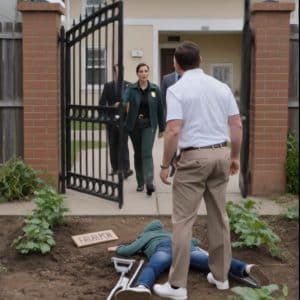
The newspaper missed the porch by three feet.
It landed softly in a flower bed, bending two tulips without breaking them.
Thirteen-year-old Mason Reed squeezed the bicycle brakes.
“Sorry,” he called into the quiet dawn.
He had already begun turning around when the mansion’s front door burst open.
A man in an expensive robe charged down the stone walkway.
Richard Halston was forty-five, wealthy, and accustomed to people apologizing before he decided whether they deserved forgiveness. He owned several businesses, chaired the neighborhood association, and lived in the largest house on Bellweather Lane.
Mason reached toward the flower bed.
“I’ll get it.”
Richard grabbed the bicycle handlebar.
“What did you do?”
“It slipped. I can replace the paper.”
Richard yanked the handlebars sideways.
Mason crashed beside the curb as the bicycle twisted beneath him. His route bag tore open, sending newspapers across the damp street.
One knee scraped the pavement.
Mason barely looked at it.
He reached instead for the bag.
Those papers were counted before sunrise. Missing even a few could mean losing the route his family depended on.
Richard pointed toward the tulips.
“Trash. You ruined my flowers.”
“They’re not ruined.”
The answer surprised both of them.
Mason was frightened, but he had delivered to this neighborhood long enough to know the difference between damage and anger looking for an excuse.
Richard stepped closer and struck him twice while he remained beside the bicycle.
Then he kicked the bike onto its side.
“Deliver trash somewhere else.”
Porch lights came on.
Curtains moved.
A woman across the street opened her door but remained behind it.
Two patrol officers sat in a cruiser near the intersection. They had been speaking to a resident about a parked vehicle, yet neither had reached Mason.
Then a black sedan stopped at the curb.
A sixty-two-year-old man stepped out in a black suit.
The patrol officers immediately stood straight and saluted.
Richard’s expression changed.
The older man walked across the street and stopped between him and Mason.
“Step away from him.”
Richard glanced at the officers.
They were not looking to him for instructions.
They were waiting for the man in the suit.
“Who are you?” Richard whispered.
The stranger looked down at the newspapers scattered across the road.
“My name is Samuel Ward.”
Richard’s face went still.
He knew that name.
Samuel Ward was the former state police commissioner whose signature appeared on the investigation Richard had spent two years trying to bury.
And one of Mason’s torn newspapers contained the first public copy of that report.
Act II
Mason began delivering newspapers after his mother’s hours were cut at the hospital laundry.
His father had died four years earlier, leaving behind a modest pension and a garage filled with tools Mason was still too young to understand.
The newspaper route paid little.
But little mattered.
It covered school lunches, part of the electric bill, and the asthma medication Mason’s younger sister needed each month.
He woke at four-thirty every morning, folded papers beneath the kitchen light, and rode seven miles before school.
Bellweather Lane was the easiest section of the route.
Wide sidewalks.
Few dogs.
Large homes with covered porches.
It was also the part he disliked most.
Residents complained if a paper landed sideways.
They complained if Mason’s bicycle crossed the edge of a lawn.
One customer photographed him because she believed his hoodie looked suspicious.
Richard Halston submitted more complaints than anyone.
He claimed papers arrived late even when Mason’s delivery scanner recorded them before six.
He claimed Mason damaged sprinklers, frightened pets, and left tire marks across grass.
None of it was true.
The newspaper distributor warned Mason that one more complaint could cost him the route.
Mason began photographing every delivery.
House number.
Porch.
Time stamp.
He stored the images on an old phone with a cracked screen.
His mother called the habit excessive.
Mason called it proof.
What he did not know was that Richard’s complaints were part of a much larger pattern.
For six years, Richard had used the Bellweather Homeowners Association to identify residents who were isolated, elderly, behind on taxes, or unable to challenge legal notices quickly.
Small violations became fines.
Fines became liens.
Liens became forced property sales.
Richard’s companies purchased the homes through quiet auctions at prices far below their value.
He did not act alone.
A property attorney prepared the filings.
A city code officer issued questionable violations.
A neighborhood security contractor documented disturbances that never happened.
Residents who objected were described as confused, hostile, or unsafe.
The police reports made the process look legitimate.
Samuel Ward first encountered the pattern while still serving as state police commissioner.
An eighty-one-year-old widow named Evelyn Price called his office after local officers repeatedly refused to take her complaint.
She said Richard’s employees entered her yard, photographed her windows, and posted notices claiming her home was abandoned.
She still lived there.
Two months later, her property was sold over unpaid association penalties she insisted she had never received.
Samuel ordered a review.
Investigators found twelve similar cases.
Before the inquiry could expand, Samuel was forced into early retirement after an anonymous ethics complaint accused him of interfering in private property disputes for political reasons.
The complaint relied on statements from Richard, the city code officer, and two local police supervisors.
The investigation against Samuel eventually collapsed.
By then, the property case had gone cold.
Evidence disappeared.
Witnesses moved.
Richard’s companies continued buying homes.
Samuel never stopped looking.
He created a private legal fund and worked with journalists to reconstruct the missing records. One reporter, Helen Brooks, spent months comparing property transfers, police calls, association notices, and code violations.
Her article was scheduled to run in Mason’s newspaper that morning.
The front page included no accusation.
The full investigation appeared in a special insert hidden inside the weekend edition.
Richard learned about it before publication.
He pressured the newspaper to delay distribution.
The editors refused.
Then he began submitting new complaints against Mason, hoping the boy would be removed from Bellweather Lane before the report reached the neighborhood.
But Mason arrived before dawn anyway.
And the newspaper that landed in Richard’s flowers carried a photograph of the one document he believed had been destroyed.
Act III
Samuel knelt beside Mason.
“Can you move your leg?”
Mason nodded.
The scrape on his knee was small, but his hands shook as he gathered the torn route bag.
“My papers.”
“We’ll get them.”
Richard straightened his robe.
“This boy damaged private property.”
Samuel looked toward the flower bed.
Two tulips leaned beneath the newspaper.
Nothing else had changed.
One patrol officer approached Mason while the other spoke into his radio. Several neighbors stepped into their driveways now that authority had visibly chosen a side.
Richard pointed at Samuel.
“You have no jurisdiction anymore.”
“That is correct.”
“Then leave.”
Samuel stood.
“I’m here as a witness.”
Richard laughed once.
“To what?”
Samuel looked toward a doorbell camera mounted above the mansion entrance.
“To everything it recorded.”
Richard’s eyes moved upward.
The camera belonged to his own security system.
It had captured him crossing the lawn, seizing the bicycle, and attacking Mason.
Richard reached for his phone.
The camera light went dark.
A neighbor across the street called out.
“Mine recorded it too.”
Then another voice came from farther down the block.
“So did ours.”
For years, neighbors had remained quiet because Richard controlled association fines, security contracts, and access to private legal services.
The sight of Mason on the curb changed something.
Perhaps it was his age.
Perhaps it was the scattered papers.
Perhaps it was simply that Richard’s cruelty had become impossible to describe as paperwork.
The two officers separated Richard from the boy.
Samuel picked up the newspaper from the flower bed.
The insert remained dry beneath the folded front page.
Across the top was the headline:
THE HOMES THAT VANISHED: INSIDE BELLWEATHER’S HIDDEN PROPERTY MACHINE
Richard lunged toward it.
An officer stopped him.
Samuel unfolded the report.
One page contained a scanned police memorandum written three years earlier. It documented repeated orders from a local captain to classify trespassing complaints against Richard’s contractors as “civil disagreements.”
The captain’s name was Anthony Wells.
One of the officers standing in the street was his son.
Officer Daniel Wells stared at the page.
“My father retired last year.”
Samuel said nothing.
Daniel continued reading.
The memorandum showed that Captain Wells had received monthly consulting payments from Bellweather Security, a company secretly owned by Richard.
Those payments began shortly before Evelyn Price lost her home.
Daniel’s face tightened.
He had spent his childhood believing his father retired with honor.
Now the truth lay in a newspaper delivered by a boy his department had just watched fall.
Richard recovered his confidence.
“This is journalism, not evidence.”
Samuel turned another page.
Helen Brooks had found the original association mail log.
It showed that violation notices supposedly sent to elderly residents were never mailed.
The certified-mail numbers belonged to unrelated packages.
One number traced to a shipment of wine delivered to Richard’s home.
Another belonged to a luxury watch.
A third connected to landscaping materials used at the mansion.
The property attorney created the notices after the deadlines passed, then attached false mailing records before requesting liens.
Mason looked toward the scattered newspapers.
“Why did he care where mine landed?”
Samuel glanced at Richard.
“Because he didn’t want anyone on this street reading it.”
That was true.
But not complete.
Inside Mason’s route bag was an envelope Helen Brooks had asked him to deliver personally to Samuel.
Mason did not know what it contained.
Richard did.
And while everyone watched the newspaper, one of his employees was already moving toward Mason’s bicycle to steal it.
Act IV
The employee was Bellweather’s private security supervisor, Craig Dalton.
He approached wearing a neighborhood patrol jacket and claimed he wanted to move the bicycle out of traffic.
Mason saw him reach for the torn bag.
“That’s mine.”
Craig ignored him.
Samuel’s driver stepped between them.
The police searched the bag with Mason’s permission and found the sealed envelope beneath the remaining newspapers.
Inside was a flash drive and a handwritten note from Helen Brooks.
Samuel—if this reaches you, the county archive copy survived. The original auctions were recorded twice. Check the purchaser deposits. H.B.
The flash drive contained scanned courthouse records that had been marked missing after a basement flood.
The files showed that Richard’s companies did not merely purchase seized homes.
They funded the buyers who appeared to compete against them.
At each auction, several bidders drove up the appearance of fair competition. Those bidders received deposits from the same private bank account the night before.
The account belonged to Bellweather Community Renewal, a charity Richard founded to “preserve neighborhood stability.”
Donations to the charity were tax-deductible.
The money financed property seizures.
Then the homes were renovated and sold at enormous profit.
Some original owners were offered rentals in their former houses at three times their previous monthly cost.
Others became homeless.
The list included Evelyn Price.
After losing her home, she moved into a motel and died eight months later.
Her daughter had spent years trying to reopen the case.
Richard called the records fabricated.
Samuel handed the drive to state investigators who had arrived with the sedan convoy.
The patrol officers had saluted Samuel not because he still commanded them, but because he had trained both during their academy years and was widely respected across the state.
The authority surrounding him was real.
Yet Samuel used none of it to pronounce guilt.
He preserved the evidence.
That frightened Richard more.
The neighborhood association office was searched before noon.
Investigators found blank violation notices already signed by the city code officer. Some named residents who had never committed an offense.
One file belonged to Mason’s family.
Richard had never met Mason’s mother.
Yet the document claimed their rented home violated neighborhood appearance rules, even though it stood outside Bellweather’s association boundary.
Attached was a proposed nuisance report describing Mason as a repeated trespasser who made residents feel unsafe.
Richard planned to use the report to pressure the newspaper company into terminating him.
If the route disappeared, the family would lose income.
More importantly, Richard could argue that no reliable witness saw his contractors visiting Bellweather homes before dawn.
Mason had seen them.
For months, he noticed unmarked vans stopping outside houses scheduled for auction.
Workers photographed porches, mailboxes, and windows.
Once, he saw Craig place a yellow notice on a door and remove it before sunrise.
Mason recorded the van because he thought it looked strange.
His cracked phone contained dates and photographs matching properties later seized for supposedly unanswered violations.
The paper boy Richard treated as invisible had documented the route of the entire operation.
When investigators asked why he took the pictures, Mason shrugged.
“They complained about me all the time. I wanted to show where I actually was.”
Self-protection became evidence.
Daniel Wells requested permission to step away from the scene after reading the documents involving his father.
Samuel refused to shame him publicly.
“You are not responsible for what he chose.”
Daniel looked toward Richard.
“But I’m responsible for what I do now.”
He turned over his body-camera footage and disclosed that dispatch had advised the patrol car not to intervene unless someone requested medical help.
The instruction came from Craig Dalton, who had no legal authority over police response.
Captain Wells had arranged that relationship years earlier.
Neighborhood security contacted selected officers directly.
Calls involving Richard were softened before entering official records.
Complaints against him became civil.
Complaints from him became urgent.
The system did not merely protect wealth.
It translated wealth into credibility.
By afternoon, Richard’s robe had been replaced with ordinary clothes provided by his attorney. His mansion no longer looked like the center of the street.
It looked like a location under investigation.
Neighbors gathered in the road.
Some held copies of Helen’s report.
Others brought old notices, photographs, and association letters.
One man admitted he had purchased a seized property without asking why the former owner left so quickly.
A woman produced security footage of contractors removing mail from an elderly neighbor’s box.
Silence had protected the scheme for years.
Now evidence arrived from every driveway.
But Samuel knew arrests alone would not restore what had been taken.
The stolen homes had new owners.
Mortgages had been issued.
Families had moved in without knowing the history.
Justice would have to untangle innocent lives from deliberate fraud.
And Mason still had seventy-three newspapers left to deliver before school.
Act V
The newspaper company sent another driver to complete the route.
Mason refused at first.
He believed losing the papers meant losing the pay.
Helen Brooks herself arrived and showed him the message from the distributor.
His full shift would be paid.
The company also withdrew every complaint Richard had submitted against him.
Mason looked at the bicycle.
Its front wheel was bent.
Samuel offered him a ride home.
“I have to finish.”
“Someone else can.”
“It’s my route.”
Samuel understood.
He asked the officers to load the bicycle into the sedan and drove Mason to the remaining houses. At each stop, Mason stepped out and placed the newspaper carefully on the porch.
Samuel did not deliver them for him.
Help was not supposed to erase a person’s responsibility or pride.
It was supposed to make the work possible again.
The Bellweather investigation lasted nearly two years.
Richard Halston, Craig Dalton, the property attorney, the code officer, and several former police officials faced consequences tied to fraud, falsified records, conspiracy, and unlawful property seizures.
Captain Anthony Wells cooperated after prosecutors presented the payment records.
His testimony exposed how complaints were downgraded and how private security influenced public response.
His son Daniel remained on duty but transferred out of the district.
He later helped develop a policy prohibiting officers from taking instructions from private neighborhood security companies.
All calls entered the public dispatch system.
Civil labels could not be used to close reports involving threats, trespassing, or document tampering without supervisory review.
The Bellweather Homeowners Association was placed under court supervision.
Blank violation forms were prohibited.
Certified notices required independent verification.
Residents gained the right to appeal fines before any property lien could be filed.
Association board members had to disclose financial interests in buyers, contractors, and legal firms.
The property cases were harder.
Some sales were reversed.
Others resulted in compensation because innocent buyers had already invested heavily in the homes.
A restitution fund was created using Richard’s frozen accounts, the sale of several investment properties, and insurance settlements.
Evelyn Price’s daughter recovered the value taken from her mother, though no payment could return the final year Evelyn spent in a motel.
She purchased a small home with a garden.
Near the front path, she planted tulips.
Not because of Richard.
Because they had been her mother’s favorite.
Samuel’s name was cleared publicly.
The state released the original investigation that political pressure had buried. Officials praised his persistence.
He rejected the language of personal redemption.
“This was never primarily about my reputation,” he said. “People lost homes while institutions debated whether the paperwork looked proper.”
He credited Helen Brooks, the displaced families, and Mason.
Reporters wanted to call Mason a hero.
He disliked the word.
“I took pictures because nobody believed me.”
The sentence became part of Samuel’s testimony before the state legislature.
A new law required courts reviewing association liens to confirm actual delivery of notices and examine conflicts of interest between boards and buyers.
Property seizures could no longer proceed solely on documents generated by the same organizations seeking to purchase the homes.
Mason’s family received enough reward money from the recovered fraud funds to cover the bicycle, medical evaluation, and lost income.
They did not become wealthy.
Mason’s mother returned to full-time work several months later.
His sister’s medication remained affordable through a hospital-assistance program Helen helped them find.
Mason kept the route.
At first, he rode more slowly past Richard’s empty mansion.
The front garden had become overgrown after the property was frozen.
The two bent tulips recovered within days.
That detail bothered him.
So much violence had been justified over flowers that were never truly damaged.
One morning, the mansion’s temporary caretaker waited near the porch.
“You can throw it from the sidewalk,” he told Mason.
Mason looked at the flower bed.
Then he rode closer and placed the newspaper beside the door by hand.
Not from fear.
From choice.
The mansion was eventually sold.
A portion of the proceeds went to the restitution fund. The new owners removed the private security signs and opened the front garden for an annual neighborhood gathering honoring residents who had fought the illegal seizures.
Mason attended once.
He stood near the same curb with a new bicycle and a repaired route bag.
Samuel approached without the black sedan.
He wore a dark coat and carried two cups of coffee, one of them mostly milk.
“You still photograph every porch?” he asked.
“Every one.”
“Trust issues?”
“Recordkeeping.”
Samuel smiled.
“That answer will take you far.”
Mason later joined his school newspaper.
His first major story examined unpaid student delivery work used by local businesses. He interviewed teenagers who received cash below minimum wage and were charged for equipment they did not damage.
Helen edited the piece but did not write it for him.
When it won a state student-journalism award, Mason’s acceptance speech lasted twenty-three seconds.
“People call evidence small when the person carrying it is small,” he said. “That doesn’t make it less true.”
Richard remembered the morning through one final image.
The black sedan stopped beside the curb.
Two officers saluted.
Samuel Ward stepped between him and the boy.
“Step away from him.”
Richard saw the respect in the officers’ posture and whispered, “Who are you?”
He believed Samuel’s status was the reason he had lost control.
It was not.
Mason deserved safety before anyone important arrived.
The homeowners deserved honest hearings before a newspaper exposed the forged notices.
Every child working before school deserved respect before a camera proved what happened.
Richard called the newspapers trash.
But those pages carried names, dates, signatures, and the history he had tried to erase.
He accused Mason of ruining his flowers.
The flowers survived.
What did not survive was the lie that Richard’s beautiful street had remained clean because everyone living there was treated fairly.
Mason’s newspaper landed a few feet from the porch.
For the first time in years, the truth landed exactly where it needed to.