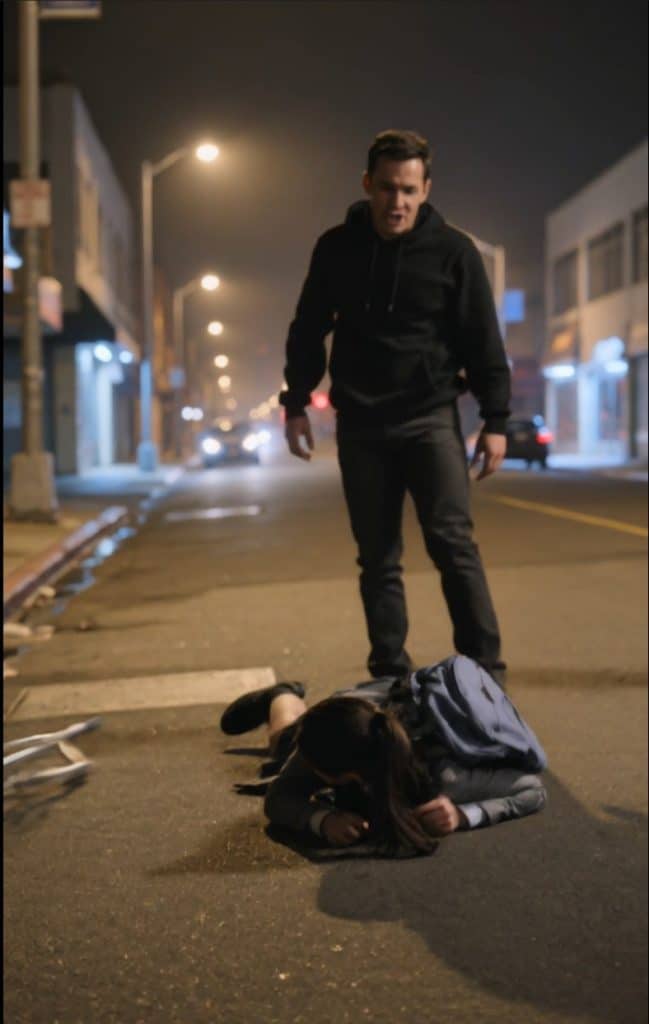
Act I
The crutch made a hollow sound against the wet sidewalk.
Seventeen-year-old Sophie Bennett moved as quickly as her injured leg allowed, her backpack pressed against one shoulder. The tutoring center had closed twenty minutes earlier, and every storefront along Mercer Avenue was already dark.
Three young men blocked the path ahead.
Sophie stopped beneath a yellow streetlight.
Dylan Price stood in the middle, dressed in a black hoodie. At twenty-one, he was older than the students who attended the tutoring center, but he had spent weeks waiting outside after evening classes.
The first time he asked Sophie out, she said no politely.
The second time, she said no firmly.
After the fifth message, she blocked his number.
Now he smiled as though her answer had never mattered.
“You’ve been avoiding me.”
Sophie turned toward the road.
One of Dylan’s friends stepped behind her.
“I need to go home.”
Dylan moved closer.
“You could have made this easy.”
Sophie tightened her grip on the crutch.
Her injured leg had not fully healed from a traffic incident two weeks earlier. A dark sedan had clipped her near the same block and driven away before anyone recorded the plate.
She had begun taking different routes home.
Dylan somehow knew every one of them.
“Move,” she said.
He attacked without warning.
The impact knocked Sophie onto the wet pavement. Her crutch and backpack skidded in opposite directions, and a light scrape appeared along her cheek.
She tried to crawl toward the backpack.
The two accomplices caught her arms and held them briefly against the ground.
Dylan stood over her.
“Trash. You shouldn’t have rejected me.”
Sophie twisted against their grip.
A closed pharmacy stood across the road. No cars passed. The tutoring center’s lights had gone dark behind her.
Dylan struck her twice more while she curled protectively.
Then he leaned over her, blocking the streetlight.
“Tonight, there’s no way out.”
A shape moved inside the alley.
A middle-aged man burst from the darkness and knocked Dylan away from Sophie with one forceful strike. Dylan landed on the pavement while his two friends released her and staggered backward.
The stranger stepped beneath the streetlight.
He was broad-shouldered, perhaps forty-eight, wearing a dark shirt with the sleeves buttoned at his wrists. His expression held none of the panic around him.
He looked first at Sophie.
Then at the two accomplices.
“Let her go.”
They were already backing away.
The man rolled up his sleeves and walked toward Dylan, but he did not attack again.
Instead, he removed a phone from his pocket and placed it on the hood of a parked car.
Its screen showed that the entire encounter had been recorded.
Dylan scrambled backward.
“Who are you?”
The stranger looked down at him.
“My name won’t help you.”
Dylan believed an unknown passerby had interrupted his revenge.
He did not know the man had been waiting in that alley specifically for him.
Act II
The stranger’s name was Marcus Shaw.
For twenty-three years, he had worked as a city detective. He investigated burglaries, assaults, missing teenagers, and crimes committed by people who believed frightened victims made unreliable witnesses.
Marcus retired after his daughter, Leah, became one of those victims.
Two years earlier, Leah had attended the same tutoring center as Sophie.
Dylan Price began waiting for her after class.
At first, he sent compliments.
Then came demands.
When Leah rejected him, he followed her to the bus stop and photographed her apartment building. He created new accounts whenever she blocked him.
Leah reported the behavior.
The tutoring center called it a personal disagreement.
A police officer told her Dylan had not made a “specific enough threat.”
Dylan’s father was Councilman Grant Price, a wealthy property developer with connections throughout the district. He donated to youth programs, funded police-community events, and paid for the tutoring center’s new computer lab.
No one said his name influenced the response.
No one needed to.
Leah eventually transferred schools and moved to live with an aunt in another state. She was safe, but she stopped attending classes in person and avoided walking alone.
Marcus blamed himself for months.
He knew how systems failed frightened families.
He never expected the system to fail his own daughter so efficiently.
After retiring, he began collecting complaints connected to Dylan.
He found seven.
A college student said Dylan waited outside her workplace after she refused him.
A restaurant employee reported that his friends surrounded her car.
A sixteen-year-old student received photographs taken through her classroom window.
None of the incidents resulted in serious action.
Each complaint looked small when viewed alone.
Together, they formed a pattern.
Marcus created a private file and contacted the families. Most were afraid to speak publicly.
Then Sophie’s mother called him.
She had obtained his number from Leah’s aunt.
Sophie had not initially described Dylan’s behavior as stalking. She said he was annoying. She said she could handle it.
Then the messages began referring to places she had never told him about.
Her tutoring schedule.
Her doctor’s appointment.
The alternate route she used after the traffic incident.
Marcus asked Sophie’s mother one question.
“Who has access to her schedule?”
The answer led back to Northbridge Academic Center.
Students used an app to check lessons, transportation notes, emergency contacts, and attendance. Parents could indicate whether a teenager walked home, waited for pickup, or used public transit.
The system was supposed to protect students.
Someone had been opening Sophie’s records late at night.
Marcus traced the access to an administrative account belonging to Assistant Director Colin Reeves.
Colin was Grant Price’s nephew.
When Marcus confronted the tutoring center privately, its director promised to investigate.
The next morning, Sophie’s account history disappeared.
So Marcus began watching the building himself.
He noticed Dylan’s friends parked nearby on several evenings.
He saw Colin leave through the rear entrance and speak with them.
And on the night of the attack, Marcus followed after hearing one of them say:
“She’ll be alone after nine.”
He entered the alley before Sophie reached the block.
He planned to photograph the group and call police the moment they approached her.
Then Dylan knocked away her crutch.
Marcus stopped being an observer.
But Dylan’s obsession was only one use for the stolen student data.
Colin had been selling private schedules to people far more dangerous than a rejected young man.
Act III
Police arrived within minutes.
Marcus kept his hands visible and immediately identified himself. He explained the single action he used to stop the attack and gave officers the recording from his phone.
Sophie remained beside the parked car while a paramedic examined her cheek and injured leg.
Her backpack was recovered from the gutter.
Inside, nothing appeared missing.
Then Sophie opened the front pocket.
“My laptop.”
The pocket was empty.
One accomplice, nineteen-year-old Aaron Mills, had picked it up during the attack.
Officers found the laptop beneath a dumpster near the alley exit. Aaron claimed he moved it so it would not be damaged.
The security video from a closed grocery store showed him trying to open it.
Sophie looked at Marcus.
“They wanted the laptop?”
Dylan shouted from beside the patrol car.
“This was about her embarrassing me.”
Marcus studied him.
Dylan was arrogant, but he was also frightened in a way that had nothing to do with being arrested.
“What is on the computer?” Marcus asked.
Sophie thought for a moment.
“Schoolwork. Tutoring files. The emails I saved.”
“What emails?”
She had received anonymous messages after reporting that someone accessed her account.
Most contained insults.
One included a spreadsheet attachment by mistake.
Sophie opened it only once before the sender deleted the message remotely. She had saved a copy because the file listed student names.
The spreadsheet contained routes, pickup times, parent phone numbers, and notes about whether families paid in cash.
Beside some names were coded labels.
ALONE.
LATE SHIFT PARENT.
NO CAR.
EASY PRESSURE.
Sophie did not understand what the labels meant.
Marcus did.
The data was being used to identify vulnerable families.
Investigators searched the accomplices’ phones.
Messages revealed that Colin sold student information to multiple groups. Some used it for theft, knowing when homes were empty.
Others targeted parents with fake emergencies, claiming a child had been injured and demanding immediate payment.
Several families had lost thousands of dollars.
Grant Price’s property company used the data differently.
It identified low-income tenants with teenagers attending Northbridge. Those families received aggressive lease-renewal demands timed around exams, medical appointments, or periods when parents worked overnight.
The company knew exactly when they were least able to fight back.
Dylan had access because his father’s business secretly funded the data system.
He used the information to track girls who rejected him.
Colin knew.
He continued providing the schedules.
Sophie’s saved spreadsheet threatened all of them.
The traffic incident two weeks earlier was no accident either.
Camera footage from a nearby gas station showed Aaron driving the dark sedan. Dylan sat in the passenger seat.
They had intended to frighten Sophie.
The car struck her more seriously than they expected.
Afterward, Dylan sent Colin a message.
She still has the file.
Colin replied:
Get the laptop before Marcus Shaw finds her.
Sophie looked toward Marcus.
“How did he know about you?”
Marcus opened a message on his own phone.
It had arrived that afternoon from an unknown number.
Stop digging into Northbridge, or Leah’s new address becomes public.
Only three people knew where Leah lived.
One was Marcus.
One was Leah’s aunt.
The third was the police officer who handled her original complaint.
And that officer now worked as security director for Grant Price.
Act IV
His name was Raymond Holt.
Raymond had taken Leah’s statement two years earlier. He assured Marcus the department would monitor Dylan and warned the family not to escalate the situation publicly.
Then he closed the complaint.
Months later, Raymond retired from the police force and accepted a highly paid position with Price Development.
He brought access, relationships, and knowledge of how investigations could be weakened without visibly stopping them.
When victims reported Dylan, Raymond contacted officers he knew.
He described the complaints as family disputes, misunderstandings, or attempts to damage the councilman.
When Northbridge parents questioned account access, he told the tutoring center to erase the logs under the excuse of protecting student privacy.
He also taught Colin which records investigators would request first.
The attack on Sophie was supposed to solve several problems.
Dylan would frighten her into silence.
Aaron would take the laptop.
Colin would delete the remaining cloud records.
Raymond would describe the incident as a confrontation involving jealous teenagers.
Marcus’s recording destroyed that plan.
Sophie’s age, injury, crutch, and clear attempts to escape left little room for another story.
Yet Grant Price tried to create one.
He arrived at the police station before midnight with two attorneys.
He claimed Marcus had targeted his son because of Leah’s old accusation. He described Dylan as the victim of a former detective’s personal revenge.
Marcus did not argue.
He placed his phone on the interview-room table.
The recording began with Dylan blocking Sophie’s path.
It captured every word.
Grant watched his son knock an injured girl to the pavement.
His expression barely changed.
Then the video reached the moment Dylan said, “Tonight, there’s no way out.”
Grant closed the phone.
“This should not be released.”
Sophie’s mother stood across the room.
“Why?”
“It would destroy several young lives.”
“My daughter is one of them.”
Grant looked toward the attorneys.
He was still thinking in terms of reputation.
Sophie was thinking about the other names in the spreadsheet.
“How many students were followed?” she asked.
No one answered.
Investigators executed warrants at Northbridge Academic Center and Price Development.
They found years of unauthorized account access, copied emergency contacts, and payments from shell companies to Colin and Raymond.
The tutoring center’s director admitted she had received earlier warnings.
She kept them quiet because Grant funded scholarships and building repairs.
“I thought we could fix it internally,” she said.
Sophie looked at her.
“You deleted the proof.”
The director began crying.
Sophie did not comfort her.
Adults had repeatedly asked frightened students to understand difficult compromises made for institutional survival.
No one asked why children had to pay for those compromises.
Raymond was arrested after attempting to destroy a backup drive. Colin agreed to cooperate and identified other people who purchased student information.
Dylan and his accomplices faced consequences for the ambush, the earlier vehicle incident, stalking, and attempts to take Sophie’s laptop.
Grant denied personal knowledge of the data sales.
Financial records told a more complicated story.
He approved payments to Raymond’s security office after every complaint involving Dylan.
He may not have ordered the attacks.
He funded the machinery that made them easier to hide.
The city council opened an ethics investigation. Northbridge lost access to its student database, and families were notified that their personal information had been compromised.
Marcus called Leah.
He told her everything.
There was a long silence on the line.
“Did you stop him?” she asked.
“Yes.”
“No, Dad. Did the system stop him?”
Marcus looked through the station window at Sophie sitting beside her mother.
“Not soon enough.”
That answer became the center of everything that followed.
Act V
Northbridge Academic Center closed for the remainder of the semester.
Students were transferred to other programs at no cost, and an independent organization contacted every affected family.
The stolen data had spread farther than investigators first believed.
Some parents changed phone numbers.
Others moved.
Several learned that robberies and financial scams they once considered random had been planned using their children’s schedules.
The tutoring center established a restitution fund using seized assets and insurance payments.
Its director resigned.
Her public statement emphasized that she never intended for students to be harmed.
Sophie read it once.
Intent mattered.
So did every warning she chose to erase.
Grant Price lost his council position and stepped away from his company while investigators reviewed his financial role. Raymond and Colin faced charges connected to the data scheme and obstruction.
Dylan’s attorneys argued that rejection had caused an emotional crisis.
The court rejected the idea that another person’s refusal could be treated as provocation.
Sophie had said no.
Nothing after that required further interpretation.
Aaron and the second accomplice eventually admitted they knew Sophie was injured before the attack. Dylan promised them money and protection through his father’s connections.
They believed the family name would keep the incident small.
Marcus’s video made that impossible.
But Sophie refused to let the recording become entertainment.
News outlets requested interviews and asked to broadcast the moment she fell.
She declined.
“The evidence can be public without my worst moment becoming a show.”
Her mother supported the decision.
So did Marcus.
He understood that visibility could protect victims, but it could also trap them forever inside the moment someone hurt them.
Sophie’s physical recovery took several months.
The earlier injury had been healing well before the ambush. The attack delayed her progress, but doctors expected her to walk normally again.
Fear healed less predictably.
Streetlights made her uneasy.
Footsteps behind her caused her breathing to change.
She stopped attending evening tutoring even after Northbridge closed.
Marcus never told her to overcome it.
He helped her family install better lights near their apartment and connected them with a counselor who worked with stalking victims.
Leah called too.
At first, their conversations were brief.
Then they began speaking every week.
Leah told Sophie what she wished someone had told her earlier.
“You do not have to become fearless to prove they lost.”
Sophie wrote the sentence inside the cover of a new notebook.
Months later, she returned to school using a cane instead of a crutch.
Students stared.
Some knew the story.
Sophie kept walking.
She completed her final exams and earned admission to a university several hours away. She chose to study information security.
Her mother asked whether the data breach influenced the decision.
“Someone built a system that knew everything about us,” Sophie said. “No one built it to notice who was abusing it.”
Marcus returned to part-time investigative work.
He helped create a nonprofit that reviewed stalking complaints involving schools, tutoring centers, and youth programs.
The organization required institutions to preserve access logs automatically. No administrator could erase them without creating an external record.
Student schedules were divided from financial and emergency information.
Employees saw only what their jobs required.
A donor could fund a computer lab.
That donor could not buy access to the lives stored inside it.
Leah eventually moved home.
She did not return because Dylan had been arrested.
She returned because she no longer wanted his choices determining where she lived.
She and Marcus met Sophie in a small café during daylight.
For the first time, the three people connected by the same pattern sat together without police reports, recordings, or attorneys.
Sophie looked at Marcus.
“You never answered him.”
“Who?”
“Dylan. When he asked who you were.”
Marcus smiled faintly.
“I was angry. Any answer would have sounded dramatic.”
“What would you say now?”
He thought about it.
“Someone who should have listened sooner.”
Sophie shook her head.
“You listened before anyone else did.”
“Because I learned too late with Leah.”
Leah reached across the table and touched his hand.
“Then learn something else too.”
“What?”
“You did not fail because another person chose to hurt me.”
Marcus had spent two years believing responsibility could be transferred backward—from the offender to the officer who missed a sign, from the officer to the father who trusted him.
Accountability required looking in the correct direction.
That did not erase institutional failure.
It prevented guilt from hiding the person who made the choice.
A year after the ambush, Sophie walked down Mercer Avenue again.
The tutoring center had reopened under new ownership. Its windows remained bright until every evening student had confirmed transportation home.
Security cameras covered the alley entrances, but the larger change was inside.
Students could report harassment directly to an outside safeguarding team.
Repeated unwanted contact triggered action before a specific threat was required.
No donor or parent could close the complaint.
Sophie stopped beneath the yellow streetlight where her crutch had landed.
The pavement looked ordinary.
That surprised her.
Places did not carry memories visibly.
People did.
She stood there for several seconds, then continued toward the bus stop.
Marcus watched from across the road, not hidden in the alley this time.
Sophie noticed him and raised one hand.
He returned the gesture, then walked away.
She did not need a shadow following her forever.
Protection had done its job only when it helped return her freedom.
Dylan remembered the night differently.
He remembered lying on the wet pavement while the man from the alley stood beneath the streetlight.
“Let her go.”
The confidence drained from Dylan’s face.
“Who are you?” he whispered.
He thought Marcus’s identity was the secret that destroyed him.
It was not.
Sophie’s refusal had been enough.
Her injury had been visible.
Her fear had been visible.
Her right to walk home safely should never have depended on a powerful man emerging from the dark.
Marcus stopped the attack.
The evidence exposed the network.
But Sophie did the hardest part herself.
She survived a night designed to convince her there was no way out.
Then she built a future beyond it.