Act I
The tomato burst beneath the white heel with a soft, wet crack.
Red juice splashed across polished leather. A few seeds clung to the edge of the shoe as shoppers moved through the narrow aisle between vegetable stalls.
The woman wearing it stopped.
Her name was Vanessa Whitmore, and everything about her seemed designed to announce that she did not belong among wooden crates, handwritten price signs, and farmers with dirt beneath their fingernails.
Her coat was bright white.
Her handbag carried the name of a European designer in small gold letters.
Her shoes cost more than some vendors made during an entire weekend.
Behind the nearest tomato stall stood fifty-five-year-old Rosa Delgado.
She wore an old green apron over a faded sweater. Her gray-streaked hair was tied back loosely, and her hands were marked by years of lifting crates, working soil, and counting change in cold morning air.
One tomato had rolled from the edge of her display.
It crossed the aisle at exactly the wrong moment.
Rosa stepped from behind the stall.
“I’m sorry,” she began.
Vanessa looked down at her shoe.
Then she lifted her eyes.
Weekend shoppers slowed around them. A child holding an apple stopped chewing. Two neighboring vendors glanced over their displays.
Vanessa noticed every face.
Embarrassment changed her faster than anger ever could.
“You did this.”
“It rolled from the crate,” Rosa said. “Let me clean it.”
She reached for a cloth beneath the counter.
Vanessa stepped away from her hand.
“Don’t touch me.”
Rosa stopped immediately.
“I wasn’t trying to.”
The explanation should have ended the moment.
Instead, Vanessa looked at Rosa’s apron, the low wooden stall, and the cardboard sign advertising three pounds of tomatoes for five dollars.
She decided the woman in front of her was beneath consequence.
Vanessa moved forward.
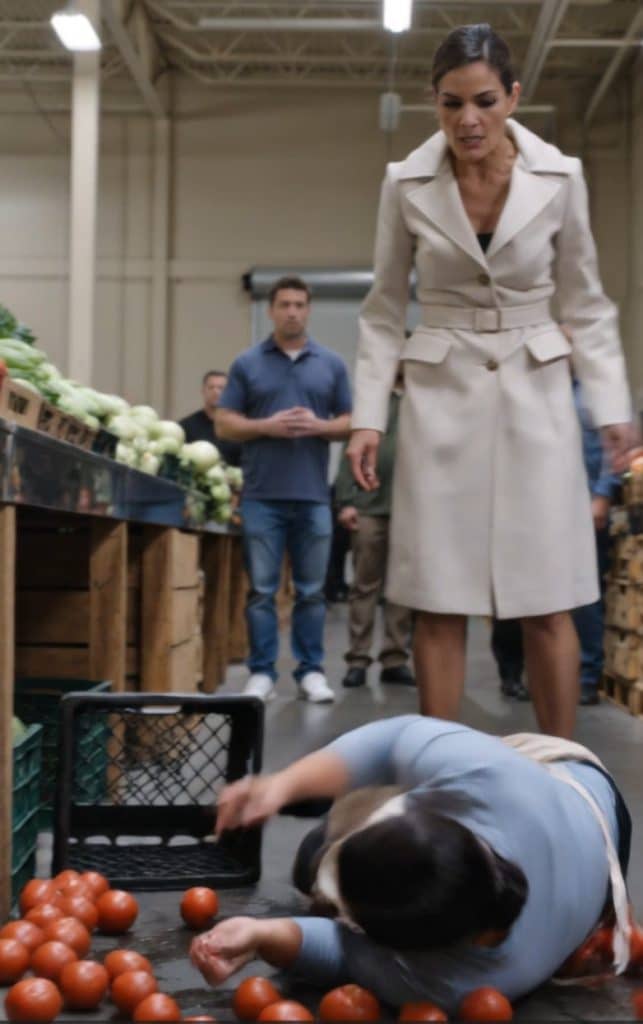
The impact sent Rosa backward into the stall. A crate tipped from its platform, and tomatoes poured across the aisle in every direction.
Rosa struck the floor beside them.
Her elbow scraped against the concrete. The breath left her body as crushed tomatoes stained the front of her apron.
The hall went silent.
Vanessa stood above her.
“Trash,” she said. “Look what you did to my shoes.”
A young vendor from the next stall rushed forward, but the older man beside him caught his arm.
Vanessa was not an anonymous shopper.
Her family owned Whitmore Retail Group, the development company negotiating to purchase the indoor market hall.
Every vendor knew the name.
Every vendor knew what could happen if the sale went through.
Rents would rise.
Stalls would disappear.
The farmers market would become an upscale food court filled with luxury brands and decorative produce no ordinary family could afford.
Rosa pushed one hand against the floor, trying to sit upright.
Vanessa stepped through the scattered tomatoes and struck her again.
Shoppers gasped.
Rosa curled protectively around her side, breathing quickly but refusing to beg.
Vanessa pointed at the produce surrounding her.
“Pick them up with your face.”
Then an engine roared from the loading lane.
A black pickup entered the hall too quickly, knocking aside two empty crates and a lightweight price board before stopping near the vegetable aisle.
Security staff jumped from the back.
A tall man in a dark jacket stepped from the passenger side.
His name was Gabriel Delgado.
He owned the market hall.
Vanessa had spent six months trying to convince him to sell it.
Gabriel saw Rosa on the floor.
He ran toward her.
And when he called the vegetable seller “Mom,” the entire market understood that Vanessa had just attacked the one person whose signature could destroy her family’s deal.
Act II
Gabriel reached Rosa first.
He knelt beside her, placed one arm carefully behind her shoulders, and helped her sit upright against the base of the stall.
“Where does it hurt?”
“My side.”
“Can you breathe?”
She nodded, though the effort showed in her face.
A security officer called emergency services while another kept Vanessa several steps away.
Gabriel lifted a clean towel from the stall and wiped crushed tomato from his mother’s apron. His hands were steady, but his expression was not.
Only after Rosa was supported did he turn.
“Who kicked my mother?”
No one answered.
The answer stood in a white coat surrounded by red tomatoes.
Vanessa’s face lost its color.
“How…?”
She knew Gabriel Delgado as a quiet businessman who owned the property beneath the indoor market.
She knew he had rejected three purchase offers from Whitmore Retail Group.
She knew he controlled a building her family desperately wanted.
She did not know his mother sold vegetables in stall fourteen.
Very few people did.
Gabriel had asked Rosa to retire years earlier.
She refused every time.
The stall had existed before the market had a permanent roof.
Before the polished floors.
Before the overhead lighting and weekend crowds.
Rosa and her husband, Mateo, once sold produce from the back of an old truck in a vacant lot. They grew tomatoes, peppers, and squash on rented land outside the city and woke before sunrise to reach customers before the heat spoiled anything.
When Mateo died suddenly, Rosa was left with a failing farm, a twelve-year-old son, and debts she could barely understand.
She sold vegetables six days a week.
At night, she cleaned restaurant kitchens.
Gabriel completed homework beneath the stall while his mother negotiated with suppliers and stretched every dollar.
The market vendors became their extended family.
A baker brought them unsold bread.
A butcher repaired their truck.
An elderly flower seller watched Gabriel whenever Rosa had to make a delivery.
Years later, Gabriel built a logistics company that helped small farms deliver directly to city markets. The company grew beyond anything either of them imagined.
When the indoor hall faced demolition, he purchased the property.
He did not rename it.
He did not replace the vendors.
He preserved the low rents and transferred ownership into a trust designed to keep the building a public market.
Rosa held the deciding vote in that trust.
The arrangement was private.
She wanted customers to judge her tomatoes, not her son’s bank account.
Vanessa’s family had discovered that the neighborhood surrounding the market was becoming valuable. New apartment towers were rising nearby. Property prices had doubled.
Whitmore Retail Group developed a plan to transform the market into a luxury shopping destination.
The public proposal promised modernization.
The private financial model told a different story.
More than two-thirds of the current vendors would be removed.
Family stalls would be replaced by national chains.
The remaining sellers would face rents four times higher than what they currently paid.
Gabriel rejected the first offer.
Then the second.
After the third, city inspectors began visiting the market more frequently.
Anonymous complaints appeared.
Fire exits were allegedly blocked.
Produce storage areas were suddenly described as health risks.
News articles questioned whether the hall was outdated.
Gabriel suspected pressure.
Rosa suspected sabotage.
She began arriving earlier than usual, watching the loading lane and checking areas vendors normally ignored.
Three days before the attack, she found a folder hidden behind empty crates near the maintenance office.
It contained inspection schedules, contractor payments, and a list of vendors marked “remove first.”
Rosa recognized Vanessa’s company logo on every page.
She told Gabriel to meet her at the market that morning.
He was on his way when security cameras showed the assault.
But the documents Rosa discovered revealed something much worse than an aggressive redevelopment strategy.
Whitmore Retail Group had been manufacturing violations.
And someone inside Gabriel’s company was helping them.
Act III
Emergency responders arrived and examined Rosa while police began speaking to witnesses.
Vanessa regained enough composure to reach for her phone.
“This is a misunderstanding,” she said.
A produce vendor stared at her.
“You knocked her down.”
“She attacked me first.”
The hall reacted with disbelief.
Vanessa pointed toward her stained shoe.
“She threw that tomato into the aisle.”
Rosa looked at her from beside the stall.
“It rolled.”
“You expect everyone to believe that?”
A teenage shopper lifted his phone.
“They don’t have to believe her. I recorded it.”
Vanessa’s eyes snapped toward him.
“Delete that.”
“No.”
The answer came softly, but it changed the air around them.
Other shoppers raised their phones.
One had recorded the initial confrontation.
Another captured the moment Vanessa stood over Rosa.
A third showed the attack from the opposite aisle.
For years, Vanessa had relied on uncertainty. Employees softened their stories. Contractors changed statements. Witnesses doubted whether challenging a wealthy family was worth the trouble.
There was no uncertainty now.
Gabriel asked one of his guards to retrieve Rosa’s bag from beneath the stall.
Inside was the folder.
Vanessa recognized it immediately.
“That was stolen.”
Gabriel opened it.
“How do you know what it is?”
She said nothing.
The first pages contained private inspection schedules. Whitmore contractors had received them days before market management.
Other documents listed deliberate actions.
Move waste bins near western exit before inspection.
Disconnect refrigeration monitor in stall twenty-two.
Photograph loading congestion at 9:15 a.m.
The instructions were designed to create evidence that the market was unsafe.
The final page contained payments made to a company called Northline Consulting.
Gabriel knew the name.
Northline had advised his board on property maintenance and regulatory compliance.
Its owner was David Mercer, Gabriel’s chief operating officer.
The man responsible for protecting the market had been selling access to Vanessa’s family.
Gabriel looked toward the loading lane.
David was already there.
He had arrived with the pickup and remained several yards away, staring at the folder in Gabriel’s hands.
Rosa saw him.
“You knew.”
David lowered his eyes.
He had worked beside Gabriel for fourteen years.
He helped expand the delivery company and negotiated the purchase of the market hall. Vendors trusted him. Staff called him before they called Gabriel.
David had also accumulated debts after a series of failed investments.
Whitmore Retail Group discovered his vulnerability.
They offered to erase what he owed.
In return, he provided inspection schedules, delayed repairs, and encouraged Gabriel to reconsider the sale.
David told himself no one would be hurt.
The vendors would receive relocation payments.
The building would become more profitable.
The neighborhood was changing anyway.
Then Rosa found the folder.
David had warned Vanessa that the evidence was inside stall fourteen.
He expected her to retrieve it quietly.
He never imagined she would lose control in front of a crowded market.
Gabriel faced him.
“How long?”
David struggled to answer.
“How long have you been working for them?”
“Eight months.”
Several vendors began shouting.
Gabriel raised one hand.
The hall quieted.
He looked at the man he once considered a brother.
“Did you create the fire violations?”
“I delayed repairs.”
“Did you alter the vendor reports?”
“Yes.”
“Did you mark stalls for removal?”
David’s silence became an answer.
Rosa watched him.
“My name was on the list.”
David looked toward her.
“I didn’t make the list.”
“You helped them use it.”
Vanessa stepped forward.
“This has nothing to do with what happened here.”
Gabriel turned toward her.
“It has everything to do with it.”
She attacked Rosa because she believed the seller had no status.
She had also tried to destroy the market because she believed the people inside it had no power.
The stain on her shoe and the redevelopment plot came from the same belief.
Everything in her path was disposable.
But the folder held one final document.
It showed that Whitmore Retail Group had already sold investment shares in a market redevelopment project it did not own.
If Gabriel refused to sell, Vanessa’s family would owe millions they did not have.
Act IV
Whitmore Retail Group had presented the redevelopment as a completed acquisition.
Investors were told the market trust had agreed in principle to sell.
Architectural plans had been approved.
Luxury tenants had paid reservation fees.
Construction loans had been issued using the future property as collateral.
But Gabriel had never signed anything.
Neither had Rosa.
Vanessa’s father, Charles Whitmore, believed enough pressure would eventually force them to agree.
The manufactured violations were part of that pressure.
If the city closed sections of the market, vendors would lose income. Some would leave. Public confidence would fall.
Gabriel would face growing costs and eventually accept a reduced offer.
Vanessa had arrived that morning expecting David to deliver news that Rosa’s evidence had been removed.
Instead, she found the woman standing behind the tomato stall.
One accident exposed everything.
Gabriel handed the documents to police.
“Preserve these.”
Vanessa’s voice sharpened.
“You cannot distribute private company records.”
“They document fraud involving my property.”
“They are incomplete.”
“Then your company can provide complete copies.”
She looked toward David.
He had already unlocked his phone.
“I have the messages,” he said.
Vanessa stared at him.
“You signed a confidentiality agreement.”
“You told me Rosa had no authority.”
“She sells vegetables.”
Rosa rose carefully with help from the paramedics.
Pain crossed her face, but she remained upright.
“Yes,” she said. “I do.”
Vanessa looked at her with open contempt.
“What does that prove?”
Rosa glanced around the hall.
At the vendors who arrived before sunrise.
At the families carrying cloth bags from stall to stall.
At the handwritten signs and uneven crates.
“It proves I know the value of something before rich people decide it is valuable.”
The vendors applauded.
Vanessa stepped backward.
She looked toward Gabriel.
“You cannot allow emotion to destroy a major investment.”
“My mother was attacked.”
“I’m talking about the property.”
“So am I.”
He revealed the trust structure.
Rosa’s vote was required for any sale.
She had the authority to block the transaction permanently.
Vanessa’s mouth opened.
She looked at the old apron, the scraped elbow, and the tomatoes crushed around Rosa’s shoes.
“You own the market?”
Rosa shook her head.
“No one person owns what this place means.”
Then she looked at Gabriel.
“But I vote no.”
The words landed harder than any shouted threat.
Whitmore Retail Group’s proposed acquisition was finished.
The pre-sold development would collapse.
Investors would demand answers.
Lenders would inspect every document.
Vanessa’s father would no longer be able to hide the fact that he had borrowed money against a property he did not control.
Police instructed Vanessa to remain where she was.
Her confidence disappeared.
She looked toward the shoppers who had once stepped aside for her white coat.
No one moved now.
“Please,” she whispered.
Rosa’s expression did not change.
Vanessa had shown no mercy when she believed Rosa was merely a vendor.
Now she asked for it because she had learned otherwise.
But Rosa did not want personal revenge.
She wanted the market protected from the next wealthy person who believed it could be stolen with paperwork.
Act V
Rosa spent two nights in the hospital.
Her injuries healed, but Gabriel remained angry long after she returned home.
He blamed security.
He blamed David.
Mostly, he blamed himself.
“I should have made your ownership public,” he told her.
Rosa sat at her kitchen table sorting tomato seeds into small paper envelopes.
“Why?”
“People would have treated you differently.”
“That is the problem.”
He looked away.
Rosa reached across the table.
“She should not have needed to know my name.”
Gabriel understood, though accepting it was harder.
He had built wealth partly to protect his mother from the hardship that shaped her life.
Yet money could only protect people once others knew it existed.
Rosa wanted something stronger.
Rules.
Evidence.
Solidarity.
A community willing to speak before a powerful man arrived in a black pickup.
The investigation into Whitmore Retail Group widened.
David cooperated with authorities and surrendered years of communications. His testimony confirmed that company officials had paid for falsified reports and manipulated inspections.
Charles Whitmore resigned.
Several planned developments were audited.
Investors sued after discovering that market ownership had been misrepresented.
Vanessa faced charges connected to the assault and the wider fraud investigation.
Her white coat appeared in countless photographs.
The tomato stain became a symbol she hated.
Rosa disliked it too.
“The story is not about her shoes,” she told a reporter. “It is about what she thought those shoes allowed her to do.”
The market hall survived.
But Rosa refused to let survival become an excuse to avoid change.
Some electrical systems were old.
Several aisles were too narrow.
Small farmers needed better cold storage, and vendors feared that even honest repairs would eventually raise rents.
So the trust adopted a new charter.
No sale could occur without approval from the vendor council.
Long-term sellers received voting seats.
Rent increases were tied to actual operating costs, not nearby luxury developments.
Inspection reports were published publicly.
No executive could review or erase a vendor complaint alone.
Gabriel also purchased an adjacent warehouse and converted it into shared storage for small farms.
The expansion created enough revenue to fund repairs without removing family stalls.
Rosa insisted that stall fourteen remain unchanged.
The wooden shelves were uneven.
The paint was worn.
The handwritten tomato sign leaned slightly to one side.
“It works,” she said whenever Gabriel offered to renovate it.
Three months after the attack, Rosa returned to the market.
Vendors lined the aisle to welcome her.
She frowned immediately.
“Don’t you people have work?”
They laughed and returned to their stalls.
A new crate of tomatoes waited behind her counter.
The young vendor who had tried to help carried it for her.
“You should sit down,” he said.
“You sound like my son.”
“That’s because he threatened all of us.”
Across the hall, Gabriel pretended not to hear.
Rosa tied on her old apron.
A faint red stain remained near the bottom. She could have replaced it, but chose not to.
Customers arrived.
She weighed vegetables, counted change, and told a child that the smallest tomatoes were often the sweetest.
By noon, the hall sounded normal again.
That mattered more than applause.
Weeks later, an elderly farmer named Samuel approached Rosa with a folder.
He had rented a stall for twenty-six years but never attended business meetings because he believed ownership decisions belonged to lawyers.
Now he wanted to join the vendor council.
“I don’t understand contracts,” he said.
Rosa pulled out a chair.
“Then we’ll learn.”
Others joined them.
A baker.
A flower seller.
Two sisters who sold honey.
Together, they reviewed the new charter line by line.
The market became harder to control because the people inside it finally understood how control worked.
A year later, Gabriel received another purchase offer.
It was larger than the Whitmore proposal.
The company promised to preserve the vendors.
Rosa read the contract and found a clause allowing rent increases after three years.
She crossed it out.
The buyer refused to change it.
The trust rejected the offer.
Gabriel smiled when he heard.
“You didn’t even consider it?”
“I considered it long enough to find the trap.”
One Saturday morning, a woman wearing expensive heels entered the vegetable aisle.
Rosa noticed her immediately.
The woman stopped at stall fourteen and selected a basket of tomatoes.
As she turned, one tomato slipped free and rolled toward her shoe.
She stepped around it.
Then she bent down, picked it up, and placed it back in the crate.
“You dropped one,” she said.
Rosa studied her.
“Thank you.”
The woman paid and continued through the market.
No crowd gathered.
No security arrived.
It was an ordinary moment of patience between two strangers.
Rosa preferred it to every dramatic headline written about her.
Later that afternoon, Gabriel helped close the stall.
He picked up an empty crate while Rosa counted the remaining tomatoes.
“You ready?”
“In a minute.”
He waited.
She looked down the aisle.
The lights reflected from the polished floor. Vendors called out final discounts. Families moved between stalls carrying bread, flowers, fruit, and vegetables.
Vanessa had looked at the market and seen land.
Rosa saw years.
First jobs.
Family recipes.
Farmers surviving bad seasons.
Immigrants learning English one customer at a time.
Children growing up beneath counters and returning as adults with children of their own.
None of it appeared in Whitmore Retail Group’s financial projections.
That did not make it worthless.
It made the projections incomplete.
Rosa removed her apron and folded it across the counter.
Gabriel lifted the last crate.
As they walked toward the loading lane, a tomato rolled from the top and stopped in the aisle.
A shopper noticed.
He picked it up and carried it back to Rosa.
“This yours?”
She smiled.
“Yes.”
He placed it carefully in her hand.
The tomato was bruised but unbroken.
Rosa turned it once beneath the overhead light.
Then she carried it home.
Not because it was valuable.
Because something did not have to be expensive to deserve care.