Act I
The dress rack shook before anyone understood why the young woman was on the floor.
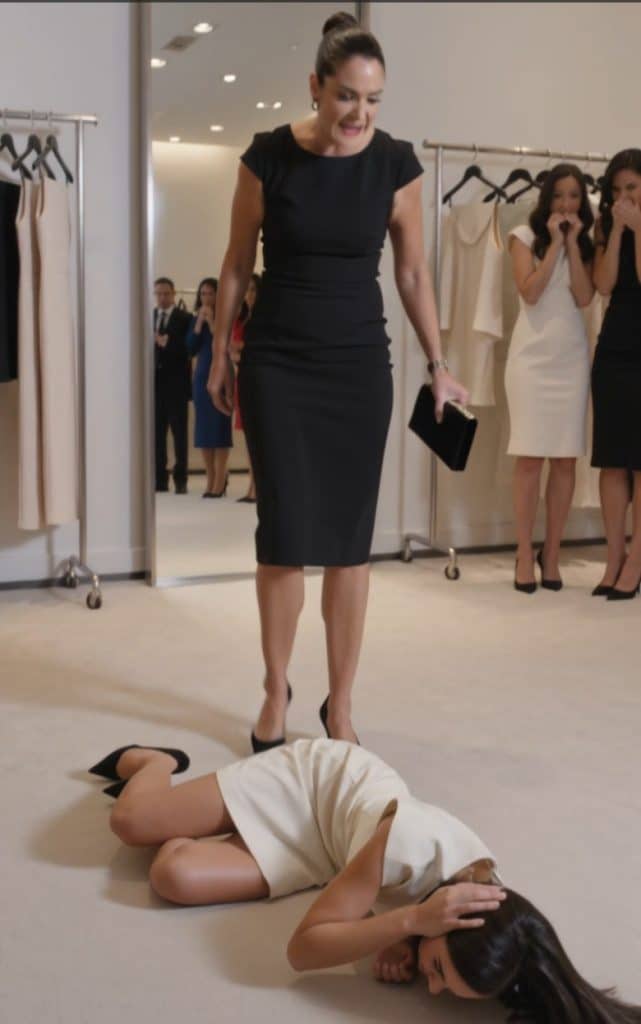
A row of silk gowns slid from their hangers. A silver clutch struck the white carpet, and twenty-six-year-old Claire Donovan landed beside it with one hand pressed to her head.
Her cheek burned.
Her lips trembled.
But she did not beg.
Standing over her was Vanessa Cross, one of the boutique’s most valuable VIP clients.
Vanessa wore a fitted black dress, sharp heels, and the expression of a woman who had never been told to wait twice. Her designer bag rested on a velvet chair while two sales associates stood several feet away, frozen.
Only moments earlier, Claire had stepped from a fitting room wearing a simple cream dress.
She had barely reached the mirror when Vanessa demanded the room.
Claire apologized and said she needed one more minute.
Vanessa looked her up and down.
The dress was from the boutique’s least expensive collection. Claire wore no visible jewelry, and her jacket had been folded over an ordinary canvas bag.
To Vanessa, the conclusion was obvious.
Claire did not belong there.
When Claire failed to move quickly enough, Vanessa attacked her, dragged her away from the mirror, and threw her onto the carpet.
Now the boutique had gone silent.
A woman near the jewelry display lifted her phone.
One sales associate took a step forward.
The floor manager stopped her with a glance.
Everyone knew Vanessa.
She spent hundreds of thousands of dollars across the chain. She hosted private shopping events, appeared in campaign photographs, and regularly threatened to have employees dismissed if they displeased her.
The floor manager had learned to survive by agreeing.
Vanessa pointed toward Claire.
“Trash. People like you don’t belong in mirrors this expensive.”
Claire pushed herself onto one elbow.
The cream dress had wrinkled beneath her. A small red mark had formed on her cheek, but her gaze remained steady.
“I was trying it on.”
“You were touching inventory meant for real clients.”
“It was on the public rack.”
Vanessa’s mouth tightened.
She stepped closer and attacked again while Claire remained down.
Several shoppers gasped.
This time, the sales associate ignored the manager and moved forward.
Vanessa turned sharply.
“Touch me, and I’ll close this store.”
The associate stopped.
Vanessa looked down at Claire.
“Crawl out before you touch another dress.”
Claire reached toward the canvas bag that had slid near the mirror.
A folder had fallen partly open.
Inside was a fabric swatch, an old photograph, and a page stamped with the boutique chain’s original logo.
Vanessa saw it.
Her face changed.
She recognized the handwritten notes in the margin.
She bent toward the folder.
Then an engine roared outside.
The boutique’s glass entrance shattered as a black supercar stopped inside the showroom, scattering a display of accessories.
Two security guards emerged first.
Then thirty-year-old Ethan Donovan stepped out.
Every employee recognized him.
He owned the Donovan House fashion chain.
Ethan saw Claire on the carpet.
He crossed the showroom, knelt beside her, and helped her sit upright. He checked her face, wrapped one arm around her shoulders, and positioned himself between her and Vanessa.
Only then did he look up.
“Which hand did you use to hit my wife?”
Vanessa’s face drained.
“Your wife…?”
But Claire had not come to the boutique to test a dress.
She had come to discover why designs created by forgotten seamstresses were being sold under Vanessa’s name.
Act II
Emergency medical staff examined Claire in the private fitting lounge.
Ethan remained beside her while security secured the store recordings and asked witnesses to stay.
“Are you dizzy?” he asked.
“No.”
“Headache?”
“Yes.”
“We’re going to the hospital.”
“After I finish.”
Ethan stared at her.
“You were attacked.”
“And the evidence is still on the floor.”
The boutique manager entered holding the canvas bag.
His hands shook.
“I’m sorry, Mrs. Donovan.”
Claire looked at him.
“Were you sorry before you knew my last name?”
He lowered his eyes.
Ethan’s expression hardened.
The manager began explaining that Vanessa had a history of difficult behavior and that employees were instructed to protect important clients.
“Important to whom?” Claire asked.
No one answered.
Vanessa waited outside the lounge with an attorney already on the way. She had recovered enough confidence to insist Claire provoked her by entering a reserved fitting area.
The reservation system showed otherwise.
Claire had booked the appointment under her maiden name, Claire Morgan.
She did that deliberately.
For months, she had heard employees describe a growing divide inside Donovan House.
Famous clients received private rooms, free tailoring, and access to unreleased collections.
Ordinary customers were watched, rushed, and sometimes discouraged from trying on expensive pieces.
Claire wanted to see it herself.
Ethan objected when she proposed visiting anonymously.
“You own part of this company,” he told her.
“That is why no one will treat me honestly if they recognize me.”
Claire had inherited no corporate title through the marriage.
She had earned one.
Before meeting Ethan, she studied textile conservation and worked in costume archives. She understood fabric construction, pattern history, and the way fashion houses erased the labor of women who worked behind famous names.
After marrying Ethan, she began reviewing the Donovan archive.
That was where she found the photograph inside the folder.
It showed six seamstresses standing behind the company’s founder in 1987.
One of them was Claire’s grandmother, Ruth Morgan.
Ruth had worked at the original Donovan workshop for twenty-three years. She cut patterns, repaired samples, and trained younger seamstresses.
She was never listed as a designer.
Yet the archive contained sketches bearing her handwriting.
The sketches matched a new luxury collection scheduled to launch under Vanessa Cross’s name.
Vanessa was not a trained designer.
She was a socialite who had recently signed a celebrity collaboration with Donovan House.
The company promoted the collection as her personal vision.
Claire recognized details from Ruth’s old notebooks.
A folded shoulder.
A hidden interior pocket.
A line of hand stitching shaped like a wave.
Ruth created those features decades earlier for a collection that was canceled after the founder’s death.
Someone had taken the archived patterns and sold them to Vanessa as newly commissioned designs.
Claire had brought the original notes to compare them with the boutique samples.
The cream dress she tried on contained Ruth’s stitching pattern.
Vanessa knew.
That was why she reached for the folder.
Ethan opened the design page.
At the bottom was Ruth Morgan’s signature.
He looked toward the floor manager.
“Who gave Vanessa access to the archive?”
The manager swallowed.
“I don’t know.”
Claire looked at him.
“Yes, you do.”
He had arranged several after-hours visits for Vanessa and the chain’s creative director, Adrian Bell.
Adrian told staff the visits were part of a confidential campaign.
No entry records were kept.
No archivist was present.
Then Claire removed the fabric swatch from the folder.
Its reverse side contained a small inventory code.
That code matched twenty-three missing archive pieces.
And every one of them had appeared in Vanessa’s collection.
The theft reached far beyond one dress.
Act III
Donovan House was built on a story the company repeated constantly.
Ethan’s grandfather, Julian Donovan, had supposedly designed every early collection alone.
Advertisements showed him sketching at midnight.
Documentaries praised his instinct.
Fashion students studied his silhouettes.
The seamstresses appeared only in the background.
Ruth knew the real story.
Julian had vision, but he could not construct every idea himself. Women like Ruth transformed rough sketches into wearable designs.
Sometimes they solved structural problems.
Sometimes they created entire pieces after Julian described only a feeling.
Their names never appeared on labels.
Ruth accepted that arrangement because the job supported her family.
But she kept notebooks.
After retirement, she gave them to Claire.
“Pretty things still have fingerprints,” she said. “Even when companies polish them away.”
Claire loved those notebooks before she understood their value.
After Ruth died, she discovered that several famous Donovan designs originated in them.
She did not accuse the family.
Ethan had inherited the company years later and knew nothing about the hidden authorship.
Instead, Claire proposed an archive review to identify uncredited contributors.
The board rejected it.
The creative director, Adrian Bell, said revisiting authorship would weaken the company’s legacy and invite lawsuits.
Ethan accepted the delay.
Claire did not.
She began cataloging the notebooks privately.
That was how she discovered the missing designs.
Adrian had been searching the archive for abandoned patterns he could quietly reuse. Modern production systems allowed him to alter colors and fabrics while preserving the original structure.
Vanessa provided the public identity.
She attended meetings, selected from prepared options, and spoke about “her inspiration” in interviews.
In exchange, she received a percentage of every sale.
Adrian kept the larger share hidden through consulting fees.
But the fraud extended beyond design theft.
The collection’s garments were marketed as handcrafted in the United States.
Many were produced overseas by subcontractors earning far below the standards promised in Donovan House reports.
Labels were changed after import.
Factory codes were removed.
A dress costing less than one hundred dollars to produce sold for four thousand.
The archive theft gave the clothes a story.
The labor deception gave them profit.
Claire found the first clue inside one of the samples. The interior stitching method was not used in any Donovan workshop.
She traced it to a subcontract factory omitted from the company’s supplier registry.
Workers there had reported unpaid wages and dangerous conditions.
Those complaints were closed by Adrian’s office.
Ethan read the files in the boutique’s private office while Claire was taken to the hospital.
The more he read, the quieter he became.
His signature appeared on the collection launch approval.
He had trusted Adrian’s reports.
The board had praised the projected revenue.
Ethan had celebrated the deal with Vanessa at a private dinner.
Now he understood what the dinner had purchased.
His wife’s grandmother’s work.
Stolen labor.
A false luxury story.
Vanessa’s attorney called the designs “shared historical inspiration.”
Then security recovered messages from her phone.
One read:
Make sure the old woman’s name stays buried. A dead seamstress can’t challenge a campaign.
Another came from Adrian:
Claire is asking about the archive. If she appears in-store, retrieve whatever she carries.
Vanessa had not recognized Claire as Ethan’s wife.
But she had recognized the folder.
Her public cruelty became an opportunity to seize it.
The assault was not planned.
The theft afterward was.
Adrian learned security had taken Vanessa’s phone.
He entered the company archive using an emergency credential and began removing boxes.
By the time guards arrived, smoke was coming from the records room.
He was trying to burn the last proof of who created the designs.
But Ruth Morgan had hidden something in the dresses themselves that no fire could erase.
Act IV
Every original pattern contained a maker’s mark.
Not a visible signature.
A sequence of tiny notches placed along the interior seam allowance.
Ruth developed the system with the other seamstresses so they could identify who solved each part of a garment.
One notch for Ruth.
Two for Maria Alvarez.
A triangle for Lena Brooks.
A curved cut for Joan Patel.
The marks survived in archived samples, production patterns, and early customer pieces stored in private collections.
Claire’s notebooks explained the code.
Independent historians examined the garments.
The evidence was undeniable.
Some of Donovan House’s most celebrated designs were collaborative works credited to one man.
The new Vanessa Cross collection copied those exact patterns.
Adrian’s fire damaged part of the archive but failed to destroy the older garments stored in a climate-controlled vault.
Investigators also recovered boxes from his car.
Inside were original sketches, removed inventory tags, and contracts with the unlisted factory.
Adrian was arrested before he left the property.
The company board held an emergency meeting.
Several directors urged Ethan to cancel the collection quietly, settle with Claire, and describe the issue as unauthorized conduct by one executive.
Claire attended with a bandage near her temple.
“Settle with me for what?”
One director shifted uncomfortably.
“For the family materials.”
“They are not only my family’s.”
She placed the photograph of the six seamstresses on the table.
“Most of their families do not know what was taken.”
Another director warned that public disclosure could destroy Donovan House’s heritage.
Claire looked at him.
“No. It will destroy the version that excluded the people who built it.”
The board turned toward Ethan.
He had spent his adult life protecting the company name.
Now the name itself stood between him and the truth.
He voted for full disclosure.
The collection was withdrawn days before launch.
Customers received refunds.
Retailers were informed that the designs had been misattributed.
Donovan House released its supplier records and funded an independent investigation into labor practices.
The unlisted factory received back wages through an emergency compensation program.
Ethan removed Adrian from every company role and suspended executives who approved incomplete audits.
Vanessa’s collaboration was terminated.
She responded by claiming she had been misled.
Her interviews told another story.
In one recording, a reporter asked how she created the signature folded shoulder.
Vanessa smiled and said it came from watching sunlight bend across the ocean.
Ruth’s notebook described the real inspiration:
Shoulder fold developed to allow factory workers easier arm movement.
The poetry belonged to Vanessa.
The solution belonged to Ruth.
At the public hearing, Vanessa appeared without her dark glasses.
Her attorney described the boutique assault as a personal confrontation unrelated to the design dispute.
Claire testified next.
She wore the simple cream dress.
The repaired version now contained a small label inside:
Pattern construction by Ruth Morgan and the Donovan workshop team, 1987.
Vanessa’s attorney emphasized that Vanessa had not known Claire was the owner’s wife.
Claire looked directly at her.
“That is not a defense.”
The room became still.
“You saw a woman in an inexpensive jacket,” Claire said. “You decided the room belonged to you more than it belonged to her.”
Vanessa lowered her eyes.
“You believed the mirror had a price requirement.”
Claire touched the label inside the dress.
“That is how this entire fraud worked.”
People without famous names made the clothes.
People with famous names took the credit.
Vanessa’s face tightened.
Claire continued.
“You treated me the way this company treated the women behind its designs.”
Visible only when useful.
Disposable when inconvenient.
But Claire did not ask the board to place her grandmother’s name above everyone else’s.
She demanded that the company find them all.
Act V
The Donovan Attribution Project began with six women in one faded photograph.
Researchers examined payroll books, fitting notes, production cards, and the maker’s marks hidden inside thousands of garments.
They identified pattern cutters, embroiderers, tailors, sample makers, and assistants whose work shaped the company’s history.
Some had died.
Others were still alive.
Maria Alvarez was eighty-three and living with her daughter in Arizona.
When Claire showed her a photograph of a famous Donovan evening coat, Maria laughed.
“That sleeve never worked.”
Fashion historians had praised the sleeve for decades.
Maria remembered spending three nights rebuilding it after Julian Donovan’s version collapsed during fitting.
Her name was added to the garment’s record.
So were the names of the women who cut, sewed, and finished it.
Donovan House changed every archive label.
Future collections listed design teams instead of presenting one celebrity as the sole creator.
Contracts guaranteed attribution rights for technical contributors.
Suppliers became publicly searchable.
Factory workers gained access to an independent wage-reporting system outside company management.
Not everyone approved.
Some luxury clients complained that transparency weakened the fantasy of fashion.
Claire answered during an industry panel.
“Fantasy should not require erasing the person who made it.”
The boutique where she was attacked reopened after repairs.
The shattered entrance was replaced.
The white carpet was removed.
Employees had always hated it because one spill could make them panic.
The new floor was polished wood designed to withstand ordinary life.
The VIP fitting room was converted into a shared appointment lounge.
High-spending clients still received personalized service.
They no longer received power over employees or other customers.
The floor manager lost his position after the investigation found he repeatedly ignored abuse to protect sales.
The associate who tried to help Claire became the new manager.
On her first day, she removed a private list ranking customers by annual spending.
She replaced it with a staff policy:
No purchase total changes the rules of human behavior.
Vanessa faced legal consequences for the assault and her role in the fraud. Her social partnerships disappeared. Brands removed her from campaigns, and former collaborators claimed they had never known how she treated employees.
Some probably had not.
Others had simply benefited from not asking.
At one hearing, Vanessa’s attorney again said she would never have acted that way had she known Claire was Ethan Donovan’s wife.
The judge asked why that distinction should matter.
Vanessa had no answer.
Her final words in the boutique had been filled with panic.
Your wife?
She believed marriage to a powerful man transformed Claire into someone important.
But Claire had been important before Ethan entered the showroom.
She had been important inside the simple dress.
She had been important when she asked for one more minute in the fitting room.
She had been important while employees decided whether her safety was worth losing a wealthy client.
The husband’s arrival changed Vanessa’s fear.
It did not change Claire’s value.
Months later, Claire returned to the boutique alone.
She wore jeans, an old jacket, and no jewelry.
A new sales associate greeted her.
“May I help you?”
“I’d like to try that one.”
Claire pointed toward a blue dress from the first fully attributed collection.
The associate brought it to a fitting room without asking whether she could afford it.
Claire emerged several minutes later.
The dress fit imperfectly at one shoulder.
The associate noticed.
“We can adjust that.”
Claire smiled.
“My grandmother would have said the same thing.”
Near the mirror, a brass panel listed the people who created the collection.
Designer.
Pattern maker.
Sample sewer.
Textile developer.
Factory team.
No role appeared smaller than the celebrity campaign.
Ethan entered quietly and saw Claire examining the names.
“You said you were coming alone.”
“I did come alone.”
“You are no longer alone.”
“That sounds more romantic than it is.”
He smiled.
Then he saw the blue dress.
“Are you buying it?”
“No.”
“Why not?”
“The shoulder is wrong.”
“I’ll alert the board.”
“You should alert the pattern team.”
Ethan nodded.
He was learning.
The company’s first public exhibition opened the following year.
It was called The Hands Behind the House.
Ruth’s notebooks appeared beside finished garments. Visitors could follow each sketch through cutting, fitting, sewing, and revision.
One display showed Julian Donovan’s original drawing.
Beside it were four pattern corrections by Ruth and Maria.
The final dress looked almost nothing like the first sketch.
For decades, only Julian’s page had been displayed.
Now the entire process was visible.
Maria attended the opening.
She touched the glass above one of her old patterns.
“I thought no one kept this.”
Claire stood beside her.
“Someone did.”
Maria looked toward the crowd reading her name.
“Too late.”
Claire did not deny it.
Recognition could not return the years when those women remained invisible.
But late truth was still different from permanent erasure.
At the end of the exhibition stood the cream dress Claire had worn during the assault.
The red mark had been cleaned.
One small wrinkle remained near the shoulder where she fell.
The museum team offered to restore it.
Claire refused.
The label read:
This dress exposed a collection built on stolen credit. It also exposed a culture that confused wealth with belonging.
No photograph of Vanessa appeared.
The story was not about preserving her humiliation.
It was about ending the system that made it possible.
On a busy Saturday, Claire watched shoppers enter the boutique.
Some carried luxury handbags.
Some wore thrift-store coats.
A teenager photographed herself in front of the tall mirror without buying anything.
No employee asked her to leave.
An elderly woman touched the sleeve of a gown and asked how it was made.
The associate turned the label outward and showed her every credited name.
The woman read them slowly.
That was the change Claire wanted.
Not a boutique where everyone pretended money did not exist.
A boutique where money no longer determined who was permitted dignity.
Vanessa had told Claire that people like her did not belong in expensive mirrors.
In the end, the mirrors stayed.
What changed was what they reflected.
Not a fantasy built around one wealthy face.
But the seamstresses, workers, customers, and quiet creators who had always been there—waiting for someone to finally see them.