Act I
The stone vase shattered before the cigarette hit the floor.
Twenty-six-year-old Evan Mercer had approached the table with both hands visible and his voice carefully controlled.
“Sir, please don’t smoke in this area.”
The guest in the expensive suit looked up slowly.
Grant Holloway was seated beneath a brass no-smoking sign, surrounded by wine glasses, half-finished plates, and three business associates who had spent the evening laughing louder than everyone around them.
He did not extinguish the cigarette.
Instead, he stood.
“You’re interrupting me.”
Evan kept his distance.
“Several guests have complained. I can move your party to the outdoor terrace.”
Grant’s face hardened.
He reached across the table, seized the heavy decorative vase, and brought it down against Evan before anyone could intervene.
The small plant dropped between the chairs. White stones scattered across the polished floor as Evan staggered sideways.
A thin mark appeared near his hairline.
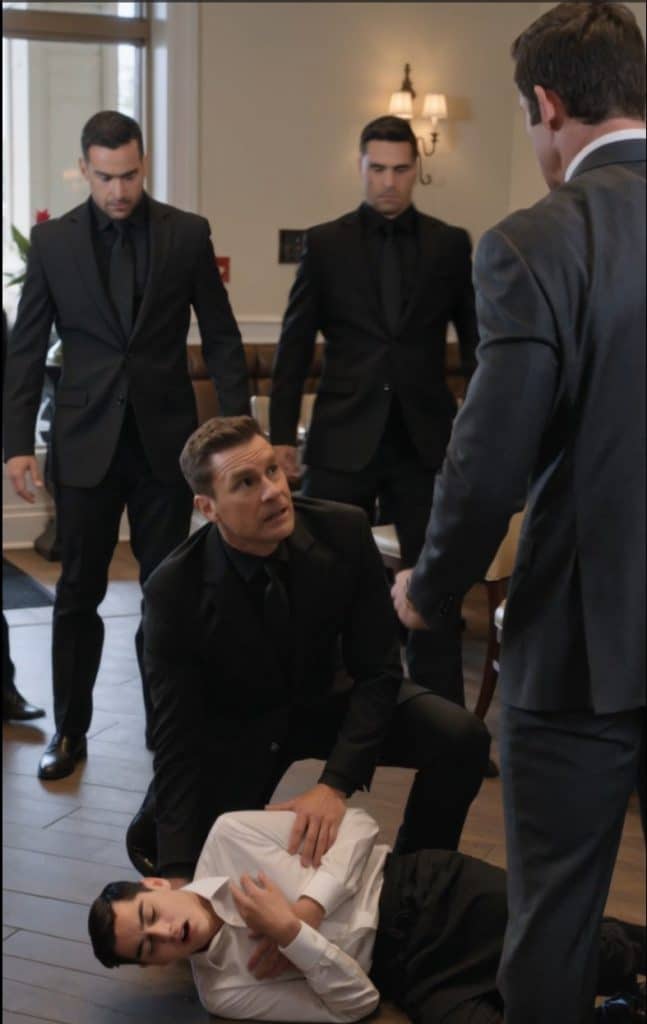
Grant stepped forward and struck him in the chest with enough force to send him down beside the broken vase.
The dining room froze.
A woman near the window covered her mouth. A busboy stopped carrying a tray. Two managers remained near the bar, watching without moving.
Grant stood above Evan with the cigarette still between his fingers.
“Trash. You don’t give orders to people like me.”
Evan pressed one hand against his chest.
His uniform was stained from a spilled glass, and each breath tightened the pain in his ribs. Still, he looked toward the table.
The cigarette had landed beside a linen napkin.
“Put that out,” he said.
Grant laughed.
Then he stepped over the white stones and attacked Evan again while the server remained curled on the floor.
“Serve from the floor.”
A young hostess reached for the emergency button beneath her station.
The dining-room manager caught her wrist.
“Don’t,” he whispered.
Grant Holloway was not simply another wealthy guest.
He owned a private investment firm, sat on the restaurant’s advisory board, and controlled contracts worth millions. His photograph hung beside celebrities and politicians in the private dining corridor.
Employees had been told that Holloway guests did not hear the word no.
Evan had said it anyway.
Outside, tires screamed against the street.
The restaurant’s glass entrance burst inward as a black luxury car pushed through the vestibule and stopped in the central aisle. A waiting table slid aside as diners stumbled back.
The rear door opened.
Adrian Mercer stepped out with two security officers behind him.
He owned the restaurant.
He also owned twelve others, along with the building, the catering company, and the hospitality group that employed nearly two thousand people.
Grant immediately straightened his jacket.
Then Adrian saw Evan on the floor.
His expression changed.
He crossed the dining room, knelt among the scattered white stones, and supported the injured server by the shoulders.
“Evan.”
The room heard the name.
Evan opened his eyes.
“Dad.”
Adrian wiped the thin mark from his son’s forehead with a clean napkin. Only after confirming that Evan could breathe did he rise and face the table.
“Who kicked my son?”
Grant’s face emptied.
“Your son…?”
But Evan had not taken a serving job because his father wanted him to learn humility.
He had entered the restaurant under another surname because guests were smoking behind locked doors—and one employee had nearly died after trying to expose them.
Act II
Aurelia had opened twenty-four years earlier with thirty tables and a kitchen too small for its ambitions.
Adrian Mercer built it with Evan’s mother, Julia.
Adrian handled investors and expansion. Julia designed the dining room, trained the first servers, and insisted that no guest’s money would ever place them above the staff.
She wrote the original service code herself.
Respect moved in both directions.
Safety rules applied to everyone.
And no employee could be punished for protecting another person.
After Julia died, Adrian kept the framed code in his office.
He stopped reading it.
Aurelia grew from a neighborhood restaurant into a national luxury brand. Private rooms appeared. Membership programs followed. Powerful guests expected secrecy, special access, and immediate accommodation.
Grant Holloway became one of them.
His investment firm financed three Mercer Hospitality expansions during a difficult year. In return, he received a permanent advisory position and access to a private dining suite beneath Aurelia.
Officially, the room was used for confidential business dinners.
Employees called it the Ember Room.
They said guests smoked there.
Not only cigarettes.
Cigars filled the underground corridor for hours, even though the building’s ventilation system was not designed to contain the smoke.
Several servers complained of headaches and breathing problems. One bartender resigned after collapsing during a private event.
The company’s operations director, Charles Wynn, said every inspection was current.
He told Adrian the Ember Room used a legally approved filtration system.
Then a server named Melissa Cole contacted Evan.
Melissa had worked at Aurelia for three years. She was dependable, quiet, and raising a ten-year-old son alone.
During a Holloway dinner, she refused to close the ventilation door because smoke was leaking toward the kitchen.
Grant ordered a manager to remove her.
Two days later, Melissa was fired for stealing wine.
She denied it.
Security footage supposedly showed her placing a bottle inside her bag, but the image was blurry and the timestamp had been altered.
Evan asked Adrian to investigate.
Adrian forwarded the matter to Charles.
Charles returned with a disciplinary file, witness statements, and an insurance report. Everything appeared legitimate.
Melissa continued insisting she had been framed.
Then she sent Evan a photograph.
It showed Grant Holloway beside a city fire inspector inside the Ember Room. The inspector was holding an envelope while workers covered a damaged air vent behind a decorative wall panel.
The photograph was taken the night before the official safety inspection.
The room passed.
Evan confronted his father.
Adrian refused to believe Charles and Grant could coordinate something so reckless beneath his own restaurant.
“You are treating suspicion like evidence.”
“You are treating paperwork like truth.”
The argument ended with Adrian accusing his son of wanting authority before earning experience.
Evan left the office furious.
Three days later, he applied for a server position under his mother’s surname, Cole.
Only the company’s attorney knew.
Adrian discovered what he had done after the hiring process began. He wanted to stop it, but Evan persuaded him to allow thirty days.
“If the restaurant is what you think it is, I’ll learn that.”
“And if it isn’t?”
“Then you need to see what happens when no one knows I’m your son.”
For four weeks, Evan carried plates, polished glasses, and listened.
He learned that servers were ordered to ignore smoking in the private rooms.
He learned complaints disappeared.
He learned managers assigned the most difficult tables to employees who questioned VIP behavior, then used negative guest reviews to fire them.
Grant’s name appeared repeatedly.
So did Charles Wynn’s.
The night of the assault, Grant was not seated in the Ember Room.
A city health delegation was inspecting the basement, so Charles moved Grant’s party upstairs and told the staff not to enforce the smoking ban.
Evan did not receive that instruction.
Or perhaps Charles wanted to see what he would do.
When Evan approached the table, Grant recognized Julia’s eyes in his face.
That was why he stared so long before reaching for the vase.
He had met Evan years earlier.
And once Grant realized who the server truly was, the assault stopped being a fit of anger.
It became an attempt to silence the one person who could connect him to Julia Mercer’s final investigation.
Act III
Police secured the dining room while paramedics examined Evan.
Adrian stepped away from the investigation. He knew Grant’s attorneys would challenge anything controlled by the victim’s father.
The restaurant’s cameras were copied by outside officers.
Charles Wynn attempted to leave through the kitchen.
Security stopped him near the service elevator.
“I’m handling a guest emergency,” he said.
“The emergency is in the dining room,” Adrian replied.
Charles looked toward Grant.
That single glance told Evan more than either man intended.
A hostess named Priya came forward first.
She admitted the dining-room manager had stopped her from pressing the emergency button. The manager then admitted Charles had instructed staff never to summon police for advisory-board members without executive approval.
Grant scoffed.
“This is a misunderstanding being inflated by frightened employees.”
A diner raised his phone.
The video showed the vase strike clearly.
Another recording captured the follow-up assault.
Grant changed his explanation.
He claimed Evan had threatened him.
Then a woman seated at the neighboring table spoke.
“The server offered to move him outside.”
More witnesses agreed.
The truth no longer depended on the owner’s son.
It belonged to everyone who had watched.
Evan asked officers to secure Grant’s cigarette case.
Grant laughed.
“You think smoking is the crime here?”
“No,” Evan said. “I think what’s inside the case is.”
The silver case contained more than cigarettes.
Hidden beneath the lining was a small electronic key marked E-4.
It opened the Ember Room.
Charles carried a matching key.
The basement door was sealed while investigators obtained proper authorization. When it was opened, the room smelled strongly of smoke despite being supposedly unused.
The filtration panel was decorative.
Behind it, ducts had been cut and redirected toward an employee stairwell.
Smoke from VIP events had been pushed into staff areas to keep it away from paying guests.
That stairwell connected to the kitchen, lockers, and break room.
Employees had been breathing what wealthy diners did not want near their own tables.
Inside a cabinet, investigators found premium cigars, private liquor, and medical inhalers labeled with employee names.
One belonged to Melissa Cole.
Another belonged to a dishwasher who had been told he was imagining his breathing problems.
Charles claimed the items had been lost and stored.
Then Evan found a narrow folder hidden behind the liquor cabinet.
It contained incident reports.
Dozens of them.
Servers described dizziness, asthma attacks, and smoke exposure. Each report carried a handwritten note.
Resolved privately. Do not enter central system.
Most were signed by Charles.
Several carried Grant’s initials.
The oldest report was written by Julia Mercer.
Evan stopped breathing for a different reason.
His mother had visited the Ember Room six months before her death. She documented illegal smoking, blocked emergency access, and payments to an inspector.
Adrian stared at her signature.
“She never told me.”
Evan turned the final page.
She had tried.
The report was addressed directly to Adrian.
It had never reached him.
Attached was a memo from Charles recommending that Julia be removed from daily operations because of “stress-related judgment concerns.”
Grant had supported the recommendation.
They used her illness to discredit her.
But Julia had left one more document.
It showed that the Ember Room was not simply an illegal lounge.
It was where Grant and Charles arranged secret investments using restaurant accounts—and one of those investments had transferred ownership of Aurelia’s building without Adrian’s knowledge.
Act IV
The property transfer appeared legitimate.
A holding company called Meridian Cultural Estates had purchased Aurelia’s building three years earlier. Mercer Hospitality now paid rent to remain inside its own flagship restaurant.
Adrian had never approved a sale.
Charles explained the monthly payments as refinancing costs.
In reality, Mercer Hospitality had been paying millions to a company controlled by Grant Holloway.
The scheme began after Julia became ill.
Grant offered emergency capital to protect the restaurant group during her treatment. Adrian signed several restructuring agreements while traveling between hospitals and board meetings.
Buried inside those documents was a temporary property option.
The option required a second signature to become permanent.
That signature appeared to belong to Julia.
She had supposedly approved the transfer two weeks before her death.
Evan examined it.
His mother always signed her last name with an open loop in the final letter.
The transfer used a closed loop.
The signature was forged.
Grant had not only taken control of the building.
He used Aurelia’s own rent payments to recover the money he invested, plus interest.
The private Ember Room served as a meeting place where city inspectors, bankers, and selected officials could be entertained beyond public view.
Smoking was not the main attraction.
Secrecy was.
Charles managed staff access. Grant controlled the guests. Anyone who objected was labeled unstable, dishonest, or replaceable.
Melissa was fired because she photographed the inspector.
Julia was pushed out because she discovered the property transfer.
Evan was attacked because Grant believed he had found the missing report.
Adrian sat in the empty dining room after police removed Grant and Charles for questioning.
Broken white stones still covered part of the floor.
“I thought I was protecting the company,” he said.
Evan’s chest had been wrapped, and a small bandage covered his hairline.
“You protected the people who made the company look successful.”
Adrian did not answer.
The board called an emergency meeting.
Several directors urged silence.
Aurelia’s reputation depended on discretion. Publicly admitting forged ownership records, illegal VIP privileges, and hidden employee injuries could destroy the entire restaurant group.
One director suggested blaming Charles alone.
Another said Julia’s report might be unreliable because she had been ill.
Adrian stood.
“My wife was not unreliable.”
The room quieted.
“She was ignored.”
He released the internal records that evening.
The consequences came immediately.
Health officials closed the Ember Room. The city suspended the inspector who had approved it. Financial regulators opened an investigation into the property transfer.
Former employees contacted the company.
Their stories matched.
A hostess fired after reporting harassment.
A cook blamed for missing liquor after refusing to serve intoxicated guests.
A manager demoted after calling an ambulance without permission.
Grant’s power had never depended only on money.
It depended on everyone believing the restaurant needed him more than it needed the truth.
Then Melissa returned with the original photograph.
The image included something no one had noticed.
In the reflection of the Ember Room mirror stood a third man holding Julia’s report.
He was a member of Mercer Hospitality’s board.
And he was preparing to sell the entire restaurant group to Grant before the investigation could void the forged property transfer.
Act V
The board member was Samuel Pierce, Adrian’s oldest business partner.
Samuel had joined Aurelia during its second year, when the restaurant was still struggling to fill weekday tables. Adrian trusted him like family.
Samuel claimed he believed Grant’s investment would preserve the company.
Recovered messages showed otherwise.
He was promised a fortune if Grant gained controlling ownership. He helped suppress Julia’s report, approved Charles’s authority, and pressured managers to protect VIP guests.
The planned sale collapsed.
Samuel resigned before he could be removed, but investigators continued examining his role in the forged documents and concealed financial transactions.
Grant’s holding company lost its claim to Aurelia after handwriting experts, digital records, and Julia’s original notes established the fraud.
Ownership of the building returned to Mercer Hospitality.
Adrian refused to celebrate.
Recovering property did not repair what happened inside it.
Aurelia closed for six months.
The Ember Room was dismantled completely. Workers removed the false walls, replaced the ventilation system, and opened the basement for inspection.
Adrian considered turning it into another dining room.
Evan proposed something else.
The space became an employee center with lockers, medical support, legal resources, and a private reporting office operated by an outside organization.
No guest could enter without invitation.
No executive controlled the complaint system.
A new policy stated that employees could refuse unsafe or abusive service without losing shifts, tips, or promotion opportunities.
VIP status disappeared.
Guests could reserve private rooms.
They could not reserve exemption from rules.
Melissa received compensation and a formal correction of her employment record. Adrian offered her a management position.
She declined.
“I don’t want to return to the place that taught me silence was part of the uniform.”
Evan understood.
She accepted a role on the independent employee council instead.
The dishwasher whose inhaler had been hidden received medical support. Other former workers received back pay, settlements, or public credit for concerns they had raised years earlier.
Some damage could not be reversed.
Several employees had left the industry entirely.
One still experienced breathing problems.
Apologies did not restore lost health.
Adrian stepped down as chief executive during the reforms.
He remained an owner but surrendered daily control to a board that included staff representatives. Financial decisions involving property, safety, and employee complaints required independent review.
He also removed Grant’s photograph from the private corridor.
Then he removed all the others.
The wall was replaced with portraits of cooks, servers, dishwashers, hosts, cleaners, and bartenders who had worked at Aurelia since opening night.
Julia’s photograph stood among them.
Not above them.
Evan did not become the new executive.
He returned to serving after he recovered.
Some employees treated him differently now that they knew who he was. They offered him easier tables and apologized when he carried heavy trays.
He stopped them.
“I was a server before you knew my last name.”
That sentence became a quiet test inside Aurelia.
Would people respect a worker before discovering a powerful connection?
On reopening night, the dining room filled slowly.
A guest near the window lit a cigarette.
A young server approached.
“Sir, please don’t smoke in this area.”
The guest looked irritated.
Then he saw other diners watching.
He extinguished it.
No vase moved.
No manager interfered.
The meal continued.
Evan witnessed the moment from across the room.
His body still tightened when he heard stone strike glass or chairs scrape suddenly. Healing had not made him fearless.
It had made him unwilling to pretend fear was gone.
Later that evening, Adrian joined him near the repaired entrance.
“I should have believed the first employee,” Adrian said.
“Yes.”
“I should have believed your mother.”
“Yes.”
“I should have believed you.”
Evan looked toward Julia’s photograph.
“Yes.”
Adrian had expected forgiveness to follow confession.
It did not.
What followed was work.
They rebuilt their relationship the same way they rebuilt the restaurant—through transparency, consistency, and decisions made when no one was applauding.
Months later, Aurelia added one line beneath its service code:
No guest becomes more important than the person required to serve them.
Grant had believed money placed him above rules.
He believed a server existed to absorb his anger, protect his comfort, and remain silent while powerful men conducted business behind locked doors.
Learning that Evan was the owner’s son destroyed that confidence.
But Evan’s dignity did not come from his father.
It was present when he enforced the smoking rule, when he protected the dining room after being struck, and when he refused to let his family save the restaurant by hiding what it had become.
Adrian’s arrival reversed the power between a guest and a server.
Evan’s investigation reversed the power inside the entire company.
And the young man Grant ordered to serve from the floor became the reason Aurelia finally remembered that true hospitality was never submission to wealth.
It was the courage to treat every person in the room as human.