Act I
The plate hit the chef before his apology was finished.
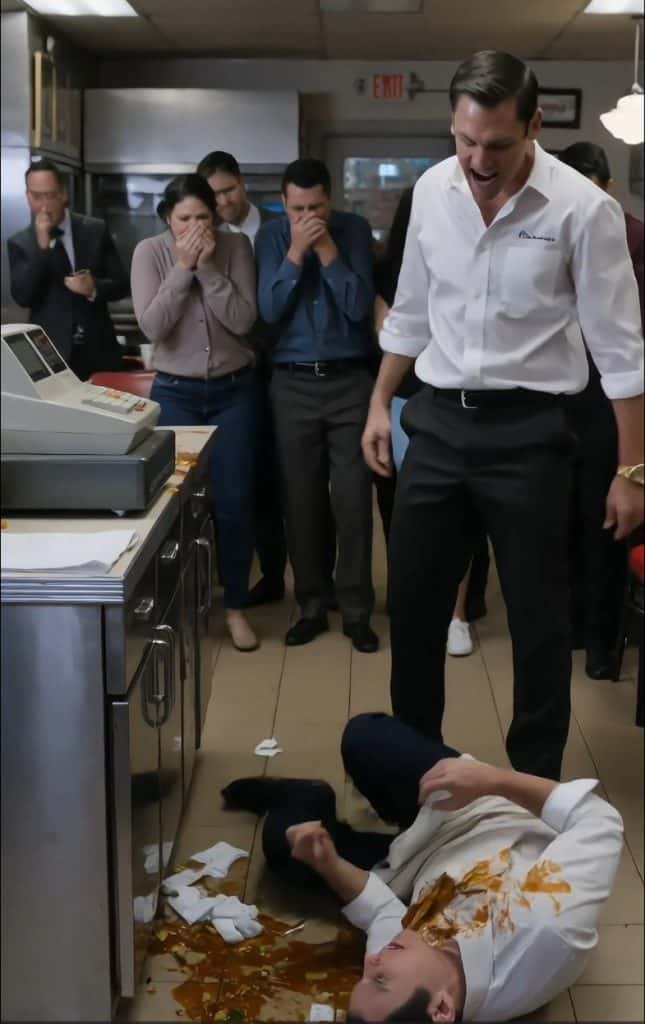
Hot sauce, vegetables, and gravy spilled over his hair and ran down the front of his worn white coat. A few customers gasped, but the wealthy man at Table Seven was already rising from his chair.
David Morales lifted both hands.
“Sir, I’m sorry. The kitchen mixed up—”
The customer stepped back and kicked him hard in the stomach.
David flew into the narrow aisle. His back struck the cashier counter, shaking the register and sending a curtain of receipts fluttering to the floor.
Then he collapsed.
For one second, the crowded diner went silent.
The pans still sizzled behind the kitchen door. A ticket printer continued spitting out orders. Somewhere near the window, a spoon rolled in a slow circle beneath a table.
The man responsible adjusted his expensive shirt.
His name was Carter Wynn.
He was forty, wealthy, and accustomed to having people recognize him. His gold watch cost more than most of the diner employees made in a year.
Three friends sat at his table.
None of them stood.
David pressed an arm against his stomach and tried to breathe. Sauce dripped from his face. A thin mark appeared at the corner of his mouth where he had struck the counter.
Carter looked down at him.
“Trash,” he said. “People like you can’t even serve food right.”
A teenage busser took one step forward.
Carter turned his head.
“Stay out of it.”
The boy stopped.
David had come out of the kitchen because Carter had ordered steak and eggs but received chicken and waffles. The server had offered to replace the dish immediately.
That should have ended it.
Instead, Carter demanded to see the chef.
David had worked since four that morning. His apron was stained, his shoulders ached, and he had not eaten since the previous night.
Still, he came out personally.
He bowed his head and apologized.
Carter answered with violence.
Now David tried to push himself onto one elbow.
Carter moved closer.
A woman by the register raised her phone.
“You should call the police,” someone whispered.
Carter heard it.
He placed his shoe against David’s side and struck him twice more while the chef curled around the pain.
Several customers shouted.
A server dropped her coffee pot.
Carter’s friends finally looked uncomfortable, but no one stopped him.
“Stay down where you belong,” Carter said.
David’s hands shook against the tile.
He did not beg.
That seemed to anger Carter even more.
“You hear me?”
David raised his face.
Beneath the sauce and humiliation, there was something steady in his eyes.
“I heard you.”
The calm reply unsettled Carter.
He glanced around the diner, expecting fear. Instead, he saw disgust.
Then the front door swung open so hard that it struck the wall.
Three men in dark suits entered.
The one in front stopped when he saw David on the floor.
His expression changed instantly.
He crossed the diner, dropped beside the injured chef, and wiped sauce from his father’s face with his own handkerchief.
Only then did he turn toward Carter.
“Who touched my father?”
And suddenly, the wrong breakfast order was the least important thing in the room.
Act II
Ethan Morales owned eighty-three restaurants across the country.
Carter knew his face from business magazines.
He knew the black suit, the quiet voice, and the two regional managers now standing behind him.
What Carter did not know was why a multimillionaire’s father was wearing a stained apron in an ordinary roadside diner.
“Your father?” he stammered.
Ethan ignored him.
He slid one arm beneath David’s shoulders and helped him sit safely against the counter.
“Dad, look at me.”
“I’m fine.”
“You can barely breathe.”
“I’ve had worse shifts.”
Ethan’s anger sharpened.
David always made jokes when he was hurt. He had done it when the family restaurant nearly failed, when his wife died, and when doctors warned that exhaustion was damaging his health.
Ethan looked toward the nearest server.
“Call an ambulance.”
“It’s already coming,” she said.
The regional managers closed the diner doors. No one was trapped, but witnesses were asked to remain until police arrived.
Carter stepped backward.
“This is being blown out of proportion.”
A customer pointed toward the security camera above the register.
“We saw everything.”
Carter’s jaw tightened.
“The chef became aggressive.”
The teenage busser found his voice.
“He bowed to apologize.”
Carter turned on him.
“You should be careful accusing people.”
Ethan stood.
He was not as tall as Carter, but the room shifted around him.
“Do not threaten my employees.”
Carter gave a nervous laugh.
“Your employees? This place belongs to you?”
Ethan looked around the diner.
The faded booths. The handwritten lunch specials. The open kitchen where his father had spent half his life.
“This was the first restaurant my family ever owned.”
David closed his eyes briefly.
The diner had opened thirty-one years earlier under a different name. Back then, it held eight tables, one broken refrigerator, and a grill that overheated every afternoon.
David and his wife, Rosa, worked opposite shifts so someone could stay home with Ethan.
They slept in a small apartment above the kitchen.
When business was slow, David sold his wedding watch to cover payroll.
When a fire damaged the dining room, employees helped rebuild it.
The restaurant survived.
Then it grew.
One location became three. Three became twelve. Ethan went to business school, modernized the company, and turned the small family operation into a national chain.
But David refused an executive office.
He kept cooking.
Not because he needed the money.
Because the original diner was where everything began.
It was also where he believed the truth about the company could still be found.
Executives saw spreadsheets.
David saw whether portions were shrinking, whether servers were exhausted, and whether managers treated dishwashers with respect.
He arrived without warning, wore the same old coat, and worked whichever station needed help.
Most customers had no idea who he was.
That was how he preferred it.
Carter looked from Ethan to David.
“I didn’t know.”
David opened his eyes.
“You didn’t know what?”
Carter hesitated.
“That he was connected to the company.”
The silence that followed was heavier than shouting.
Ethan stepped closer.
“So attacking him would have been acceptable if he were just the chef?”
Carter said nothing.
Police entered through the front door.
Behind them came paramedics.
As they examined David, one of the regional managers picked up the scattered receipts. Among them was a folded document stained with gravy.
He opened it.
His face changed.
“Ethan,” he said quietly. “You need to see this.”
The paper was not a food order.
It was an internal report showing thousands of dollars in unexplained charges connected to several restaurants.
At the bottom was Carter Wynn’s name.
And David had been carrying it because he planned to confront his son that morning.
Act III
Carter was not merely an angry customer.
His investment firm owned a minority stake in Morales Dining Group.
Two years earlier, Ethan had accepted outside capital to expand into airports and shopping centers. Carter’s company promised rapid growth without interfering in daily operations.
The promise lasted six months.
Soon, executives appointed by Carter began cutting costs.
Experienced cooks were replaced with temporary workers. Healthcare hours were reduced. Maintenance requests were delayed.
Restaurants appeared more profitable on paper.
Employees paid the price.
Ethan received polished reports showing higher margins and improved efficiency. Complaints were filtered through regional offices before reaching him.
David heard a different story.
A dishwasher named Maria told him her medical coverage disappeared after her schedule was reduced by fifteen minutes per week.
A night cook said broken ventilation had filled his kitchen with smoke for months.
Servers complained that customer tips were being used to cover shortages they did not cause.
Each complaint led back to a management system introduced by Carter’s firm.
David began collecting records.
He visited restaurants quietly. He copied payroll statements, maintenance requests, and internal emails.
At one location, employees claimed they were ordered to clock out and continue cleaning.
At another, a manager charged workers for uniforms that were supposed to be free.
The worst discovery involved a supplier called Wynn Hospitality Solutions.
It sold food and cleaning products to the chain at inflated prices.
The company was controlled through a series of shell businesses.
The final owner was Carter’s brother.
David carried the first full audit in his apron pocket that morning.
He intended to give it to Ethan after the lunch rush.
Carter had come to the diner for another reason.
He knew an internal review was underway.
Someone at headquarters had told him David was gathering evidence.
Carter expected to find an exhausted cook he could intimidate into silence.
He did not know the cook was Ethan’s father.
As the regional manager showed Ethan the report, Carter’s confidence collapsed.
“That document is confidential,” he said.
Ethan looked at him.
“Why are you worried about it?”
“I’m not.”
“You recognized it from across the room.”
Carter’s friends began gathering their coats.
A police officer stopped them.
“Please remain available as witnesses.”
One of the men turned toward Carter.
“You said we were here for breakfast.”
Carter ignored him.
Ethan read the first page.
Then the second.
His face became still.
“Dad, how long have you known?”
David winced as the paramedic checked his back.
“Long enough.”
“Why didn’t you tell me?”
“I tried.”
Ethan remembered the messages.
Three requests from his father to meet privately.
Two were rescheduled by assistants.
The third disappeared from his calendar.
Someone had been controlling access to him.
David reached into his apron and removed a small key.
“Locker in the kitchen.”
The police opened it with his permission.
Inside were copies of employee statements, photographs, invoices, and a flash drive containing months of internal communication.
One email came from Carter directly.
Keep labor complaints away from Ethan until the expansion closes. Once the contracts are signed, they won’t matter.
Another instructed managers to classify employee injuries as personal medical issues.
A third discussed pressuring David to retire.
Carter moved toward the door.
An officer blocked him.
“This is ridiculous. Those emails are being misinterpreted.”
The teenage busser spoke again.
“Like the chef becoming aggressive?”
Several customers laughed bitterly.
Carter looked at him with hatred.
Ethan stepped between them.
“You will never frighten anyone in this restaurant again.”
Carter lifted his chin.
“You can’t remove my firm without triggering the partnership clause.”
He was right.
The investment agreement contained a penalty large enough to threaten the entire company.
Carter believed that contract still protected him.
Then David pointed toward the last page of the audit.
Rosa Morales had left behind something neither man knew existed.
And it gave David the power to end the partnership himself.
Act IV
Rosa had never trusted investors.
Before her death, she placed the family’s original restaurant and its founding shares into a private trust.
Ethan managed the company.
David controlled the trust.
The documents included a morality provision written in plain language: any investor who endangered workers, falsified company records, or damaged the founding restaurant could be removed by the trustee without compensation beyond the independently assessed value of legitimate shares.
Ethan had forgotten the clause.
Carter had never read it carefully.
David had.
From his chair beside the counter, he looked at Carter.
“You thought I was just the cook.”
Carter’s attorney arrived forty minutes later.
By then, police had taken witness statements and copied the surveillance footage.
The video showed Carter dumping the plate, attacking David, and striking him again after he fell.
No confusion.
No self-defense.
No missing context.
Only cruelty.
Carter’s attorney tried to separate the assault from the financial investigation.
David refused.
“They came from the same place,” he said.
The attorney frowned.
“What place?”
“The belief that anyone serving you is beneath you.”
The company board met that evening.
David joined by video from the hospital, still wearing the stained chef coat because police had not yet released his belongings.
Carter appeared with three lawyers.
He denied ordering illegal labor practices. He blamed overzealous managers and claimed the supplier contracts had been approved fairly.
Then the employees testified.
Maria described losing healthcare coverage.
A cook showed photographs of burns caused by unsafe equipment.
A former manager admitted he had been ordered to alter time records.
The regional executives who had hidden complaints were suspended.
Two surrendered company laptops.
Financial investigators traced payments from Morales Dining Group to Carter’s shell suppliers. The overcharges totaled millions.
Carter’s own messages connected him to the scheme.
His attorney requested a private settlement.
David shook his head.
“Private is how this survived.”
The board invoked Rosa’s clause.
Carter’s firm lost its management rights immediately. Its shares were frozen pending a fraud investigation and valuation.
Carter was removed from every company property.
But Ethan did not escape responsibility.
When the meeting ended, he sat alone with his father.
“I should have known,” he said.
David looked at him through the hospital screen.
“You should have listened.”
“I thought the reports were reliable.”
“You believed numbers because numbers never interrupted you.”
Ethan lowered his eyes.
David’s voice softened.
“You built something bigger than we imagined. But the bigger it became, the farther you moved from the people holding it up.”
“I failed them.”
“Yes.”
The answer hurt because David did not soften it.
“What do I do now?”
David looked down at his shaking hands.
“You stop trying to save the brand.”
Ethan frowned.
“Then what do I save?”
“The people.”
The next morning, Morales Dining Group closed every location for an independent labor audit.
The decision cost millions.
Shareholders protested.
Ethan did not reverse it.
Unpaid wages were restored. Medical benefits were reinstated. Unsafe kitchens were repaired. Employees fired after reporting misconduct were offered compensation.
Carter’s financial scheme was turned over to federal investigators.
His assault charge proceeded separately.
The video made his public image impossible to repair.
But the most devastating moment came months later, when he faced David in court.
Carter apologized only after realizing the judge was ready to impose consequences.
David listened without expression.
Then he told the court exactly what the apology was missing.
Act V
“You are sorry he was my son,” Carter said.
David shook his head.
“No. You are sorry I was his father.”
The courtroom became silent.
Carter stared at him.
David continued.
“If I had been a cook with no wealthy family, you would have forgotten me before dessert.”
Carter’s lawyer objected.
The judge allowed David to finish.
“You asked who I was after you learned who my son was,” David said. “But you had enough information before that.”
He held up one hand.
“I was a man apologizing for a mistake. That should have been enough.”
Carter received a criminal sentence for assault, while the financial case continued through separate proceedings. His investment firm collapsed after other companies examined their own contracts.
Several former partners sued.
The gold watch, the expensive shirts, and the powerful friends could not erase the diner footage.
David returned to work six weeks later.
Ethan tried to stop him.
“You’re supposed to rest.”
“I rested yesterday.”
“You cooked for nine hours yesterday.”
“Then I’m rested from resting.”
The original diner reopened with repaired counters, new kitchen equipment, and the same faded booths David refused to replace.
Ethan arrived before sunrise on reopening day.
He wore an apron.
David looked at it.
“You tied that wrong.”
“I run eighty-three restaurants.”
“You still tied it wrong.”
David fixed the knot.
Employees gathered in the dining room before the doors opened.
Ethan announced a new ownership program granting workers shares in the company. Each location would elect an employee representative with direct access to the board.
Complaints could no longer pass through regional managers before reaching headquarters.
Overtime records would be independently monitored.
No executive bonus would be approved while employee safety violations remained unresolved.
Then Ethan announced one final change.
The original diner would no longer be used as a ceremonial headquarters.
It would become the company’s training center.
Every new executive would work there for two weeks.
They would wash dishes, clean tables, handle the register, and take late-night shifts.
A board member asked whether that was truly necessary.
David answered before Ethan could.
“Yes.”
The first customer that morning was the woman who had recorded the attack.
She ordered coffee and eggs.
When David placed the plate in front of her, she smiled.
“Right order this time?”
He looked offended.
“We make one mistake in thirty-one years, and no one lets it go.”
The diner filled quickly.
Servers called orders. Pans sizzled. Receipts gathered beside the register.
Near the counter, a framed copy of Rosa’s handwritten rule hung on the wall:
No one who enters hungry should leave feeling small.
Beside it was a second plaque added after the attack:
Respect is not a reward for importance. It is the minimum owed to everyone.
The teenage busser who had stepped forward became a shift supervisor.
Maria joined the employee board.
The cook injured by unsafe equipment received treatment and returned only after the kitchen passed inspection.
Some former employees never came back.
Ethan understood that repairs did not create instant forgiveness.
Trust returned slowly, one decision at a time.
Late one evening, after the last customer left, Ethan found David wiping the cashier counter.
A faint dent remained where his back had struck it.
“We could replace that,” Ethan said.
David ran the towel over the mark.
“Leave it.”
“Why?”
“So people remember.”
Ethan stood beside him.
“Remember Carter?”
“No.”
David looked toward the kitchen.
“Remember what happens when everyone is too afraid to move.”
Ethan was quiet.
Then he asked the question he had avoided for months.
“Were you ashamed of me?”
David rested both hands on the counter.
“I was afraid for you.”
“Why?”
“Because success can make a person think distance is the same as leadership.”
Ethan absorbed the words.
“I’m trying to change.”
“I know.”
“Is it working?”
David handed him the towel.
“The floor needs mopping.”
Ethan laughed.
Then he took the towel.
Outside, traffic moved beneath the diner’s red sign. Inside, father and son cleaned the restaurant where their family story had begun.
Carter had looked at David’s stained apron and seen failure.
He had seen an exhausted man serving food and believed that meant he could humiliate him without consequence.
The arrival of the owner had frightened him.
The family connection had destroyed his confidence.
But it was never the reason David deserved protection.
He had earned no less dignity before Ethan entered the room.
He had been a chef.
A father.
A widower.
A man who had worked through exhaustion and still stepped out of the kitchen to apologize for someone else’s mistake.
That should have been enough.
And after the day receipts fell like white leaves around him, the entire company finally understood it.