Act I
The first punch drove the air from Mr. Lawson before the crane even stopped swinging.
He folded forward beside the wet concrete slab, one gloved hand reaching for balance, but the second strike caught him across the face and sent him down hard onto the site floor. His hard hat rolled across the concrete with a hollow clatter, and the blueprints he had been carrying slid into the mud.
Then the investor kicked them.
Pages scattered beneath orange safety cones, across tire tracks, into dust and rainwater, while workers in hard hats froze where they stood.
A city inspector lowered her clipboard. A crane operator leaned from his cab. Near the temporary investor tent, men in clean boots and tailored coats stared at the man on the ground as if the site itself had stopped breathing.
Mr. Lawson stayed on one hand.
His palm had scraped against the concrete. A small mark showed near his lip. His old reflective vest was smeared with dust, and his limp looked worse as he tried to shift his weight.
Still, his eyes remained focused.
That focus seemed to anger Blake Mercer even more.
Mercer stood over him in a blazer, clean hard hat, and boots that had never seen a real workday. He was the project’s biggest investor, the kind of man who walked through construction sites with cameras behind him and called workers “the backbone of the city” only when microphones were on.
Now his face was twisted with contempt.
“You think you can hold up my tower?” Mercer snapped.
Mr. Lawson did not answer.
He looked at the blueprints lying in the mud.
Mercer followed the glance and ground one polished boot into the nearest page.
“Concrete trash lifts beams,” he said. “It doesn’t read plans for towers.”
The site went silent.
Not because nobody cared.
Because too many people had learned that money on a job site could hit harder than a fist.
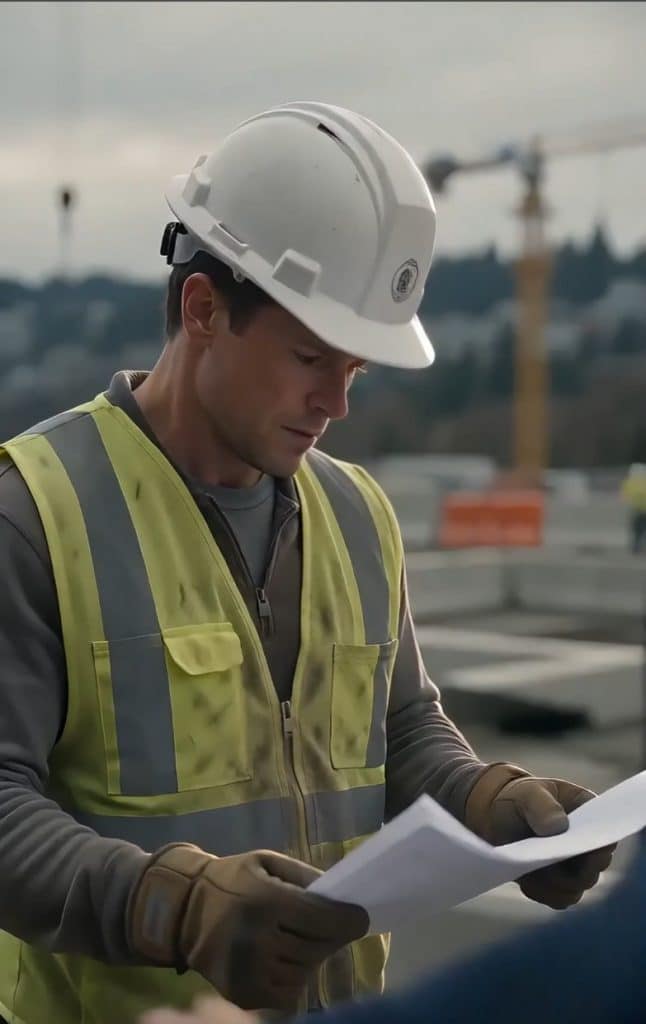
Mr. Lawson slowly reached for his hard hat.
Mercer kicked it farther away.
That was when a construction pickup roared through the site gate.
It braked inches from Mercer, throwing mud against his clean boots and making him stumble backward onto the edge of the slab. The driver’s door opened before the engine settled.
An older engineer in an orange safety vest stepped out.
White hard hat. stern face. eyes blazing.
He walked past Mercer without a word.
Straight to the man on the concrete.
Act II
The Lawson Tower site rose from a muddy block in Seattle like a promise nobody had earned yet.
Cranes cut through the gray sky. Rebar stood in ordered grids. Concrete trucks came and went beneath drizzle that turned red dust into slick mud. Investors saw renderings: glass walls, rooftop gardens, luxury offices, public plazas, and a skyline photograph waiting to happen.
Workers saw something else.
They saw loads, tolerances, bolt patterns, shear walls, weather delays, rushed pours, and the quiet danger of people in suits who thought concrete obeyed optimism.
Mr. Lawson saw all of it.
His full name was Owen Lawson.
He was thirty-nine years old, sun-darkened from years on sites, with a slight limp from a job accident that had never fully left him. He dressed like the workers because he had started as one. His father poured concrete. His mother ran payroll for a small structural firm out of a cramped office above a hardware store. Owen learned early that buildings do not stand because rich men imagine them.
They stand because people check the things no one applauds.
Rebar spacing.
Foundation curing.
Load paths.
Drainage.
Welds.
The hidden bones of a city.
Owen became an engineer because he wanted to build safely, not beautifully on paper and dangerously in real life. That belief made him respected by workers and inconvenient to investors.
Blake Mercer considered him more than inconvenient.
He considered him expensive.
Mercer’s firm had taken over financing for Lawson Tower after promising to bring “discipline” to the budget. In investor language, discipline often meant cutting anything that did not impress a press release. The backup drainage system was excessive. The seismic dampers could be reviewed later. The concrete testing schedule was too conservative. The steel change orders were “technical pessimism.”
Owen called them what they were.
Necessary.
Seattle was not a city where a tower could be built on arrogance. The ground held water. The weather changed fast. The earth itself had a memory. Every engineer in the region knew that the skyline was only as honest as the calculations beneath it.
Mercer hated that Owen could stop work with a signature.
The public did not know Owen’s real role. Most investors did not either. They saw an old vest, work gloves, a limp, and assumed he was a foreman or site laborer with too much opinion.
But Owen Lawson was the engineer of record.
More than that, he was the final technical authority named in the original development agreement. The tower had been his father’s last dream before he died: a mixed-use project with union labor, affordable units, and structural standards higher than the minimum code required.
Then the money came in.
And money began trying to rewrite the dream.
For three months, Owen documented problems. Concrete samples rushed. inspection windows shortened. safety reports edited before reaching the city. A subcontractor pressured to approve rebar substitutions before weather exposure testing came back.
He suspected Mercer.
He needed proof.
So that morning, Owen arrived without the white hard hat he usually wore during official inspections. No company jacket. No executive badge. Just an old reflective vest, work gloves, and the blueprints Mercer had demanded he stop “obsessing over.”
He wanted to see what happened when the man with money believed the man holding the plans had no power.
Mercer gave him the answer with two fists and a boot.
Now Senior Engineer Harold Pike had arrived with mud on his tires, fury in his face, and city inspectors waiting near the slab.
And the tower was about to tell the truth.
Act III
Harold Pike crouched beside Owen without touching him too quickly.
“Mr. Lawson,” he said, formal and clear, “the city inspectors are waiting.”
The gasp moved through the site like wind through scaffolding.
Lawson.
A young inspector looked from Owen to the sign at the gate. A worker near the rebar grid pulled off his gloves slowly. One of Mercer’s assistants turned pale as the name finally connected with the project title stamped on every permit board.
Blake Mercer stared from the slab edge.
“You’re…?” he said.
Owen picked up his hard hat.
Harold reached for the blueprints, then paused and let Owen gather the first sheet himself. It took longer. His hand hurt. His breath still had not fully steadied.
No one rushed him.
The site watched him lift the muddy page, shake off the grit, and fold it carefully under one arm.
Then he stood.
His limp showed.
So did his authority.
Harold turned toward the site supervisor.
“Preserve camera footage. Lock the gate feed. No one moves the marked blueprints, and no one touches the slab until the inspectors finish their review.”
Mercer’s expression hardened.
“Review?” he snapped. “This man was obstructing work.”
Owen looked at him.
“I was preventing a failure.”
The word failure landed heavier than any punch.
Workers shifted near the concrete edge. Investors looked at one another. A crane operator climbed down from his platform, no longer willing to watch from above.
Mercer forced a laugh.
“You’re a laborer with a clipboard.”
Harold’s eyes went cold.
“He is the engineer of record.”
The silence after that was absolute.
Even the machinery seemed distant.
Owen slid one muddy blueprint onto a temporary worktable and pointed to a red mark near the foundation detail.
“Your team tried to move the shear wall inspection to after the pour.”
Mercer’s jaw tightened.
“That is a scheduling matter.”
“No,” Owen said. “It is a structural matter dressed in a schedule.”
A city inspector stepped closer.
“That’s why we’re here.”
Mercer looked at her.
Then at Harold.
Then at Owen.
For the first time, he seemed to understand that the people he had dismissed as site noise were carrying documents he could not buy with charm.
Harold picked up another page from the dust.
“This morning, we received revised plans from Mercer Development showing a substitution Owen never approved.”
Mercer’s face changed quickly.
Too quickly.
Owen saw it.
So did the inspectors.
“You signed my name to a change order,” Owen said.
Mercer’s mouth opened.
No confident answer came.
The workers around the slab stood still, hard hats bright against the gray Seattle sky, watching a powerful man discover that buildings keep records even when people lie.
Harold moved between Owen and Mercer.
“The inspectors were waiting for Mr. Lawson’s confirmation before issuing a stop-work order.”
Mercer’s breath shortened.
Owen looked at the tower skeleton rising behind them.
“Now they have it.”
Act IV
The emergency review happened under a temporary canopy while rain began tapping against plastic sheeting.
It was not a boardroom.
It was better than a boardroom.
The concrete slab lay visible beyond the cones. Rebar stood exposed. Mud stained the blueprints. Workers gathered near the fence line. City inspectors, legal counsel, the senior engineering team, and Mercer’s investors stood in a rough circle around the folding table.
No polished walls.
No catered coffee.
Just the site.
The place where truth had to hold weight.
Owen placed the damaged hard hat on the table.
Beside it, he laid the blueprint Mercer had stepped on.
The muddy boot print crossed a foundation note written in Owen’s own hand:
No pour approval until seismic tie verification complete.
Harold read it aloud.
Mercer’s face tightened.
“This is being dramatized.”
Owen looked at him.
“You punched the engineer responsible for deciding whether your tower is safe to build.”
A worker near the fence muttered, “Sounds dramatic enough.”
No one corrected him.
The lead inspector opened the file.
“We have discrepancies between the submitted city set and the investor-circulated construction set.”
Mercer snapped, “Those were preliminary.”
Owen shook his head.
“They were distributed to the subcontractor this morning.”
The subcontractor, a quiet woman with rain dripping from her hard hat, stepped forward.
“Yes,” she said. “My crew was told to follow the Mercer set to keep the schedule.”
Mercer turned sharply.
“You misunderstood.”
She met his eyes.
“No, sir. I was pressured.”
That word changed the air.
Pressed schedules were common. Hard conversations were common. But pressure that touched safety was something else. On a site, pressure could become a crack. A crack could become a headline. A headline could become names no one wanted carved into anything.
Owen opened his field notebook.
“For weeks, my team has documented attempts to reduce inspection windows, skip curing delays, alter reinforcement placement, and delay reporting to the city.”
Mercer’s investors began looking at him differently.
Not morally at first.
Financially.
Then fearfully.
That was how accountability often entered expensive rooms: through liability before conscience.
Owen continued.
“My father built Lawson Structural with one rule. If the math says stop, you stop.”
Harold’s expression softened for half a second.
He had known Owen’s father.
Everyone who had been in Seattle construction long enough knew the elder Lawson. A man who could walk a site once and spot a problem young engineers missed in full reports. A man who treated laborers with respect because he had spent enough years tying rebar in winter rain to know intelligence did not always wear clean boots.
Owen looked at Mercer.
“You thought labor didn’t read plans. That is why you missed the danger. The people closest to the concrete knew something was wrong before your investors did.”
Mercer’s voice dropped.
“You will destroy this project.”
“No,” Owen said. “I am stopping you from doing that.”
The lead inspector signed the first order.
“Work is halted pending structural review.”
Mercer stiffened.
The second order followed.
“Suspected unauthorized plan alteration will be referred for investigation.”
Mercer turned toward his attorney.
The attorney did not move fast enough.
Harold placed his hand on the table.
“Mercer Development is removed from site operations pending review of contract violations.”
Mercer’s face drained.
“You can’t remove me from a project I finance.”
Owen picked up the hard hat.
His voice was quiet.
“You finance materials. You don’t own gravity.”
The site fell silent.
That sentence traveled farther than any shout would have.
Mercer looked around for support and found only workers, inspectors, and investors now calculating the cost of standing too close to him.
“You’re making a mistake,” he said.
Owen looked down at the boot-marked blueprint.
“No,” he said. “I found one before it became a building.”
Act V
Blake Mercer was escorted through the site gate in clean boots that no longer looked impressive.
Rain had begun to fall steadily, darkening the concrete and turning the mud deeper around the tire tracks. His blazer was spotted with water. His hard hat sat crooked. Behind him, the cranes stood still.
That was what broke him most.
Not being removed.
Seeing the project stop.
A tower he believed existed to multiply his name had gone silent because the man he called concrete trash knew which line on a blueprint could not be crossed.
At the gate, Mercer turned back.
“You’ll regret this delay,” he said.
Owen stood beside Harold, old reflective vest damp from rain, hard hat under one arm.
“I would regret a collapse more.”
Mercer had no reply to that.
Security walked him out.
For a few seconds, the crew did not move. They looked at Owen, then at the slab, then at the scattered blueprints that had been gathered, dried, photographed, and logged as evidence.
The lead inspector stepped forward.
“Mr. Lawson,” she said, “we’ll need your full technical statement.”
Owen nodded.
“You’ll have it.”
The workers began moving again, not to build, but to secure the site. Cover exposed materials. mark hazards. shut down equipment properly. protect what could still be saved.
That mattered to Owen.
Stopping work did not mean abandoning it.
It meant respecting it enough not to rush.
By evening, the stop-work order was public. By morning, local construction circles knew Mercer Development was under investigation for unauthorized plan alterations and safety interference. By the end of the week, two investors withdrew support unless Lawson Structural remained in full authority.
Mercer’s statement called the incident a disagreement over process.
The footage made that lie impossible.
People saw the punch.
They saw the blueprints kicked into dust.
They heard the insult.
Concrete trash lifts beams. It doesn’t read plans for towers.
Construction workers across the city repeated the line with a bitterness that turned quickly into pride.
Because they did read plans.
They read skies. schedules. soil. steel. concrete. fear. shortcuts. the mood of a crane operator before wind picked up. the hesitation of a young inspector about to be overruled. the silence of men in suits when safety cost money.
Owen hated becoming a symbol.
But he understood symbols could do useful work if they pointed away from ego and toward rules.
The tower remained paused for six weeks.
During that time, every altered drawing was reviewed. The shear wall details were restored. Substituted materials were rejected. The inspection schedule was rewritten under direct city oversight. Workers were given authority to flag discrepancies without going through investor channels.
A new sign was placed at the site entrance.
Plans are safety documents. Respect the people who read them.
Some investors called it dramatic.
Owen kept it up.
The damaged hard hat was not thrown away.
Harold wanted it in the office lobby. Owen refused. He did not want polished visitors treating it like a branding story.
So they placed it in the workers’ trailer instead, beside a copy of the boot-marked blueprint.
The card beneath read:
The day the tower stopped before pride became structural.
New hires saw it during orientation.
Harold told the story plainly.
“An engineer was knocked down. A crew froze. No schedule, investor, or title is worth that hesitation.”
Owen approved of that.
He had not wanted pity.
He had wanted the next worker who saw a dangerous shortcut to speak before someone more powerful told them to be quiet.
Months later, the project restarted.
Slower.
Cleaner.
Better.
Mercer was gone. His firm remained under review. The investors who stayed had learned, painfully, that safety was not an obstacle to profit. It was the only reason profit could stand without shame.
Owen walked the site every morning.
Still in the old vest.
Still with the limp.
Still stopping to listen when apprentices asked questions others might dismiss.
One rainy afternoon, a young laborer named Miguel approached him near the rebar grid.
“Mr. Lawson?”
Owen looked up from a measurement check.
Miguel held a folded plan sheet.
“I think the anchor layout on this page doesn’t match the field mark.”
Owen took the sheet.
He checked once.
Then again.
Miguel was right.
It was not a catastrophic issue. Not yet. But it mattered.
Owen looked at him.
“Good catch.”
Miguel tried not to smile too widely.
“No one ever told me I could question the drawings.”
Owen handed the plan back.
“You’re not questioning them. You’re reading them.”
That sentence stayed with the crew.
By the time the tower reached its tenth floor, the site felt different.
Not perfect.
No construction site is.
There were still arguments. weather delays. budget pressure. mistakes caught late. inspectors who annoyed everyone by being right. But the crew moved with a new kind of confidence. Not careless confidence. The disciplined kind that comes from knowing the person in charge will stop the job before letting pride build over error.
At the topping-out ceremony, investors wanted Owen onstage.
He refused until the workers were invited first.
So the ceremony changed.
Ironworkers, concrete crews, crane operators, electricians, inspectors, and apprentices stood beneath the final beam before anyone in a blazer spoke. The beam carried hundreds of signatures, not just executives and donors.
Miguel signed near the center.
Harold signed beside him.
Owen signed last.
Not because he was most important.
Because he wanted to see every other name before adding his own.
When the beam lifted into the gray Seattle sky, the crew went silent. Not from fear this time. From recognition.
A building was not a rendering.
It was trust made heavy.
Owen looked up as the crane swung the beam into place.
For a moment, he thought of his father.
If the math says stop, you stop.
But if the work is honest, you build.
The beam settled.
Bolts aligned.
Workers cheered.
Owen did not smile broadly. That was not his way. But something in his face eased, as if the tower had finally earned the right to rise.
Months later, when the building opened, no plaque mentioned Blake Mercer.
The lobby instead carried a small etched line near the structural exhibit Owen insisted be placed at eye level, not hidden in a technical corner.
A city stands because unseen work holds.
Visitors walked past it quickly.
Workers did not.
They stopped.
They read.
They understood.
Blake Mercer had called him concrete trash in front of everyone.
But by the time the tower stood against the Seattle rain, every person on that site knew the truth.
Mr. Lawson had never been pretending to read plans for towers.
He was the reason the tower was safe enough to touch the sky.