Act I
The tasting spoon hit the floor first.
Then Chef Gabriel Morales did.
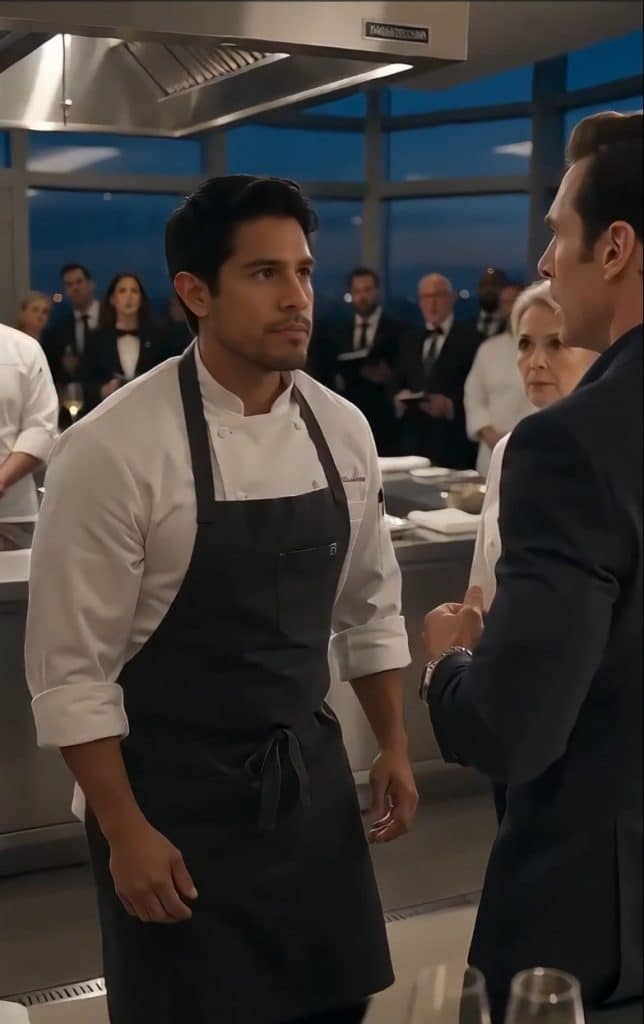
For half a second, the rooftop restaurant went silent in a way kitchens never did. No knife against board. No pan sliding across flame. No champagne laughter from the investor tables. Just the thin metallic sound of a spoon spinning near a fallen white towel while the city skyline glittered behind glass like it had not just watched a man get knocked to the floor.
Gabriel caught himself on one hand beside the open kitchen pass.
His old white chef coat twisted at the shoulder. His black apron dragged against the polished floor. A small mark colored the corner of his mouth, and his breath caught once from the blow that had sent him down in front of critics, journalists, line cooks, servers, and wealthy guests who had come to witness the opening of the year.
Above him stood Miles Bancroft.
Investor. Majority backer. Public face of the restaurant group.
Black suit. Open collar. Designer watch. A stare that treated human beings like expenses waiting to be cut.
He looked furious.
Not because he had lost control.
Because Gabriel had tasted from the wrong plate.
The plate sat on the pass beneath a heat lamp, untouched now, its sauce still shining around a piece of fish prepared with the kind of patience that made critics lean forward before they even lifted a fork.
Miles pointed at it.
“Who told you to touch that?”
Gabriel looked up slowly.
“I was checking the balance,” he said.
Miles laughed once.
The sound was ugly in the clean rooftop air.
Then, before anyone could step between them, Miles kicked the towel aside and leaned over Gabriel like the floor had finally put the chef where he belonged.
“Kitchen trash cooks for us,” he said. “It doesn’t taste from plates made for owners.”
A sound moved through the room.
A gasp from a server. A breath from a critic. A soft curse from someone near the champagne table.
But nobody stopped Miles.
Not yet.
That was the poison money brought into restaurants. It did not know how to cook, but it knew how to frighten the people who did. It walked past burn scars and fourteen-hour shifts and called itself vision.
Gabriel’s eyes stayed steady.
He did not argue.
He did not beg.
He reached for the fallen towel, folded it once with careful fingers, and set it beside the dropped spoon.
That small act made Miles sneer harder.
Then the rooftop elevator doors opened.
A group of food critics stepped out behind a woman in a pristine chef jacket, short gray hair, and an expression sharp enough to cut through bone.
Executive Chef Helena Cross walked straight toward Gabriel.
And every cook on the line lowered their tools.
Act II
Helena Cross did not raise her voice.
She had never needed to.
For thirty years, she had run kitchens where fear was common, but waste was unforgivable. She had survived male chefs who threw pans, investors who confused restaurants with trophies, and dining rooms full of guests who wanted genius on a plate but did not care who bled behind the pass to put it there.
She had hired Gabriel Morales once.
Then she had lost him.
Now she saw him on the floor of his own opening night, and the muscles in her face went still.
That was how everyone knew she was furious.
She stepped between Miles and Gabriel.
“Chef Morales,” she said, formal and clear, “the critics are ready.”
The sentence struck the rooftop harder than any pan hitting tile.
Miles froze.
“Morales?” he said.
The name barely came out.
Gabriel rose slowly.
He did not take Helena’s hand at first. He placed one foot beneath him, steadied his breath, and stood with the controlled silence of a man who had learned long ago not to give powerful people the satisfaction of seeing pain become panic.
His kitchen team watched him.
Not Miles.
Not Helena.
Him.
That was the first thing the investors noticed.
The saucier near the stove lowered her whisk. The sous-chef stopped plating garnish. The pastry lead turned from the final course and faced Gabriel with a respect that made the room rearrange itself around him.
Miles looked from one face to another, searching for the version of the kitchen he thought he had purchased.
He did not find it.
Helena turned to him.
“Mr. Bancroft,” she said, “you just assaulted the chef-owner of this restaurant in front of press, critics, staff, investors, and security cameras.”
The word owner landed slowly.
Then all at once.
A journalist raised her camera.
A critic removed his glasses and looked at Miles as if the evening had become much more interesting than dinner.
Miles gave a sharp laugh.
“That’s impossible.”
Gabriel wiped the corner of his mouth with the towel. The motion was calm, almost delicate.
“It was on the first page of the partnership agreement,” he said.
Miles’s jaw tightened.
The partnership agreement.
A document Miles had signed through counsel, skimmed through arrogance, and treated like a formality because men like him believed contracts were written for people with less leverage.
The restaurant was called Cielo Norte.
Its press materials described it as a rooftop Mexican-Californian tasting room built on memory, fire, coastal ingredients, and immigrant kitchens. Miles had loved those words because they sounded expensive when printed on cream paper.
He had not loved the man behind them.
Gabriel Morales had never looked like Miles’s idea of a star chef. He did not shout for cameras. He did not wear custom jackets. He did not perform genius with tweezers under blue light. He worked in an old coat because he liked the weight of it. He tasted everything because his grandmother had taught him that food lied if you did not listen carefully.
Miles saw the coat and assumed labor.
The critics saw the menu and expected authorship.
Helena knew both were the same man.
She turned slightly toward the elevator, where the newly arrived critics stood waiting beneath the rooftop lights.
“Chef,” she said to Gabriel, “they came for your menu.”
Gabriel looked at the plate on the pass.
Then at Miles.
And the whole room felt the shift before anyone said another word.
Act III
Gabriel Morales had built Cielo Norte in a notebook long before there was a rooftop, a skyline, or an investor pretending the dream belonged to him.
The first menu was written in pencil in the back of a bus.
He was seventeen, riding home from a dishwashing shift in East Los Angeles, smelling like steam, bleach, and roasted peppers from the prep station he was not yet allowed to touch. His mother cleaned hotel rooms. His father drove produce trucks before his knees gave out. His grandmother, Inés, cooked for everybody.
Not professionally.
Better than that.
She cooked because feeding people was how she remembered the village she left, the children she raised, the dead she missed, and the life that had never once given her a proper table.
Gabriel learned flavor from her hands.
Charred tomato. Burnt onion. Lime over salt. Corn ground patiently. Fish kissed with smoke. Beans that took all day and tasted like forgiveness.
By twenty-two, he was working under Helena Cross in San Francisco, where she taught him discipline without stealing his voice. She yelled when the food deserved better. She praised rarely. She noticed everything.
At twenty-nine, Gabriel opened a pop-up that critics called “quietly devastating.”
At thirty-four, he had a loyal following, no capital, and a menu too personal for the restaurant groups that wanted him to turn it into a concept.
Then Miles Bancroft arrived.
Miles did not come as a villain.
They rarely do.
He came smiling, with capital, lawyers, connections, and a promise that Gabriel could finally build the restaurant his grandmother would have understood. He said the right things about heritage and craft. He called the food soulful. He called Gabriel a visionary when critics were listening.
Behind closed doors, he called the menu hard to scale.
He wanted the tamal course made smaller and prettier. He wanted fewer staff meals because they affected food cost. He wanted to replace the handmade tortillas with a supplier that photographed well and tasted like cardboard. He wanted Gabriel in the kitchen when it helped the story and invisible when investors toured the room.
Gabriel fought him quietly.
That was his mistake.
Quiet men are often mistaken for weak ones.
Helena warned him.
“Money doesn’t respect silence,” she said. “It fills it.”
So Gabriel did the one thing Miles never expected.
He protected the menu legally.
With Helena’s help, Gabriel structured the final partnership so that culinary authority, menu ownership, critic-night execution, and the restaurant’s name rights remained with him. Miles held financial power, but not creative control. If Miles interfered with kitchen operations during service, violated labor protections, or publicly damaged the restaurant’s integrity, Gabriel could trigger a buyout clause at a punitive valuation.
Miles signed it because he assumed no chef would dare use it.
Then opening night came.
The critics were delayed in the elevator lobby. The investors were drinking champagne. Press cameras were sweeping the skyline. Miles was growing impatient because he had promised his friends a flawless first impression.
He saw Gabriel tasting from the first critic plate.
Not stealing.
Not disrespecting.
Doing what chefs do.
And in that moment, Miles forgot the paperwork, the clauses, the ownership structure, the years of work, and the hands that built the room.
He saw a man in an old coat touching something he believed belonged to money.
So he hit him.
Now Gabriel stood beneath the heat lamps while Helena Cross reached into her jacket and removed a folded copy of the agreement.
Miles saw the red tab on the page.
His face changed.
That was when Gabriel knew.
Miles had remembered the clause.
Act IV
“Mr. Bancroft,” Helena said, “service is paused.”
Miles snapped his head toward her.
“You don’t have that authority.”
“No,” she said. “He does.”
Every eye turned to Gabriel.
The city glittered behind him. The skyline, the champagne, the open kitchen, the critics waiting with notebooks half-open. All of it had been arranged for spectacle.
But Gabriel looked at the line.
At his cooks.
At the people who had prepped for eighteen hours and slept badly for weeks because they believed the first night mattered.
His voice was quiet when he spoke.
“Fire off the first course for the staff table.”
Miles blinked.
“What?”
Gabriel turned to the sous-chef.
“The staff table. Now.”
The kitchen moved instantly.
That obedience frightened Miles more than defiance.
Plates began to form down the line. Not the critics’ plates. Not the investors’ plates. Small bowls of warm masa broth, roasted mushroom, charred chile oil, and the herb Gabriel grew on the restaurant’s back stairwell because no supplier carried the exact bitterness he wanted.
The first course of the Cielo Norte tasting menu.
The origin course.
The one based on the soup his grandmother made when there was almost nothing in the kitchen and still somehow enough for everyone.
Gabriel looked toward the dining room.
“No critic eats before the people who made this night possible,” he said.
The staff went still.
Some looked down quickly. One dishwasher near the service entrance wiped his eyes with the heel of his hand and pretended he had not.
Miles’s voice rose.
“You are destroying the opening.”
Gabriel looked at him.
“You did that when you put your hands on me.”
A flash popped.
Then another.
Journalists had stopped pretending not to document the collapse.
Helena handed the agreement to the restaurant’s attorney, who had emerged from the investor table looking as if he had been waiting all night for disaster to become official.
The attorney opened to the marked page.
“Mr. Bancroft,” he said, “under Section 14, Chef Morales may initiate immediate operational control review based on investor misconduct that endangers staff, service, reputation, or contractual culinary authority.”
Miles looked around at the other investors.
Some stared into their glasses.
Some suddenly became fascinated by the skyline.
Nobody wanted to stand beside a man who had been cruel in front of critics.
“You all needed my money,” Miles said.
Gabriel nodded once.
“Yes,” he said. “And that was expensive in ways the budget never showed.”
Helena’s eyes sharpened with something like pride.
The staff plates reached the pass.
Gabriel picked up the first bowl and handed it to the dishwasher.
“For you,” he said.
The young man froze.
Then accepted it with both hands.
That image did more damage to Miles than any insult could have.
Because in one gesture, Gabriel showed the room what ownership meant to him.
Not domination.
Responsibility.
A critic near the elevator closed his notebook.
Then opened it again and began writing faster.
Miles saw him.
Panic finally broke through the investor mask.
“You can’t review the restaurant based on this,” Miles said. “You haven’t eaten.”
The critic looked up.
“I’m reviewing the restaurant,” he said. “This is part of it.”
The kitchen held its breath.
Gabriel turned back to the line.
“Reset the first course,” he said. “Critics next.”
The cooks answered as one.
“Yes, Chef.”
Miles flinched.
Act V
By midnight, Miles Bancroft had been removed from the rooftop by private security.
By morning, the video was everywhere.
It began with the punch, the towel falling beside the tasting spoon, Gabriel on the floor, Miles leaning over him beneath the lights of the open kitchen.
“Kitchen trash cooks for us. It doesn’t taste from plates made for owners.”
Then came Helena Cross stepping out of the elevator with the critics behind her.
Her voice cut through the rooftop.
“Chef Morales, the critics are ready.”
And then Miles, pale and stunned, whispering one word.
“Morales?”
People called it a perfect restaurant scandal.
They were wrong.
It was a restaurant truth.
Because the night did not end with the video. It ended with service.
Gabriel cooked.
Not for revenge. Not for content. Not to prove dignity through perfection. He cooked because the food had waited years to be served, and his grandmother’s name was hidden in too many dishes for him to let Miles Bancroft be the final taste of the evening.
The critics ate in near silence.
Course by course, the room changed.
The masa broth came first, humble and deep, served in bowls that warmed the hands. Then smoked black cod with citrus and ash. Then a handmade tortilla folded around braised greens, not elevated, not deconstructed, simply honored. Then duck with mole so dark it seemed to carry decades inside it.
The final dessert was a small square of corn cake with burnt honey and salt.
Gabriel called it Para Inés.
For Inés.
One critic tasted it and stopped writing.
Another removed his glasses.
Helena stood near the pass, arms folded, watching Gabriel move through pain with the discipline of someone who refused to let cruelty season the food.
The next morning, the first review landed.
It did not ignore the assault.
It did not romanticize it either.
The headline read:
At Cielo Norte, the Chef Took Back the Room Before He Served the First Course
The review praised the food as “personal without pleading, exact without losing warmth, and rooted in labor the dining room is finally forced to see.”
By the end of the week, every table for three months was booked.
By the end of the month, Miles’s stake was under legal challenge.
By the end of the season, Gabriel and a small group of aligned investors had triggered the buyout clause. Miles fought it publicly, then privately, then through lawyers who kept telling him the same thing in more expensive language.
He had signed the agreement.
He had been recorded violating it.
He had turned himself from investor into liability.
The restaurant kept his money only long enough to remove him.
Then it returned what the contract required and erased his influence from the walls.
No portrait. No founder plaque. No hidden thank-you on the menu.
Nothing.
Gabriel made one change to the kitchen after that.
Above the pass, where only the cooks could see it, he hung the white towel from opening night inside a narrow frame. Beside it, he placed the dropped tasting spoon, cleaned but slightly bent.
The cooks protested at first.
It felt too painful.
Gabriel shook his head.
“Not a trophy,” he said. “A warning.”
Under it, Helena wrote six words in black marker.
No money outranks the hands.
The phrase became the kitchen’s spine.
Staff meals became mandatory and beautiful. Dishwashers tasted sauces. Servers learned the origin of every dish before they carried it. Investors were allowed into the kitchen only by invitation, and never during service. Anyone who spoke down to staff was escorted out before dessert.
Some guests complained.
Those guests did not get second reservations.
Six months later, Cielo Norte earned the kind of recognition Miles had once wanted to hold over everyone’s head. Critics praised it. Chefs visited quietly after their own services. Young cooks asked to stage there not because it was famous, but because they had heard no one was invisible inside the kitchen.
Gabriel still wore the old coat.
A sponsor offered to design him a new one.
He refused.
The coat had belonged to his first chef de partie job. It carried old stains that no laundry could fully remove, faint burns near one cuff, and a tear Helena had once stitched badly after a brutal service in 2012.
It reminded him that a chef was not made by opening night.
A chef was made by every night before it.
One evening, after the final table left and the city settled into midnight blue beyond the rooftop glass, Gabriel stood alone at the pass.
The kitchen was clean. The towel frame caught a thin reflection from the skyline. Somewhere downstairs, the last elevator hummed.
Helena stepped beside him.
“You ever regret not walking out that night?” she asked.
Gabriel considered it.
Then he looked at the stove, the spoons, the prep lists for morning, the staff table where the dishwashers had eaten the first course before any critic.
“No,” he said. “I think I finally walked in.”
Helena smiled faintly.
“That sounds like something a critic would love.”
“Don’t tell them.”
She laughed and left him there.
Gabriel reached for a spoon, tasted the sauce cooling in a small pot, and adjusted it with a pinch of salt.
A tiny correction.
Almost nothing.
Everything.
Months earlier, Miles Bancroft had stood in that same kitchen and declared that men like him owned the time, the room, the plate, the story.
But the restaurant had answered differently.
Every service answered differently.
Every dish carried the truth forward.
Money could rent a skyline. It could buy marble, glass, champagne, and press cameras. It could put its name on a door and convince itself that creation had a price.
But it could not taste for the chef.
It could not command respect from the line.
It could not own a menu born from memory, hunger, labor, and love.
And on that rooftop, high above the city, Chef Gabriel Morales kept proving it night after night.
The kitchen was his.
The story was his.
And the first plate had always belonged to the hands that made it.