Act I
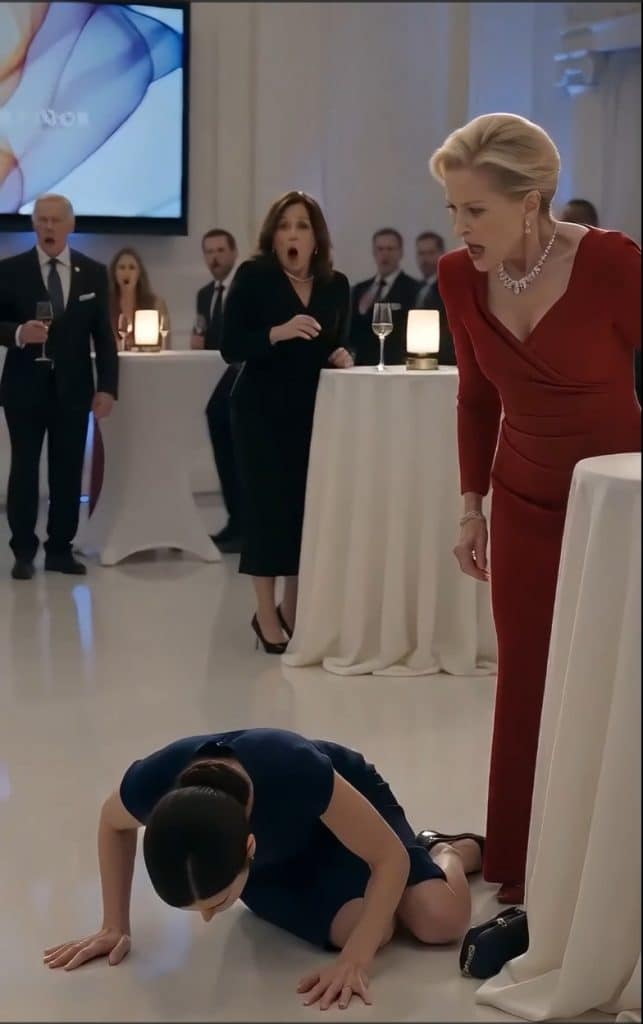
The slap cut through the ballroom before the orchestra knew to stop playing.
For a moment, the whole white room seemed to freeze in pieces: champagne trembling in crystal glasses, doctors turning in their tuxedos, donors pausing beneath glowing screens of children’s faces and surgical success stories. Then Dr. Amelia Marlowe hit the polished floor beside a VIP table, her dark clutch sliding under the white linen as the sound of it skidded into the sudden silence.
No one moved fast enough to help her.
Not the surgeons who had spent their lives moving quickly in emergencies. Not the trustees whose names were printed on the evening program. Not the wealthy guests who had just applauded themselves for caring about people they would never have to meet.
Above Amelia stood Vivian Hartwell, platinum blonde, diamond necklace, red evening gown, and a smile that had turned sharp with rage.
Vivian was one of Boston Memorial’s largest donors.
Everyone in the ballroom knew that.
Everyone also knew what happened to hospital employees who embarrassed her.
Amelia braced one hand on the floor. Her palm stung. Her lip had caught the edge of the blow, and she tasted something metallic, but her expression barely changed. Black hair in a low bun. Sharp eyes. Dark-blue minimalist dress. No visible panic.
That composure made Vivian even angrier.
“You think you can just sit at my table?” Vivian snapped.
Amelia slowly looked toward the place card that had been knocked sideways during the attack.
Dr. A. Marlowe.
It lay half-hidden beneath a fallen napkin.
She reached for it.
Vivian stepped on the edge of the card.
Then she struck Amelia again.
The second slap made someone gasp out loud.
A nurse near the back covered her mouth. A young resident took a step forward, but an older doctor caught his sleeve, warning him without words. In that room, money had a pulse. It moved through wings, grants, fellowships, equipment, promotions.
And Vivian Hartwell had enough of it to make decent people hesitate.
She leaned down toward Amelia, perfume and contempt filling the space between them.
“This table is for people who save lives with money,” Vivian said, her voice carrying across the ballroom. “Not charity trash waiting for pity.”
The words landed colder than the slap.
Amelia did not answer.
She only looked up at Vivian with a stillness that did not belong to humiliation. It belonged to an operating room just before the first incision, when every emotion disappeared and only precision remained.
Vivian saw the look and mistook it for defiance.
“You don’t belong here,” she said.
Across the ballroom, the double doors burst open.
A group of senior doctors entered in a rush, led by a Black man in a tuxedo with a hospital board pin shining against his lapel.
Dr. Marcus Ellison, director of Boston Memorial, stopped when he saw Amelia on the floor.
His face hardened.
And the room finally understood that Vivian Hartwell had made a mistake.
Act II
Dr. Ellison did not look at Vivian first.
That was what destroyed her confidence.
He walked straight past the donor in the red gown, past the frozen champagne servers, past the trustees who had gone pale at their own table. His eyes stayed on Amelia, and by the time he reached her, three senior physicians had formed a protective line behind him.
“Dr. Marlowe,” he said, controlled and furious, “they’re waiting for you.”
The ballroom inhaled all at once.
Vivian’s face changed.
Not fully. Not yet. Her pride fought to hold the shape of superiority, but fear had already slipped beneath it.
“Dr…” she whispered. “Marlowe?”
Amelia rose slowly.
She did not accept the hand of the surgeon beside her. Not because she was ungrateful, but because she had learned long ago that certain rooms needed to watch her stand without assistance.
She straightened her dress. Smoothed one sleeve. Then she bent to retrieve her clutch from beneath the table.
The small act seemed to shame the whole room.
Because everyone had seen it slide away from her.
Everyone had seen her fall.
Everyone had heard the insult.
Vivian forced a laugh.
“There must be some misunderstanding,” she said, her voice suddenly smoother. “I thought she was—”
“A guest you were allowed to strike?” Dr. Ellison asked.
The question cut cleanly.
Vivian’s fake smile flickered.
“I was protecting my table.”
Amelia looked at the place card under Vivian’s heel.
“My table,” she said.
It was the first thing she had said since hitting the floor.
Two words.
Quiet. Flat. Enough.
Vivian looked down, saw the card, and lifted her shoe as if the paper had burned her. A hospital trustee stepped forward and picked it up. The name was clear now.
Dr. Amelia Marlowe
Incoming Chair, Marlowe Center for Surgical Equity
The title moved through the room in whispers.
Marlowe Center.
Some of the guests turned toward the donor screens at the front of the ballroom. The evening’s gala had been built around the announcement of a new surgical equity center, a program designed to fund complex procedures for patients whose insurance companies or bank accounts would otherwise decide their future.
No one had been told the full identity of the physician leading it.
The board had kept that for the stage.
Vivian Hartwell had expected the night to belong to her.
Her family foundation had donated millions to Boston Memorial over the years. Her portrait hung outside the oncology wing. Her name appeared on plaques beside rooms she had never entered except for photographs.
She had arrived that evening believing she was the moral center of the ballroom.
Then she saw a woman in a simple dark dress at the most important table and assumed the worst thing a person like Vivian could imagine.
That the woman had been invited out of pity.
Amelia knew that assumption well.
She had been living under versions of it since she was eight years old, when her mother used to clean offices in the financial district at night and bring home leftover pastries wrapped in napkins. Amelia would sit under a desk with a library book, learning the names of bones while her mother emptied trash cans for men who never looked at her face.
By thirteen, Amelia knew hospitals from the wrong side of the curtain.
By seventeen, she knew what it felt like to translate medical bills for a parent who was too tired to cry.
By thirty-nine, she had become one of the most respected reconstructive surgeons in the country, though she still preferred dark dresses, modest earrings, and rooms where the work mattered more than the name card.
That humility had fooled Vivian.
But it had not fooled the hospital.
And it had not fooled the people waiting behind the ballroom stage.
Dr. Ellison lowered his voice.
“Amelia,” he said, “the board is assembled. The families are waiting. The press is in the east hall.”
Vivian’s eyes snapped toward him.
“The press?”
Amelia looked at Vivian then.
Cold. Composed. Medically authoritative.
“Yes,” she said. “Tonight was never about your table.”
And that was when Vivian began to truly panic.
Act III
The Marlowe Center was not funded by Vivian Hartwell.
That was the secret the hospital had guarded for six months.
Every donor in the room had assumed the new surgical equity center existed because wealthy people had finally decided to be generous. That was how rooms like this protected their pride. They put their names on healing and forgot to ask who had been harmed first.
But the center had been funded by a patent.
Amelia’s patent.
Three years earlier, Dr. Marlowe had developed a low-cost surgical stabilization device for emergency trauma reconstruction. It was simple, durable, and easier for smaller hospitals to use than the expensive systems sold by major suppliers.
Medical companies fought over licensing rights.
Amelia negotiated one condition before she signed.
A portion of every royalty payment would go into a protected fund for patients denied advanced surgical care because they were poor, uninsured, underinsured, undocumented, or simply unlucky enough to be sick in the wrong ZIP code.
The fund grew faster than anyone expected.
By the time Boston Memorial invited her to lead the new center, it had enough money to change thousands of lives.
Vivian Hartwell had not known that.
If she had, she would have smiled, shaken Amelia’s hand, and called her visionary.
That was what made Amelia’s face so cold.
Vivian’s cruelty did not come from a single misunderstanding. It came from a worldview. She respected money only when it looked like hers. She respected medicine only when it thanked her from a stage. She respected suffering only when it arrived dressed properly for a gala.
But there was another secret beneath the center.
One Vivian did know.
Years earlier, before Amelia became famous, before the patent, before the board invitations, she had been a surgical fellow at Boston Memorial. She was brilliant, relentless, and inconvenient. During a routine review, she noticed a pattern in the charity surgery approvals.
Certain patients were being delayed.
Not because doctors refused them.
Because a donor-controlled committee had quietly inserted itself into the process, pressuring administrators to prioritize cases that photographed well, thanked well, and made the hospital look generous at fundraising events.
A child with a complicated spine case waited six months.
A father who needed reconstructive surgery after a workplace accident was denied twice.
A young woman with a rare condition was approved only after a donor gala needed a “patient success story.”
Amelia filed a report.
The report disappeared.
A week later, her fellowship evaluation changed.
Suddenly she was difficult. Cold. Not collaborative. Brilliant but arrogant. The kind of woman senior men warned other rooms about while pretending concern.
The pressure became unbearable.
Amelia left Boston Memorial before they could ruin her name.
Vivian Hartwell was on the donor committee then.
Her signature appeared on three of the meeting summaries Amelia had copied before leaving.
Now, ten years later, the hospital wanted Amelia back.
Not as a fellow.
Not as a grateful former employee.
As the physician with enough reputation, money, and documentation to force the institution to become honest.
The gala was supposed to announce two things.
The opening of the Marlowe Center.
And the independent review of donor influence on patient care.
Vivian had spent the evening believing she was seated near power.
She had not realized power was the woman she knocked to the floor.
Dr. Ellison turned toward the nearest security officer.
“Please preserve the ballroom footage,” he said.
Vivian’s lips parted.
“Marcus,” she said softly, suddenly using his first name, “let’s not make a scene.”
The director’s expression did not move.
“You already did.”
A few people looked up toward the cameras positioned near the donor screens.
Vivian followed their eyes.
Her face went still.
For decades, she had known how to control rooms. She could redirect conversations, bury complaints, pressure boards, replace staff, and turn cruelty into etiquette.
But she could not unslap a woman in front of two hundred witnesses.
She could not pull the insult back out of the air.
And she could not stop Amelia Marlowe from walking to the stage.
Act IV
The orchestra remained silent as Amelia crossed the ballroom.
Every step felt louder than music.
Doctors moved aside for her first. Then donors. Then trustees. The same people who had frozen when she fell now opened a path as if the floor itself belonged to her.
Amelia did not rush.
She passed Vivian without looking at her.
That was the punishment Vivian felt most.
Not anger.
Dismissal.
At the edge of the stage, Dr. Ellison offered his hand. This time, Amelia accepted it, not because she needed help standing, but because the room needed to see the hospital director publicly honor the person Vivian had tried to degrade.
When Amelia reached the podium, the donor screens behind her changed.
The smiling gala photos disappeared.
A black-and-white photograph filled the center screen instead: a little girl sitting in a hospital hallway beside a woman in a cleaning uniform, both asleep beneath harsh fluorescent light.
Amelia looked at it for a long moment.
“My mother worked nights,” she said.
Her voice was steady. No tears. No performance.
“She cleaned offices, hotels, and for a while, a hospital. When she got sick, she apologized to doctors for taking up their time. She believed care was something poor people had to earn by being polite.”
No one moved.
Vivian stood near the VIP table, breathing shallowly.
Amelia continued.
“That belief did not come from nowhere. It was taught. By forms. By waiting rooms. By billing departments. By people who speak of charity as if it is a favor instead of a responsibility.”
The words found every corner of the ballroom.
Some donors lowered their eyes.
Some doctors did too.
“This center exists because skill should not be reserved for the wealthy,” Amelia said. “It exists because a patient should never have to become photogenic to become worthy.”
A quiet sound went through the crowd.
Dr. Ellison stood beside the stage steps, watching Vivian.
The hospital attorney had already moved closer to the trustees’ table with a folder in hand.
Amelia looked directly at Vivian for the first time since taking the podium.
“And tonight, after what happened in this room, I am adding a condition to my partnership with Boston Memorial.”
Vivian stiffened.
The trustees looked up sharply.
Dr. Ellison did not. He already knew.
Amelia placed both hands on the podium.
“The Marlowe Center will not accept restricted gifts from donors who seek influence over patient selection, clinical priorities, or public storytelling. Every legacy donor arrangement connected to surgical access will be reviewed. Every delayed charity case from the last fifteen years will be audited. And any donor found to have interfered with care will have their name removed from hospital spaces funded under false ethics.”
The ballroom went completely silent.
Then someone at a back table began to clap.
Not loudly.
Just once.
Then again.
A nurse joined.
Then a resident.
Then a surgeon who had spent years hating the donor committee but never said so publicly.
The applause grew, not warm and polite like gala applause, but uneven and human.
Vivian turned red.
“This is outrageous,” she said, too loudly.
Her voice cracked over the clapping.
“My family built half this hospital.”
Amelia leaned toward the microphone.
“No,” she said. “Patients did.”
The applause stopped at once, not because it weakened, but because the sentence had landed too deeply for noise.
Amelia’s face remained calm.
“Patients trusted us with their fear. Nurses carried the weight. Doctors gave their hands. Staff kept the building alive. Donors helped. That is different from ownership.”
Vivian looked around for rescue.
No one came.
The board chair stood from the trustees’ table.
“Mrs. Hartwell,” she said, “your foundation’s pending naming agreement is suspended effective immediately.”
Vivian’s diamond necklace shifted against her throat as she swallowed.
“You can’t do that.”
The chair looked at Amelia, then back at Vivian.
“We just did.”
Act V
By midnight, Vivian Hartwell’s portrait was removed from the gala screens.
By morning, Boston Memorial had issued a statement announcing an independent ethics review.
By the end of the week, three donor committees were dissolved.
The hospital did not mention the slap in its official language. Institutions rarely confessed in plain English when shame would do. But the video had already spread beyond the ballroom: Vivian in red, Amelia on the floor, the insult, the doors bursting open, Dr. Ellison’s voice cutting through the room.
“Dr. Marlowe, they’re waiting for you.”
People replayed Vivian’s final stammer again and again.
“Dr… Marlowe?”
They called it a perfect reversal.
Amelia did not.
A perfect reversal would have helped the patients delayed years ago. It would have cleared her name when she was a fellow instead of after she became too successful to dismiss. It would have told her mother, while she was still alive, that needing care was not a moral failure.
But justice was rarely perfect.
Sometimes it arrived late, dressed in a dark-blue gown, with a small mark near its lip and enough evidence to make a ballroom stop smiling.
Two months after the gala, the first Marlowe Center patients arrived.
No cameras were allowed in the consultation rooms.
That was Amelia’s rule.
No donor photographs beside hospital beds. No forced gratitude videos. No children turned into proof that rich people had souls. If a patient wanted to tell their story, they could. If they wanted privacy, they received it without argument.
The center’s first major case was a teenage violinist whose family had been denied coverage twice.
The second was a father from Worcester who had lost the use of his hand after an industrial accident.
The third was a retired cafeteria worker who cried when Amelia told her the surgery would not bankrupt her daughter.
Amelia did not cry with her.
She held her hand.
That was enough.
As the audit continued, more truths surfaced. Emails. Meeting notes. Donor requests written in language polished enough to hide their cruelty. Vivian Hartwell’s name appeared often, not always as the loudest voice, but as the most comfortable one.
She had believed influence was natural.
She had believed access was earned by proximity to wealth.
She had believed charity meant standing above people and deciding who deserved to be lifted.
That belief cost her everything she cared about publicly.
Her foundation lost its hospital privileges. Her naming agreement vanished. Her invitations stopped arriving. The red gown from the gala appeared in headlines for weeks, though Vivian never wore red in public again.
Amelia never gave a dramatic interview about her.
When asked what she wanted to say to the donor who struck her, she answered simply, “Nothing. My work is with patients.”
Still, people inside Boston Memorial remembered.
They remembered the clutch sliding beneath the table.
They remembered the silence after the insult.
They remembered Amelia standing at the podium and redefining ownership in a room full of people who thought money made them holy.
Months later, Dr. Ellison found her alone in the new center before the ribbon-cutting ceremony.
The hallway smelled faintly of fresh paint. The walls were still bare except for one framed photograph near the entrance.
It was not a donor portrait.
It was the black-and-white picture of Amelia and her mother asleep in the hospital hallway.
Dr. Ellison stood beside her.
“She would be proud,” he said.
Amelia looked at the photograph for a long time.
“She would ask if I ate breakfast.”
He laughed softly.
Then the quiet returned.
Outside, guests were gathering. Doctors, nurses, patients, staff, a few carefully selected donors who understood the new rules. There would be speeches, but Amelia had kept them short. She wanted the doors open more than she wanted applause.
Before stepping into the hall, she touched the small clutch she had carried again that day.
The same one from the gala.
Someone had suggested she replace it. She refused.
Not because she wanted to remember Vivian.
Because she wanted to remember the floor.
The cold shock of it. The silence around it. The exact moment a room full of healers forgot what healing required because power had raised its hand.
Amelia walked to the entrance of the Marlowe Center.
This time, when the doors opened, no one looked down at her.
Patients looked up.
Doctors stepped aside.
Nurses smiled.
And on the wall behind her, beneath her mother’s photograph, a line had been engraved in simple black letters:
Care is not charity. It is a promise.
Amelia read it once, then turned toward the waiting crowd.
Her face was composed. Executive. Unshaken.
The same woman Vivian Hartwell had mistaken for someone begging to belong now stood at the center of the hospital’s future.
And when she stepped forward, the room did not make space out of pity.
It made space out of respect.