Act I
The name badge hit the polished black floor before anyone spoke.
It bounced once beneath the glass counter, spun under the spotlight, and landed face-up beside a display case holding watches worth more than most homes.
LAURENT.
The young man wearing the cashier suit stumbled backward into the counter, one hand bracing against the glass. A rare watch inside the case trembled on its velvet stand. Security guards turned sharply. Wealthy shoppers froze between brass-trimmed displays.
Mr. Laurent caught his breath.
A faint red line appeared near the corner of his mouth.
The man who had slapped him lowered his hand slowly, as if even the violence had been expensive.
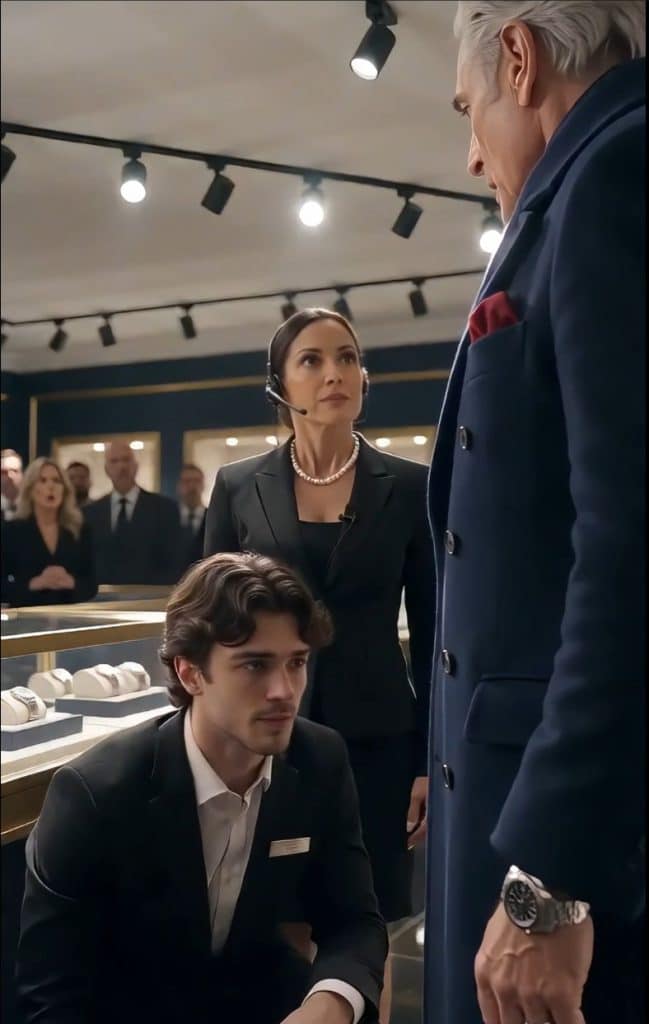
Victor Halden stood in a navy cashmere coat with a red pocket square, silver hair combed perfectly back, and an oversized watch gleaming on his wrist. His face held the disgust of someone who believed rules were for people waiting outside velvet ropes, not men like him.
“You polish watches,” Victor said. “You don’t question men who buy them.”
The boutique went silent.
Behind the counter, Mr. Laurent stayed still, his dark wavy hair falling slightly across his forehead. His white shirt collar had twisted under the black cashier jacket. He looked young, ordinary, and painfully outmatched beneath the spotlights.
That was why Victor had chosen to humiliate him.
Moments earlier, Victor had demanded to handle a rare prototype without gloves, paperwork, or verification. Mr. Laurent had refused quietly.
Not rudely.
Not loudly.
Just refused.
Victor had smiled at first. Then demanded the director. Then leaned closer and said the store existed because men like him spent money in places like this.
Mr. Laurent had answered, “The watch is not available for unauthorized handling.”
That was when Victor struck him.
Now the fallen badge glittered on the floor.
A boutique client in pearls covered her mouth. A sales associate looked toward security, but no one moved fast enough. In luxury spaces, people often waited for permission before defending dignity.
Victor stepped closer.
“I’ve bought watches in Geneva, Paris, and New York,” he said. “I will not be lectured by a cashier with a rented suit.”
Mr. Laurent bent slowly to pick up the badge.
Before his fingers reached it, a door opened near the private office.
The boutique director rushed out.
Amelia Cross moved with controlled urgency, pearl necklace bright against her tailored black suit, headset still clipped near her cheek. Her face went pale when she saw the young man near the floor.
She did not look at Victor first.
She went straight to Mr. Laurent.
“Mr. Laurent,” she said, voice formal and shaken, “your family’s new flagship store is ready for inspection.”
The room stopped.
The camera of every eye shifted from the fallen badge to the glowing Laurent logo on the wall.
Victor’s hand tightened around the strap of his leather portfolio.
“Laurent?” he whispered.
And the young cashier he had slapped slowly rose beneath the name his family had spent generations building.
Act II
Julian Laurent had been raised to distrust velvet ropes.
His grandfather used to say a locked glass case could protect a watch, but it could also reveal the soul of the person standing in front of it.
Henri Laurent had founded the brand in a tiny workshop above a pawn shop in Chicago after immigrating with two suitcases, a broken pocket watch, and a stubborn belief that timepieces should carry memory, not ego. He repaired watches for nurses, factory workers, soldiers, teachers, and bus drivers long before collectors began whispering the Laurent name in auction houses.
His first rule was written on a card taped above the workbench.
Respect the hand before the wrist.
Julian grew up hearing that sentence.
He heard it at family dinners, at factory visits, at quiet Sunday mornings when his father taught him how to open a case back without scratching the metal. A watch, his father said, became meaningful only because someone wore it through a life.
Luxury came later.
Fame came later.
The problem came after that.
By the time Julian was twenty-eight, Laurent had become one of the most desired watch brands in the world. Private collectors waited years for limited pieces. Celebrities borrowed them for award shows. Wealthy men spoke about movements and complications the way other men spoke about bloodlines.
The company grew richer.
But the stores grew colder.
Julian noticed it first as a customer.
He visited boutiques without announcement, dressed plainly, listening to the way sales associates treated people who came in to browse rather than buy. Sometimes he was proud. Sometimes he was embarrassed.
At the Los Angeles flagship, he watched a security guard follow a young couple because their shoes looked worn. In Miami, a salesman laughed after an elderly man asked whether the store repaired older watches that were not rare. In Manhattan, a VIP client ordered an associate to bring him coffee and nobody corrected him.
Julian began writing reports.
The board called them emotional.
His father called them necessary.
But before the family could enforce a company-wide reset, the American division prepared to open its newest flagship in a luxury shopping district. It was meant to be the crown jewel: black floors, brass trim, rare pieces under spotlights, a private viewing salon, and a client list filled with people who measured respect by how quickly doors opened for them.
Julian requested one condition before launch.
He wanted to work the floor anonymously.
Not as an heir.
As a cashier.
The board hated the idea.
His father loved it.
“Your grandfather repaired watches for men who never asked his last name,” he told Julian. “Go learn who still deserves ours.”
So Julian put on a simple black cashier suit, clipped a small badge to his lapel, and reported to the boutique under only one visible name.
Laurent.
Most people assumed it was coincidence, branding, or a staged employee surname.
Victor Halden assumed it meant nothing.
That mistake would cost him more than access to a watch.
It would expose the rot Julian had come to find.
Act III
Victor Halden arrived with a reputation already walking ahead of him.
The boutique had been warned.
Major collector. High annual spend. Private vault owner. Difficult but valuable.
That was how wealthy cruelty often entered buildings: renamed as value.
Victor moved through the store like a man inspecting property he expected to own soon. He barely looked at the junior associate who greeted him. He criticized the lighting near one case. He tapped the glass with one finger until security politely asked him not to.
Then he saw the prototype.
The Laurent Meridian One.
Only three existed.
One for the family archive. One for the museum exhibition in Geneva. One for the inspection event that evening, locked beneath reinforced glass until Julian approved the final display.
Victor’s eyes sharpened.
“I’ll try that one.”
Julian stood behind the counter. “I’m sorry, sir. That piece is not available for handling before the inspection.”
Victor smiled without warmth. “I didn’t ask if it was available.”
Julian kept his voice even. “No prototype may be removed without authorization from the director and family office.”
“Family office,” Victor repeated, amused. “Do you even know what that means?”
“Yes, sir.”
That answer irritated Victor more than ignorance would have.
He wanted fear, confusion, apology. Instead, Julian gave him procedure.
Victor leaned over the counter. “I’ve spent more with this brand than you will ever earn.”
Julian did not move.
“The rule still applies.”
The boutique clients watched from behind champagne displays and velvet seating. A man near the chronograph case looked entertained. A woman whispered that someone should get the director. Security shifted, but not enough.
Victor’s face hardened.
He reached toward the case.
Julian stepped between his hand and the lock.
“No, sir.”
The slap came so fast the room seemed to break around it.
Julian hit the counter, the badge tore from his jacket, and the rare watches trembled beneath the glass.
Victor’s insult followed.
You polish watches. You don’t question men who buy them.
For one second, Julian felt the sting in his face before he felt the humiliation.
Then he saw the badge on the floor.
Laurent.
His grandfather’s name.
His father’s name.
His own.
Victor had not merely struck an employee. He had struck the idea that anyone behind a counter could have authority over a man carrying a platinum client card.
Julian stayed quiet.
Not because he was afraid.
Because Victor was still speaking, and every word was evidence.
Then Amelia Cross arrived.
She had directed Laurent boutiques for fourteen years. She knew collectors, billionaires, celebrities, and men who thought a watch made them immortal. She also knew Julian from the factory floor, where he had spent summers cleaning gears under a master watchmaker who refused to treat him like an heir.
When Amelia saw him bleeding slightly beside the counter, her horror was immediate.
But she understood one thing.
This was not a moment to hide.
It was a moment to reveal.
“Mr. Laurent,” she said, “your family’s new flagship store is ready for inspection.”
The room turned toward the logo.
Victor finally read the badge.
And the silence became a machine closing around him.
Act IV
Victor tried to laugh.
It was a poor imitation of confidence.
“Mr. Laurent,” he said, adjusting his coat. “My apologies. I assumed you were store staff.”
Julian picked up the badge from the floor.
He looked at the dented clasp, then back at Victor.
“I was store staff.”
Victor’s smile faltered.
Julian clipped the badge carefully back onto his jacket.
“That is why your behavior was honest.”
A murmur moved through the boutique.
Victor’s jaw tightened. “This is being exaggerated. I asked to view a piece. Your employee refused. Things became heated.”
Amelia stepped forward.
“Security footage will be preserved,” she said. “All case audio, floor cameras, and client interaction logs.”
Victor’s eyes flicked toward the ceiling cameras.
That glance told Julian enough.
A security guard moved closer, no longer uncertain. The sales associates stood straighter. Clients looked from Victor to the young man they had mistaken for powerless.
Julian touched the corner of his mouth once, then lowered his hand.
“You wanted the Meridian One,” he said.
Victor swallowed. “I am a serious collector.”
“No,” Julian said. “You are a man who mistakes possession for respect.”
Victor flushed. “I have supported this brand for years.”
“You have purchased from it,” Julian replied. “That is not the same thing.”
The words landed cleanly.
Amelia held a tablet in both hands. “Mr. Halden’s client profile includes three prior complaints from staff across two boutiques.”
Victor turned sharply. “Those were misunderstandings.”
Julian looked at her. “Read them.”
Amelia hesitated only a second.
Then she read.
A Geneva associate insulted for refusing after-hours access. A Miami security guard threatened after enforcing a photography restriction. A New York sales consultant reduced to tears after Victor accused him of being “too common” to explain complications.
The boutique listened.
Victor’s face darkened. “Private client notes are confidential.”
“So was your contempt,” Julian said. “Until you made it public.”
A woman client near the pearl display spoke quietly.
“I saw him hit you.”
Another customer added, “He reached for the case first.”
The man near the chronograph display looked down, ashamed now that the entertainment had become testimony.
Victor’s voice lowered. “Be careful. Collectors talk.”
Julian nodded.
“Yes. They do.”
He turned toward Amelia.
“Cancel Mr. Halden’s Meridian allocation. Suspend all pending service privileges. Remove him from the inspection list and forward the footage to legal.”
Victor stared at him. “You can’t blacklist me.”
Julian’s voice remained calm.
“I can protect the people who work under my family’s name.”
Victor took one step closer, then stopped when security moved.
His oversized watch flashed under the light.
For the first time, it looked less like status and more like costume.
Julian looked at it.
“My grandfather would have repaired that watch with care,” he said. “Even if you walked into his shop with no money. That was his standard.”
Victor’s lips parted.
Julian’s eyes hardened.
“You walked into ours with plenty and showed none.”
Act V
Victor Halden left the boutique without the watch he came for.
Security did not drag him.
That would have given him a story to tell.
Instead, he walked out under the Laurent logo while every client watched him pass the glass cases he would no longer be invited to open. His polished shoes clicked across the black floor. The brass door closed behind him with a soft final sound.
The boutique remained still after he was gone.
Luxury spaces often recovered quickly from unpleasantness. A fresh glass of champagne. A smoother smile. A whispered assurance that everything was handled.
Julian refused to let this one recover too fast.
He stood in the center of the store with the small badge still crooked on his jacket.
“Everyone stays,” he said.
No one argued.
Not the clients.
Not the staff.
Not even the security guards.
He turned first to the youngest sales associate, a woman who had been standing near the strap display with tears in her eyes.
“What is your name?”
“Maribel,” she said softly.
“Has anyone spoken to you like that here?”
Her face tightened.
That was answer enough.
Julian looked around. “Has anyone been told to tolerate abuse because the client spends well?”
The silence was full.
Amelia closed her eyes briefly.
Julian understood.
The boutique had not failed because Victor Halden was cruel.
The boutique had failed because too many systems had learned to price cruelty before stopping it.
That changed that evening.
The inspection did not begin with champagne or speeches. It began with staff testimony. Associates spoke about clients who snapped fingers, mocked accents, touched displays without permission, and threatened careers over rules they disliked. Security guards admitted they were often told to protect watches faster than people.
Julian listened to all of it.
Then he called his father.
By morning, Laurent issued a new global client conduct policy.
No purchase history could override staff safety. No VIP status could excuse harassment or physical misconduct. Any client who threatened, touched, or degraded employees would lose access to allocations, private previews, and service privileges.
Collectors exploded.
Forums filled with outrage. Men who owned safes full of watches complained about being treated like schoolchildren. One anonymous post claimed Laurent had “forgotten who keeps the brand alive.”
Julian answered through an official statement.
The people who craft, sell, repair, and protect our watches keep the brand alive. Clients are welcome to join that respect, not replace it.
The statement traveled further than any marketing campaign.
Some buyers left.
Better ones arrived.
Months later, the flagship reopened after its formal launch. The black floors shone. The brass trim gleamed. Rare watches sat beneath spotlights like small planets of metal and time.
But the store felt different.
Not less luxurious.
More awake.
A framed card appeared behind the main counter, copied from the old workshop above the pawn shop.
Respect the hand before the wrist.
Clients asked about it often.
Staff answered with pride.
Julian continued visiting stores anonymously, though it became harder after the Halden incident spread through private circles. Sometimes people recognized him immediately and became charming. That did not impress him.
He watched how they spoke to the doorman.
How they handed empty glasses to attendants.
How they reacted when told no.
That was where character lived.
One afternoon, months after the slap, Julian returned to the flagship in a simple sweater and no badge. Near the entrance, a teenage boy stood with his father, staring at a modest vintage repair display rather than the rare pieces.
His jacket was worn at the cuffs.
His father looked nervous, as if expecting to be asked to leave.
Maribel approached them.
Not with suspicion.
With warmth.
“Beautiful piece,” she said, nodding toward the old watch on the father’s wrist. “Would you like us to take a look at it?”
The father blinked. “It’s not expensive.”
Maribel smiled.
“That doesn’t mean it isn’t valuable.”
Julian looked down.
For a moment, he saw his grandfather’s workshop.
The pawn shop stairs. The card above the bench. The belief that time meant nothing unless it held someone’s life with care.
Amelia appeared beside him.
“You’re smiling,” she said.
“Don’t report it to the board.”
“I might. It’s rare.”
He laughed softly.
Then his gaze drifted toward the spot near the glass counter where his badge had fallen.
The floor had been polished clean.
No mark remained.
But Julian remembered everything.
The slap.
The clatter.
Victor’s voice telling him he had no right to question men who bought watches.
The word that had left Victor pale.
Laurent?
That had not been the real reveal.
The real reveal came before that, when Victor saw a cashier and decided dignity was optional.
Julian turned toward the glowing logo on the wall.
His family name looked elegant there. Clean. Expensive. Powerful.
But he knew names were only metal until someone lived up to them.
So he stepped behind the counter, rolled up his sleeves, and helped Maribel prepare the old watch for inspection.
The boy watched, amazed.
The father relaxed.
And beneath the quiet spotlights of the most exclusive watch boutique in the district, Julian Laurent remembered the truth his grandfather had carried across an ocean with a broken pocket watch in his hand.
A timepiece may tell you the hour.
But the way a person treats the one behind the counter tells you who they are.