Act I
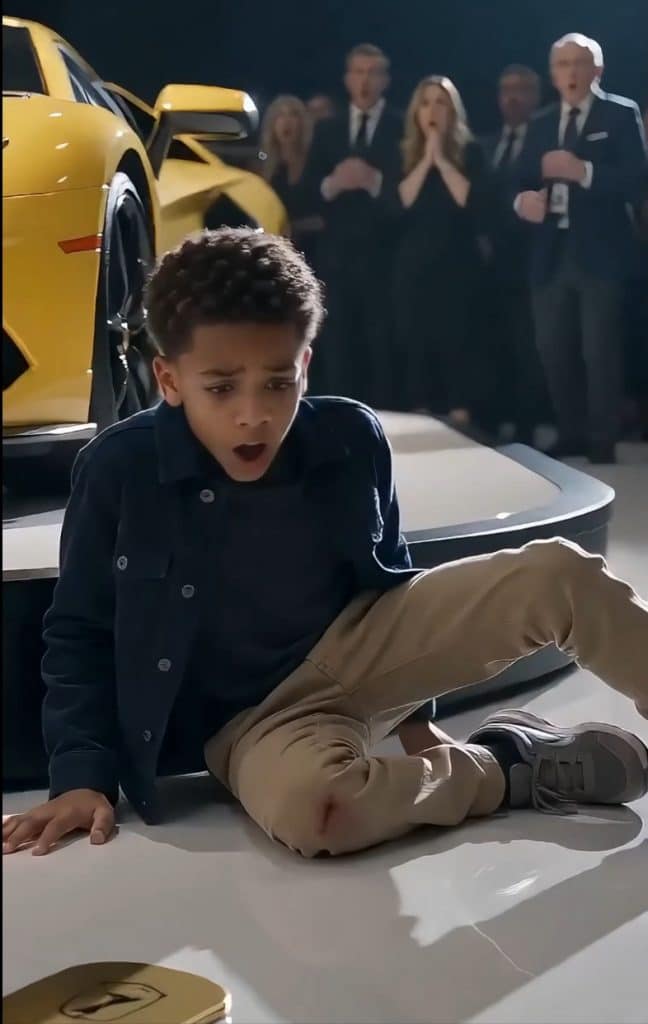
The gold paddle hit the showroom floor before the boy did.
It clattered once against the glossy white tile, spun beneath the bright auction lights, then slid to a stop beside the raised Lamborghini platform. A second later, the twelve-year-old boy stumbled backward from the slap and fell hard in front of the crowd.
Gasps rippled through the room.
No one moved.
The luxury supercar auction had been polished into perfection. Rare Ferraris glowed under spotlights. Lamborghinis sat like jewels on black platforms. A Rolls-Royce display gleamed beneath a wash of gold light. Wealthy collectors stood in tailored suits, holding champagne and auction paddles, speaking in low voices about engines, provenance, and investment value.
Then one man decided a child did not belong there.
The boy’s name was Caleb Bennett.
He wore a plain navy jacket, khaki pants, and sneakers. His short curls were neat, his eyes bright even through the shock. His sleeve had torn slightly at the elbow when he hit the floor, and one knee had scraped against the polished tile.
He did not cry.
That seemed to annoy the man standing over him.
Graham Whitlock, one of the most feared collectors on the American auction circuit, adjusted the cuff of his burgundy blazer as if the slap had inconvenienced him more than the child. His gray hair was slicked back. His watch glittered under the lights. His smile was not gone, only sharpened.
“A kid like you couldn’t even afford the tires,” he said.
The insult drew a few uncomfortable breaths from the crowd.
Caleb stayed low, one hand braced against the floor, his gaze moving toward the gold paddle lying out of reach. The private bidder number stamped across it caught the light for half a second.
Graham saw the paddle too.
He laughed.
“That isn’t a toy.”
Caleb lifted his eyes.
“It’s mine.”
The answer was quiet.
Too quiet for Graham’s taste.
He stepped closer, casting a shadow over the boy and the fallen paddle.
“You wandered into the wrong room, son. This auction is for collectors. Serious buyers. People who understand what they’re touching.”
Caleb looked past him, toward the car on the platform.
A vintage Lamborghini Miura in deep orange paint, its curves shining beneath the spotlights like fire held still.
He knew that car.
Not from posters.
Not from videos.
From a photograph in his grandfather’s study.
Graham followed his gaze and smirked.
“Don’t look at it like that. Cars like this don’t belong to children.”
The auction crowd remained frozen.
The boy slowly pushed himself up, his face still marked by humiliation, his small hand tightening at his side.
Then the bidding screen behind the Lamborghini flickered.
A new update flashed across the giant display.
And the auction manager came down from the podium so quickly that everyone turned.
Act II
The auction manager moved like a man who had just watched a disaster unfold in slow motion.
His black tuxedo was immaculate, his headset clipped neatly against one ear, his tablet gripped in one hand. A minute earlier, he had been directing bids with smooth professionalism from the podium. Now his face had gone pale.
“Clear the platform,” he said sharply to a nearby attendant.
The attendant stepped aside at once.
Graham turned, irritated.
“Finally,” he said. “Remove this child before he damages something.”
The auction manager did not answer him.
He walked directly to Caleb.
That was the first crack in Graham’s confidence.
The second came when the manager lowered himself slightly, not quite kneeling, but enough to meet Caleb with respect rather than authority.
“Young Mr. Bennett,” he said, voice clear enough for the entire showroom to hear, “your grandfather asked us to prepare your winning bid.”
The room stopped breathing.
Behind them, the giant bidding screen completed its update.
BENNETT FAMILY TRUST.
WINNING BIDDER.
The words glowed above the Lamborghini platform.
The crowd erupted into whispers.
Someone dropped a champagne flute onto a tray with a sharp clink. A woman in a cream suit covered her mouth. Two men near the Ferrari display exchanged a look of pure panic, as if they had just realized they had laughed too soon.
Graham Whitlock froze.
His smug collector’s smile disappeared.
“Bennett?” he whispered.
Caleb stood slowly.
The auction manager retrieved the gold paddle from the floor and held it out with both hands. That small gesture did more to silence the room than any announcement could have. A grown man who controlled access to some of the rarest cars in the country was returning a child’s paddle like it belonged to royalty.
Caleb took it.
His fingers were steady.
“Thank you, Mr. Lawson,” he said.
The auction manager’s expression tightened with regret.
“I am deeply sorry, sir.”
Graham’s face changed again.
Sir.
The boy he had slapped was being addressed as sir.
Caleb looked toward the screen, then toward the car. He did not smile. He did not gloat. He looked like a child trying very hard to remain composed while adults learned what they should have known before hurting him.
Graham forced a laugh.
“This is absurd. He’s twelve.”
Caleb turned to him.
“My grandfather said age doesn’t stop people from owning things,” he said quietly. “But it should stop adults from hitting children.”
The showroom went silent.
Not shocked this time.
Ashamed.
And Graham Whitlock finally understood that the slap had not put the boy in his place.
It had put himself on display.
Act III
The Bennett name had lived in American automotive history long before Caleb was born.
His great-grandfather had built engines in Detroit when factories still sounded like thunder. His grandfather, Elias Bennett, had started as a mechanic’s apprentice, then became a restorer, then a collector, then the quiet force behind one of the most respected family trusts in the classic car world.
But Elias Bennett was not like men such as Graham Whitlock.
He did not collect cars to dominate rooms.
He collected them because machines held memory.
The first car he ever restored was a rusted Corvette found behind a closed gas station. The second was a Ferrari nobody believed could be saved. By the time Elias became wealthy, he had learned something money often makes people forget: anything beautiful can be ruined by arrogance.
Caleb grew up in his grandfather’s workshop.
Not the museum garage where visitors came to admire polished vehicles behind ropes. The real workshop. The one with oil stains on the floor, labeled bolts in coffee cans, half-finished engines, and old radios playing blues music on rainy afternoons.
Elias taught him how to listen to cars.
Not just engines.
Stories.
“This one belonged to a doctor who drove it to house calls,” he once told Caleb, patting the hood of an old Jaguar.
“This one was hidden during a divorce,” he said another time.
“This one,” he whispered beside the orange Lamborghini, pointing at a framed photograph, “was the one I let get away.”
The Lamborghini Miura belonged once to a Black race engineer named Malcolm Price, a friend of Elias’s from the early days. Malcolm had helped tune performance cars for men who would later pretend he had only held tools. He never got rich from his knowledge. He was pushed out, underpaid, and forgotten in the official stories.
But Elias remembered him.
The orange Miura had been Malcolm’s dream car. For one brief year, he owned it. Then debt, illness, and a dishonest dealer forced him to sell it under pressure. Elias tried to buy it back for him, but by the time he had the money, the car had vanished into private collections.
Decades later, the Miura surfaced at auction.
Elias was too ill to attend.
So he sent Caleb.
Not because Caleb was spoiled.
Because Caleb understood why the car mattered.
The Bennett Family Trust had registered him as representative bidder under private authorization. The documents were complete. The payment guarantee had been cleared. The auction house knew.
Most of the crowd did not.
Caleb had arrived early with a security liaison who stepped away to resolve paperwork near the entrance. Caleb asked if he could see the Lamborghini up close.
He carried the gold paddle carefully.
He stood near the platform without touching the car.
That was when Graham saw him.
Graham Whitlock had wanted the Miura for years. Not for the story. Not for Malcolm Price. Not even for Elias Bennett.
He wanted it because other collectors wanted it.
To him, rarity was not beauty.
It was victory.
And when he saw a Black boy standing beside the Lamborghini with a gold paddle in hand, he did not see a registered bidder.
He saw an insult to the hierarchy he believed made rooms like this work.
So he stepped in.
He grabbed the edge of Caleb’s paddle, sneered at his clothes, and accused him of pretending to bid.
Caleb said, “Please let go.”
Graham slapped him.
And now, under the spotlights, the entire auction house was about to learn what kind of man the car world had been applauding.
Act IV
The auction manager, Marcus Lawson, turned toward the crowd.
“This auction is paused,” he announced.
A wave of murmurs rolled across the showroom.
Graham’s eyes widened.
“You cannot pause a live auction because of a misunderstanding.”
Marcus looked at him.
“A misunderstanding?”
Graham swallowed.
“I thought he had taken someone’s paddle.”
“You thought,” Marcus said carefully, “a child with valid registration, standing beside a car his family had already cleared to bid on, was stealing because you did not believe he belonged here.”
The words were polished, but they cut deep.
Graham’s jaw tightened.
“Be careful.”
Marcus’s expression hardened.
“No, Mr. Whitlock. You be careful.”
Security moved closer from the edge of the room.
Caleb noticed them and looked down at the paddle in his hand. He did not want the room to become louder. He did not want people staring at the tear in his sleeve or the mark on his knee. He wanted his grandfather beside him. He wanted the workshop smell of motor oil and old radios. He wanted adults to stop turning every wound into a spectacle.
Marcus seemed to sense it.
He lowered his voice.
“Young Mr. Bennett, would you like to step into the private room?”
Caleb looked toward the Lamborghini.
“No,” he said.
The answer surprised everyone.
Caleb straightened his shoulders.
“My grandfather told me not to leave rooms when people try to shame me out of them.”
The crowd went still.
Graham stared at him, stunned by the composure he had mistaken for weakness.
Then a new voice came from near the entrance.
“Elias said that often.”
An elderly Black woman walked into the showroom with a cane of her own, silver hair pinned beneath a black hat. She wore a tailored cream coat and a Bennett Family Trust pin at her lapel.
Caleb’s face softened.
“Grandma Ruth.”
Ruth Bennett crossed the floor slowly, but the crowd parted fast.
She stopped beside Caleb and touched his shoulder gently.
Then she looked at Graham.
“You struck my grandson.”
Graham’s lips parted.
“I didn’t know who he was.”
Ruth’s eyes narrowed.
“That is not a defense. That is the confession.”
The showroom absorbed the sentence.
Ruth turned to Marcus.
“Is our bid confirmed?”
“Yes, Mrs. Bennett,” Marcus said. “The Bennett Family Trust is the winning bidder.”
“Good.”
She looked at Caleb.
“Then finish what your grandfather sent you here to do.”
Caleb nodded.
Marcus stepped back toward the podium, but Ruth lifted one hand.
“And one more thing,” she said.
The room waited.
Ruth looked at the Lamborghini beneath the lights.
“My husband is buying this car in memory of Malcolm Price, the engineer who once owned it and was never given credit in the records attached to this auction.”
Several collectors shifted uncomfortably.
Graham looked away.
Ruth continued.
“The sale will be completed only after the provenance file is corrected.”
Marcus’s face changed.
He knew that name.
So did a few others.
Because the omission had not been an accident. It had been convenient. A car was worth more, in certain circles, when its story stayed attached to wealthy owners and not the Black engineer who made it sing.
Graham’s panic deepened.
He had built his own bid around the old provenance file.
A file that erased Malcolm.
A file that now looked as ugly as the slap.
Act V
Security escorted Graham Whitlock away from the platform.
He did not fight.
Men like him rarely did when the room stopped protecting them.
He tried explanations instead.
“I overreacted.”
“I was protecting the integrity of the auction.”
“I never meant to hurt the boy.”
Ruth Bennett listened to none of it.
Caleb watched only for a moment, then looked back at the Lamborghini.
The car’s orange paint glowed under the spotlights. To the crowd, it was a trophy. To Graham, it had been proof of superiority. To Elias Bennett, it was unfinished business.
To Caleb, it suddenly felt like a promise.
Marcus returned with the sale documents and a corrected provenance addendum already being drafted by the auction house legal team. The giant screen changed again.
BENNETT FAMILY TRUST.
ACQUIRED IN HONOR OF MALCOLM PRICE.
A different sound moved through the room then.
Not shock.
Respect.
A few people clapped, uncertain at first. Ruth did not encourage it. Caleb did not need applause from people who had waited to see whether he mattered before deciding he deserved protection.
Instead, he walked to the edge of the platform.
“Can I see it?” he asked.
Marcus nodded.
“Of course, sir.”
A specialist opened the rope barrier and guided Caleb closer. This time, no one stopped him. No one laughed. No one asked if he could afford the tires.
Caleb stood beside the Lamborghini and placed one hand near, but not on, the door.
He imagined Malcolm Price behind the wheel. He imagined his grandfather searching auction records late into the night. He imagined the car returning not as a prize, but as a piece of history repaired at last.
Ruth stood behind him.
“Your grandfather will be proud,” she said.
Caleb looked at his torn sleeve.
“He’ll be mad about this jacket.”
Ruth smiled faintly.
“He will say jackets can be fixed. Character is harder.”
Across the room, the crowd had grown quieter. The bystanders who had done nothing during the slap now stood with the discomfort of people who understood that silence had been part of the scene.
Marcus approached Caleb again.
“Young Mr. Bennett,” he said, “on behalf of the auction house, I apologize. We failed to protect you before we recognized you.”
Caleb looked up at him.
“You should protect kids even if you don’t know their name.”
Marcus bowed his head.
“You’re right.”
That line traveled farther than any bid that night.
Within twenty-four hours, Graham Whitlock was banned from every major auction operated by the house. His collector memberships came under review. Videos from the showroom circulated privately before lawyers contained what they could, but the damage to his reputation had already been done.
More importantly, the auction house changed its rules.
Minor bidders representing trusts would be assigned visible protection from entry to exit. Harassment would trigger automatic suspension. Provenance files would require expanded historical review, especially for vehicles connected to overlooked engineers, mechanics, racers, and builders whose names had been stripped from the record.
The Miura returned to the Bennett estate two weeks later.
Elias Bennett was waiting in his wheelchair outside the workshop when the covered transport arrived. Caleb stood beside him, wearing a new jacket but holding the same gold paddle.
When the cover came off, Elias did not speak for a long time.
His hand trembled against the armrest.
Then he whispered, “Hello, Malcolm.”
Caleb looked at him.
“You got it back.”
Elias shook his head.
“We got his name back. The car is just how we carried it home.”
Months later, the Miura appeared at a public exhibition curated by the Bennett Family Trust.
Not behind velvet ropes for collectors only.
The display welcomed students from trade schools, young mechanics, families, and anyone who wanted to understand the hands behind the machine. Beside the car stood a large panel about Malcolm Price, his engineering work, and the people who tried to erase him.
At the bottom was a smaller note.
Recovered by Elias Bennett and Caleb Bennett.
Caleb stood in the corner on opening day, watching a group of children crowd around the display. One boy pointed at the Miura and asked if someone like him could build cars too.
Caleb smiled.
“My grandfather says cars don’t care where you come from,” he said. “They care if you listen.”
The boy grinned.
That evening, after the crowd left, Caleb walked alone to the Miura.
The showroom was quiet now.
No Graham Whitlock.
No cruel laughter.
No gold paddle clattering across the floor.
Only the car, the lights, and the restored name beside it.
Caleb looked at his reflection in the orange paint.
He no longer saw the boy who had been knocked down beside a Lamborghini.
He saw the one who stood back up while the screen behind him told the truth.
And somewhere, in the silence of that room, history sounded like an engine finally turning over.