Act I
The watch box rattled before the room understood the violence.
Its velvet-lined glass lid trembled on the long dining table, the rare pieces inside shifting only slightly beneath the golden lamps. A champagne flute tipped against a catalogue and stopped just before spilling over the printed title.
Mori Private Collection.
Then Madam Mori fell back into a dining chair.
The slap had turned her face sharply, and the grip on her wrist left a faint red mark against her skin. A small mark appeared near her lip, but she did not cry out. She only caught the chair arm with one hand, breath controlled, black hair still pinned low, pearl earrings shining quietly beneath the light.
The five-star hotel dining room froze.
Collectors in tuxedos stopped mid-conversation. Servers in white jackets held still near the wall. Watch specialists lowered their eyes from the displays. Along the table, rare watches rested beneath glass like tiny kingdoms of gold, steel, and time.
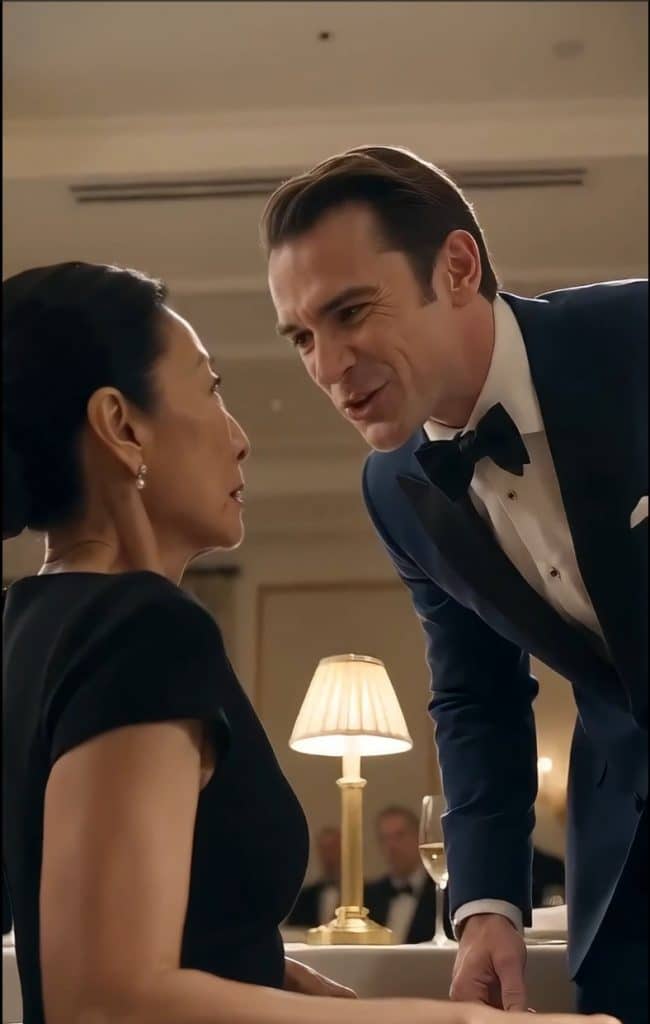
The man standing over her wore a midnight-blue tuxedo and a heavy watch that looked more like a declaration than an instrument.
Victor Harlan.
A collector famous for outbidding museums, humiliating specialists, and calling himself a guardian of taste.
He looked down at Madam Mori with open disgust.
“Collectors inherit taste,” he said, voice sharp enough to cut through the room. “Trash like you only wipes fingerprints off the glass.”
No one breathed.
Madam Mori remained seated, one hand on the chair arm, the other resting near the edge of the table. Her expression did not collapse into fear. It settled into something colder.
Distance.
As if Victor had not wounded her dignity, but revealed the limits of his own.
He leaned closer.
“Do you even know what you almost touched?”
Her eyes moved to the glass watch box.
Inside, under warm light, lay a slim platinum watch with a cracked ivory dial and blue hands thin as breath.
She knew every scratch.
Every repair.
Every silence it had survived.
At the head of the table, a chair scraped loudly.
The collectors’ chairman, Harold Pembroke, rose so quickly his napkin fell to the floor. Silver hair, glasses, ceremonial watch club pin, black tuxedo suddenly stiff with horror. He hurried down the length of the table, face pale.
Victor turned, irritated.
“Harold, this woman was mishandling the collection.”
The chairman ignored him.
He stopped beside Madam Mori and bowed his head slightly.
“Madam Mori,” he said, voice formal and ashamed, “your family’s collection is the centerpiece of tonight’s dinner.”
The dining room went silent.
A catalogue opened on the table as if moved by fate.
Mori Private Collection.
Victor’s face emptied.
“Mori?”
Madam Mori slowly stood.
Act II
Keiko Mori learned time from a watch that no longer kept it.
It sat in a small lacquer box on her grandfather’s desk in San Francisco, wrapped in blue silk and handled only when he was in a mood quiet enough for memory. The watch had a cracked ivory dial, platinum case, and hands that had stopped at 4:17 long before Keiko was born.
When she was eight, she asked him why he kept a broken thing.
Her grandfather looked at her for a long time.
“Because some things stop working,” he said, “but they do not stop speaking.”
His name was Hiroshi Mori.
He was not born rich. He was born in California to parents who lost almost everything during the war, then rebuilt their lives with patience so disciplined it looked like silence. Hiroshi repaired watches in a narrow shop between a dry cleaner and a grocery store. He worked under a lamp for twelve hours a day, restoring other people’s heirlooms while wearing a plain steel watch he had bought secondhand.
People trusted him with expensive things before they trusted him with respect.
He noticed that.
Keiko noticed it too.
She grew up behind the counter, listening to customers speak loudly when they thought her grandfather did not understand luxury because he worked with tools instead of wearing diamonds. Men in suits dropped watches onto felt pads and said, “Be careful with that,” as if his hands had not saved pieces their grandfathers had neglected.
Hiroshi never argued.
He repaired the watch.
Returned it perfect.
Then bowed just enough to remain unreadable.
But privately, he collected time.
A watch from a Japanese American doctor who carried it through military service. A pocket watch from a Black railway worker whose grandson could not afford the restoration, so Hiroshi did it for free and kept a photograph instead of payment. A woman’s art deco watch rescued from a pawnshop because he recognized the engraving of a long-forgotten suffrage club.
The Mori collection did not begin as a display of wealth.
It began as a rescue mission.
Each piece held a story about survival, labor, exile, ambition, love, and the fragile arrogance of people who believed time belonged to them.
Keiko inherited that belief before she inherited anything else.
By thirty, she had turned the small family collection into one of the most respected private horological archives in the world. She bought carefully, restored ethically, and refused to sell pieces to collectors who treated history like a mirror for their ego.
That made her admired.
It also made her disliked.
Men like Victor Harlan wanted access to the Mori name because it meant seriousness. If a watch passed through Mori hands, it gained credibility no amount of money could fake. Victor had tried for years to acquire the platinum watch with the cracked dial, the one Hiroshi called The 4:17.
Keiko refused every offer.
The watch was not for sale.
Not yet.
Tonight’s dinner was meant to announce a traveling exhibition and scholarship fund for young watchmakers from underrepresented backgrounds. Keiko had agreed to lend the collection for viewing before select collectors, specialists, and donors, but only if the evening’s purpose remained education, not conquest.
She arrived quietly.
No entourage.
No security around her body.
No announcement.
An elegant minimal black dress, pearl earrings, calm eyes, and the quiet expensive presence of a woman who had nothing to prove to people trained to mistake noise for power.
She wanted to see how the room treated the watches when it thought only staff were watching.
More importantly, she wanted to see how it treated the staff.
Victor Harlan noticed her near the display box before the first course.
He saw an Asian American woman standing quietly beside glass, one finger near the latch, and decided she must be there to polish what men like him had gathered to own.
He did not ask her name.
He did not ask why she was there.
He decided her place for her.
And in rooms built around expensive objects, that mistake often reveals the cheapest soul.
Act III
The first offense, according to Victor, was that Keiko touched the catalogue.
It lay open beside the display box, cream pages printed with photographs of the watches under glass. Keiko noticed one caption had been placed beside the wrong reference number. A small error. Harmless to most guests, but not to her.
The watch pictured belonged to her grandmother.
The caption belonged to a banker’s chronograph.
Keiko turned the page back and placed one finger lightly under the printed line.
A server nearby saw her and whispered, “Madam, would you like me to call the coordinator?”
Keiko gave a small nod.
Before the server could move, Victor’s voice cut in.
“What are you doing?”
Keiko looked up.
Victor stood across the table, heavy watch flashing under his cuff.
“There is an error in the catalogue,” she said.
His eyebrows lifted.
“And you are qualified to correct it?”
“Yes.”
The simplicity of her answer irritated him.
He glanced at the server.
“Is she with the hotel?”
The server hesitated.
That hesitation cost the room its courage.
Keiko watched him struggle between truth and hierarchy. He knew she was important because the event coordinator had whispered her name earlier. But Victor was a major donor, a club member, a man who could make complaints travel faster than explanations.
Keiko spared him.
“I am a guest,” she said.
Victor smiled.
It was not amusement.
It was permission he gave himself to be cruel.
“A guest does not hover over display cases before dinner.”
Keiko’s eyes stayed calm.
“A serious guest reads before speaking.”
A few collectors near the table went still.
Victor’s face tightened.
“I know this collection.”
“No,” Keiko said softly. “You know its market.”
That sentence reached exactly the wrong part of him.
Victor stepped around the table.
“You people always confuse sentiment with knowledge.”
Keiko’s expression cooled.
“You people?”
“Technicians. Appraisers. Assistants. Anyone allowed near beautiful things long enough to imagine proximity equals taste.”
The server looked down.
A specialist near the wall swallowed hard.
Keiko closed the catalogue.
The motion was careful.
Final.
Victor saw her fingers near the display box and grabbed her wrist.
Hard.
“Don’t touch that.”
The glass rattled.
Keiko tried to pull back.
He slapped her.
The sound cracked through the dining room.
A chair jolted behind her as she fell into it. The watch box trembled but stayed intact. Gasps broke from the collectors and servers, then died under the terrible weight of disbelief.
Victor stood over her, breathing hard.
“Collectors inherit taste,” he said. “Trash like you only wipes fingerprints off the glass.”
Keiko’s wrist stung.
Her lip burned.
But her eyes went first to the platinum watch inside the box.
4:17.
Her grandfather’s broken watch.
The one he had kept because some things stopped working but did not stop speaking.
In that moment, it spoke clearly.
This room had forgotten what it was supposed to honor.
Then Harold Pembroke rose from the head of the table.
The old chairman had watched the exchange with slow-building alarm, but the slap broke through the etiquette that had trapped everyone else. He hurried down the table with shame written across his face.
Because he knew what Victor had not bothered to learn.
The woman he had struck was not guarding the Mori collection.
She was the reason it existed.
Act IV
Harold reached Keiko and lowered his posture with trembling respect.
“Madam Mori,” he said, “are you hurt?”
The title moved through the dining room like the ticking of a hundred clocks suddenly heard at once.
Madam Mori.
A specialist near the wall inhaled sharply.
A collector at the far end whispered, “That’s Keiko Mori?”
Victor froze.
Keiko stood slowly without taking Harold’s arm, though he offered it. She smoothed the front of her black dress, adjusted one pearl earring, and rested her faintly reddened wrist beside the catalogue.
Her face had changed.
Not into anger.
Into altitude.
She looked at Victor from a height money could not reach.
Harold turned to the room, voice formal and heavy with embarrassment.
“Ladies and gentlemen, Madam Keiko Mori is the owner and steward of the Mori Private Collection. Her family’s watches are the centerpiece of tonight’s dinner and the foundation of the scholarship announcement.”
The silence deepened.
Victor’s mouth moved once before sound came out.
“I didn’t know.”
Keiko looked at him.
“No.”
He swallowed.
“I mean, I didn’t know you were Mori.”
“That was never the problem.”
The words were quiet.
Every person heard them.
Victor’s face flushed.
“I thought she was interfering with the display.”
A server near the wall spoke before fear could stop him.
“She was correcting the catalogue.”
The room turned.
The young server went pale, but Keiko looked at him once, steady and approving.
Victor’s jaw tightened.
“This is being exaggerated. I was protecting an irreplaceable collection.”
Keiko opened the catalogue to the incorrect caption.
“You were protecting your fantasy of belonging to it.”
A few collectors lowered their eyes.
Harold removed his glasses and rubbed the bridge of his nose.
“Mr. Harlan, your membership privileges are suspended pending review.”
Victor stared at him.
“You cannot be serious.”
“I am.”
“I have supported this club for fifteen years.”
Keiko looked toward the watch on his wrist.
“And yet it taught you nothing about time.”
The sentence landed with elegant cruelty.
Victor’s hand twitched toward the heavy watch he wore so proudly.
Harold’s voice hardened.
“Hotel security will escort you from the dinner.”
Victor’s face sharpened with panic.
“Over one regrettable moment?”
Keiko’s eyes stayed serene.
“A moment is only small when it does not reveal anything.”
No one defended him.
That was the reversal he felt most.
The same collectors who had laughed at his stories, admired his acquisitions, and feared his bidding power now studied their plates. They understood that Victor had not merely embarrassed himself.
He had exposed the culture that let objects become more protected than people.
Victor lowered his voice.
“Madam Mori, I apologize for the misunderstanding.”
Keiko’s expression did not soften.
“You misunderstood nothing. You understood exactly whom you believed you could touch.”
The room went still.
Security arrived beside the velvet curtain.
Victor’s voice broke into a breathless whisper.
“Mori?”
Keiko closed the catalogue.
“Yes,” she said. “And taste is not inherited by men who mistake possession for reverence.”
Act V
Victor Harlan was removed before the first course.
His midnight-blue tuxedo disappeared through the hotel doors, his heavy watch catching the light one last time as if trying to remind the room of his importance. It failed.
No one followed.
No one objected.
The dinner remained silent long after he left, because everyone understood the uglier truth: Victor had acted alone, but he had not been created alone.
He had been tolerated.
Admired.
Excused.
Rewarded for confusing cruelty with discernment.
Keiko returned to her seat at the center of the table, not the side, and placed the Mori catalogue in front of her. Harold stood beside her, visibly shaken.
“We can postpone the announcement,” he said quietly.
Keiko touched her reddened wrist once.
“No.”
“Madam Mori—”
“My grandfather repaired watches after being insulted by men who could not oil a hinge,” she said. “He would dislike postponement on behalf of arrogance.”
Harold bowed his head.
So the dinner continued, though not as planned.
The scripted remarks were abandoned. The champagne toast was removed. The first course cooled while Keiko stood and opened the glass display box herself.
Every collector in the room watched her hands.
Calm.
Precise.
Unhurried.
She lifted the platinum watch with the cracked ivory dial.
“This watch stopped at 4:17,” she said. “My grandfather never repaired the movement.”
A few specialists leaned forward.
“He could have. He repaired more complicated pieces every week. But he believed the stopped time mattered. It marked the hour his father locked the family shop for the last time before they were forced to leave it behind.”
The room changed.
The watch was no longer an object.
It was evidence.
Keiko continued.
“Collectors often speak of rarity. Provenance. Condition. Value. But objects do not become meaningful because they are expensive. They become meaningful because they carry human life beyond the reach of forgetting.”
Her eyes moved slowly around the table.
“If you cannot honor the people attached to an object, you do not deserve the object.”
No one looked away.
That night, the Mori Scholarship for Young Watchmakers was announced without applause at first. The guests seemed unsure whether applause would cheapen what had just been said.
Then the servers began.
Softly.
One pair of hands, then another.
The specialists joined next.
Then the collectors, slower, humbled.
The program funded apprenticeships, tool grants, restoration training, and archival research for students who loved horology but had been told the field belonged to old families, old clubs, and inherited rooms.
Keiko added one more rule before signing the founding document.
Every scholarship student would be allowed to handle the watches.
Not through glass.
Not as decoration.
Under supervision, with respect, but with their own hands.
Harold hesitated.
Keiko looked at him.
“Reverence without access is just another locked door.”
The rule stayed.
A year later, the Mori collection opened its first teaching exhibition in New York. The room was smaller than the hotel dining room, brighter, less intimidating. Students stood beside workbenches with loupes, gloves, and tools arranged carefully in trays.
One of them, a nineteen-year-old named Sofia, held The 4:17 for the first time.
Her hands shook.
Keiko noticed.
“Breathe,” she said.
Sofia laughed nervously.
“I’m scared I’ll damage it.”
“That is not a bad fear,” Keiko replied. “It means you understand trust.”
The girl looked down at the cracked dial.
“It’s beautiful.”
“It is also wounded,” Keiko said. “Most beautiful things are, if they have survived long enough.”
Across the room, young watchmakers studied movements that collectors had once hidden in safes. They asked questions about gears, enamel, engraving, migration, war, inheritance, theft, repair, and memory. They learned that timepieces were not trophies.
They were witnesses.
Keiko kept the original dinner catalogue in her office.
The page with the mistaken caption remained marked.
Beside it, she placed the hotel incident report, not because she enjoyed remembering Victor Harlan, but because institutions too easily polish shame until it looks like an unfortunate misunderstanding.
She would not let that happen.
The collectors’ club changed too.
Slowly.
Membership rules were rewritten. Conduct standards were enforced. Hotel staff and specialists were given authority to report abuse from guests. Collectors who treated experts or servers as invisible found themselves increasingly uninvited.
Some called it excessive.
Keiko called it late.
Years later, people still told the story of the dinner.
Some told it as the night Victor Harlan slapped the wrong woman.
Keiko disliked that version.
It made the lesson too shallow.
The point was not that Victor failed to recognize wealth.
It was that he failed to recognize dignity without wealth announcing itself first.
One evening, after the teaching exhibition closed, Keiko stood alone beside The 4:17. The room was quiet. The city moved beyond the windows. Her grandfather’s watch rested under soft light, still stopped, still speaking.
She touched the glass lightly.
“I kept it open,” she whispered.
Not sold.
Not hidden.
Open.
The memory of the slap had not vanished.
She could still hear the watch box rattle. She could still feel Victor’s grip on her wrist. She could still remember the room waiting to see whether she was important enough to defend.
But the memory no longer ended at that table.
It ended with students holding history carefully.
With servers speaking truth.
With collectors learning, finally, that ownership is not the same as understanding.
Victor Harlan had been wrong.
Collectors do not inherit taste.
They inherit responsibility.
And those who cannot tell the difference between a fingerprint on glass and a human hand reaching toward history deserve neither the watch nor the time it keeps.