Act I
Claire Donovan had stopped pouring for one reason.
The bottle in her hand did not match the service screen.
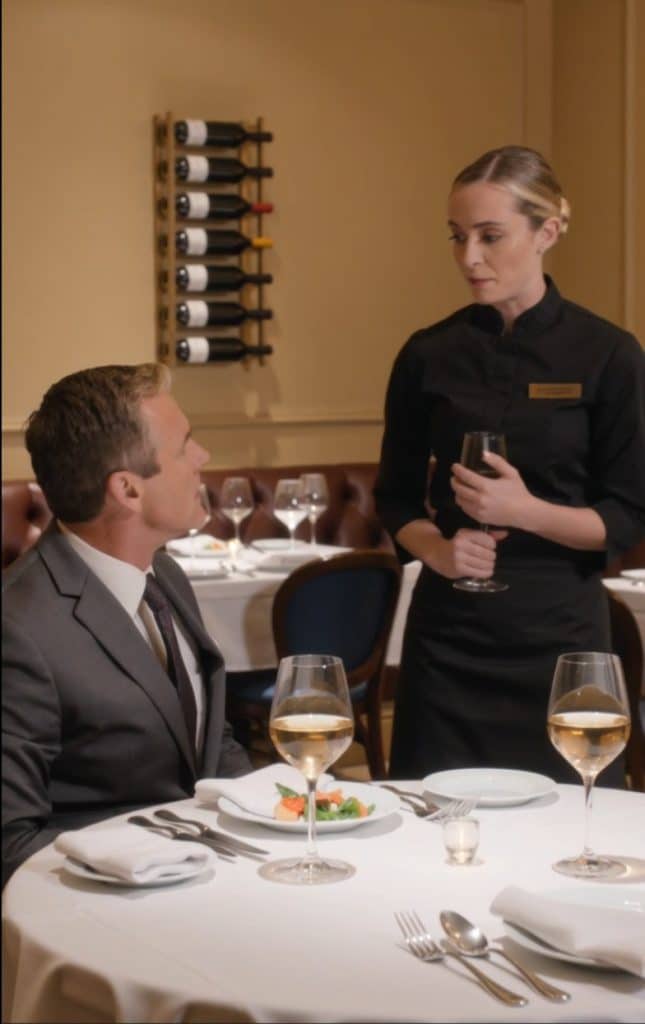
Around the Manhattan dining room, crystal glasses caught the warm golden light while executives leaned across white tablecloths. At the center VIP table, four business partners waited for a rare Bordeaux that had been presented as the centerpiece of their dinner.
Claire turned the bottle slightly, checking the small importer code beneath the back label.
That extra second irritated Richard Vale.
He was forty-eight, wealthy, immaculately dressed, and used to people responding faster when he raised his voice. When Claire leaned toward the glass again, he ordered her closer and put a hand against her lower back despite her attempt to maintain professional distance.
Claire stepped away.
“Please keep your hands away from me.”
Richard looked at her as though the boundary itself had offended him.
“Trash. I paid for service.”
The table went quiet.
His business partners looked down.
A server several feet away stopped moving.
Claire still held the bottle.
Richard rose.
The confrontation turned violent.
Claire was knocked down beside the wine table and assaulted again briefly while crystal glasses rattled above her. Nearby diners gasped, but no one intervened before Richard stopped.
He stood over her as though the entire room were merely another audience he had purchased.
“Serve closer when I tell you.”
Then the wine-cellar door slammed open.
Gabriel Moretti came up the narrow staircase two steps at a time.
At fifty-two, Gabriel was both the owner of the restaurant and one of the most respected sommeliers in the country. His black suit carried only one ornament, a small silver wine pin at the lapel.
He saw Claire on the floor.
He saw Richard.
And he saw the bottle still lying near her white service cloth.
Gabriel crossed the dining room, stopped Richard from getting near her again, and struck him once before placing himself firmly between the man and the fallen server.
The business partners froze.
“That hand just ended your table, your deal, and your name in this room.”
Richard stared at him.
“My deal?”
Gabriel did not look at Richard.
He picked up the bottle.
Claire had been checking its label because the restaurant’s cellar system showed the wine came from Vale Continental Distribution.
Richard’s company.
And that bottle was supposed to be part of a final private tasting before Gabriel signed a seven-year distribution contract covering six restaurants.
The contract was worth millions.
But the small importer code Claire had paused to inspect did not match the refrigerated shipment record attached to the delivery.
One bottle.
One mismatched code.
One server careful enough to notice it.
Gabriel turned the bottle toward the light.
The expensive dinner had just stopped being a negotiation.
It had become an audit.
Richard thought Claire’s hesitation had delayed his wine. In reality, it may have saved Gabriel from signing the most expensive mistake of his career.
Act II
Gabriel had spent thirty years building his reputation around one principle.
A restaurant could survive a bad night.
It could not survive a broken chain of trust.
Guests trusted the kitchen.
The kitchen trusted suppliers.
Sommeliers trusted importers.
Importers trusted warehouses.
Every expensive bottle that reached a Manhattan table carried an invisible history behind it.
Where it came from.
When it arrived.
How it was stored.
Who handled it.
For ordinary wine, small variations rarely became dramatic.
For rare wine, they could matter enormously.
A bottle worth several thousand dollars might spend years waiting for the right buyer.
Heat could damage it.
Repeated temperature swings could age it badly.
Improper storage could turn a famous label into an expensive disappointment.
That was why Gabriel’s restaurants required controlled delivery for premium inventory.
Vale Continental had approached him eight months earlier.
Richard’s company had expanded rapidly.
It promised refrigerated transport, verified warehouse conditions, detailed delivery records, and priority access to difficult allocations.
The offer was attractive.
Gabriel’s restaurant group had grown faster than its existing cellar network.
Vale Continental could simplify everything.
One distributor.
One platform.
One insurance structure.
One delivery standard.
Richard also promised access to private allocations usually reserved for larger hotel groups.
Gabriel remained skeptical.
So he created a trial period.
For six months, Vale Continental supplied a portion of the restaurant’s premium wine.
Claire became involved almost by accident.
She had joined the restaurant as a junior wine server after completing a certification course at night.
She was not the head sommelier.
She did not make purchasing decisions.
But she was unusually careful with labels.
During training, Gabriel had taught servers to verify four details before opening certain bottles.
Producer.
Vintage.
Importer.
Cellar assignment.
Most employees focused on the first two.
Claire checked all four.
Three weeks before Richard’s dinner, she noticed a bottle with an importer code that differed from the inventory record.
She reported it.
A supervisor assumed the discrepancy came from a relabeling update.
The bottle remained unopened.
Then another appeared.
Different vintage.
Same issue.
Claire entered a note into the cellar system.
The note was closed the next morning as a catalog correction.
No one investigated further.
Gabriel never saw it.
Then Richard scheduled the VIP tasting.
The purpose was larger than dinner.
Vale Continental wanted the exclusive contract.
Richard brought three potential investment partners because he was simultaneously raising capital to expand his distribution network.
A successful deal with Gabriel’s restaurant group would strengthen his presentation to them.
The table was not merely expensive.
It was strategic.
That made Claire’s pause especially inconvenient.
Richard had arrived expecting the evening to prove that his company delivered rare wine with effortless precision.
Instead, the server holding his showcase bottle was staring at the back label too long.
The bottle had been chosen to prove Richard’s company could be trusted. Claire was beginning to prove exactly the opposite.
Act III
Gabriel closed the cellar to outgoing premium bottles that night.
Nothing was destroyed.
Nothing was relabeled.
Nothing was quietly corrected.
He called the restaurant group’s outside beverage auditor and asked for a complete comparison between Vale Continental deliveries and physical cellar stock.
The first discrepancy involved the tasting bottle.
According to Vale’s shipment record, it had traveled from a bonded refrigerated warehouse in New Jersey directly to Gabriel’s Manhattan receiving dock.
But the importer code linked the bottle to a different warehouse batch.
That batch had passed through an independent storage facility in Queens.
The difference did not automatically mean fraud.
Distributors moved inventory between warehouses.
Codes changed.
Shipments were consolidated.
But Gabriel’s contract required refrigerated handling for that category.
The Queens facility did not appear on Vale’s approved premium-storage list.
Then auditors examined temperature records.
Vale Continental provided continuous digital temperature summaries with every premium shipment.
The reports were nearly perfect.
Almost suspiciously perfect.
Day after day, temperatures stayed within a narrow controlled range.
Then the auditors compared those summaries with dock-arrival sensors used by Gabriel’s restaurant.
Several deliveries arrived warmer than the distributor records suggested they should have.
Still not enough to prove damage.
Enough to ask questions.
The next clue came from truck assignments.
Vale’s premium invoices included refrigerated-delivery surcharges.
But vehicle logs showed several shipments had been transferred during the final delivery leg onto ordinary city trucks.
Vale argued that the transfer periods were short.
Sometimes they were.
But customers had still been billed for continuous controlled transport.
Then the financial incentive became clearer.
Refrigerated city delivery was expensive.
Manhattan traffic made it worse.
A specialized truck could spend an hour moving three blocks.
Vale’s operations department had begun using neighborhood consolidation.
Large refrigerated trucks delivered wine to small staging locations outside the busiest parts of Manhattan.
Smaller vehicles completed the final routes.
For ordinary inventory, it was efficient.
For premium inventory sold under continuous cold-chain terms, it violated the service specification.
The system was supposed to block those transfers.
Instead, employees had discovered an override.
A premium shipment could retain its original handling class even after a vehicle change.
The billing system saw premium.
The truck log saw standard.
Nobody had built a reconciliation between them.
Then Gabriel’s auditor found another layer.
Vale’s sales team received commission based partly on premium-service revenue.
Operations managers were measured partly on delivery cost.
Sales benefited from keeping wine classified premium.
Operations benefited from moving it more cheaply.
The override made both departments look successful.
Richard claimed he had not personally created the routing method.
The records supported that possibility.
The problem did not require a chief executive manually directing trucks.
It required a company where every department could improve its own number while the customer received something different from what had been sold.
Then Claire’s closed reports resurfaced.
She had flagged two mismatched importer codes before the VIP dinner.
Each note had been marked resolved as catalog maintenance.
The employee closing them worked in inventory administration.
Why?
Because unresolved premium discrepancies damaged Vale’s service-compliance rating inside the shared portal.
A catalog correction did not.
The bottle did not change.
Only the category of the complaint changed.
Then the auditors checked other restaurant clients.
Several had similar discrepancies.
Small.
Easy to explain individually.
A label mismatch.
A late truck.
A temperature reading entered manually after a sensor failed.
A delivery class corrected after arrival.
No single event proved a company-wide deception.
Together, they formed a pattern.
Then came the insurance problem.
Vale carried enhanced cargo coverage for high-value wine transported under specified conditions.
If a loss occurred during approved premium handling, coverage was clear.
If wine had been transferred through an undeclared staging facility or ordinary vehicle, coverage could become complicated.
Gabriel had nearly signed a seven-year contract assuming the risk structure was stronger than the underlying operations.
Richard’s humiliation of Claire had opened the door.
But Claire’s label check was what walked everyone through it.
Richard had treated a server’s caution like incompetence. By morning, that caution had become the most valuable piece of due diligence in the room.
Act IV
Gabriel suspended the exclusive distribution negotiation.
Not every Vale bottle was rejected.
Not every employee was blamed.
Existing inventory was reviewed according to actual evidence.
Wine with verified handling remained available.
Questionable lots were isolated for inspection.
Where storage history could not be confirmed, the restaurant decided case by case whether the wine could be used, returned, or removed from premium sale.
Then Vale’s business partners asked for the audit findings.
Gabriel provided only what contracts and law allowed.
He did not turn Claire’s assault into gossip.
He did not release dining-room footage publicly.
But the commercial findings were enough.
The investors had been considering a major expansion based partly on Vale Continental’s claimed premium logistics capacity.
Now they wanted the same answers Gabriel wanted.
How many premium deliveries had been transferred?
How many refrigeration surcharges had been billed?
How many temperature summaries described conditions no sensor had actually measured?
How often had service complaints been closed as catalog corrections?
Richard’s deal began weakening under questions that had nothing to do with his social status.
Then Gabriel changed his own restaurant systems.
A distributor could no longer close a cellar discrepancy unilaterally.
If restaurant staff created the alert, restaurant staff had to acknowledge the resolution.
Importer code mismatches remained visible.
Vehicle changes on premium shipments required reconciliation.
Temperature exceptions could be explained.
They could not disappear.
Then staff reporting changed.
Claire’s notes had been treated as minor because she was a junior employee.
Gabriel removed job rank from the initial review screen.
A discrepancy from a server entered the same queue as one from a sommelier.
Expertise still mattered when evaluating the issue.
Status did not determine whether the issue existed.
Then the restaurant group reviewed its VIP culture.
Richard had behaved as though buying expensive wine purchased control over the person serving it.
Gabriel knew no software could eliminate entitlement.
But management could make boundaries clearer.
Servers were permitted to step away from any guest who touched them inappropriately or behaved aggressively.
Managers had to take over immediately.
No employee was required to remain tableside because an important guest might spend more money.
VIP meant valuable customer.
It did not mean temporary ownership of staff dignity.
The incident involving Richard proceeded separately through appropriate legal channels.
Restaurant security footage was preserved.
Witness statements were collected.
Claire was offered support and time away.
Gabriel did not act as investigator, judge, and publicist at once.
He had intervened during the incident.
Formal consequences required their own process.
Then came the contract itself.
Gabriel did not sign it.
Neither did he immediately award the business to Vale’s competitor.
Instead, the restaurant group reopened bidding with new controls.
Any distributor seeking premium status had to provide independently verifiable chain-of-custody and temperature data.
Delivery class had to match actual vehicle history.
Subcontracted storage locations had to be disclosed.
Billing categories had to reconcile with operational records.
The reforms applied to everyone.
That was the point.
A rule invented only to punish Richard would disappear with Richard.
A better procurement system would remain.
Claire returned weeks later.
She was not promoted to head sommelier overnight.
Gabriel refused to turn professionalism into a fairy tale.
She still had training to complete.
Experience to gain.
Exams to pass.
But the restaurant corrected something more important.
When she noticed a discrepancy, the system listened before somebody powerful had to confirm she was right.
For the first time, the restaurant understood that respect for expertise begins long before the person holding it receives an impressive title.
Act V
Nine months later, another VIP dinner filled the same corner of the Manhattan dining room.
Different company.
Different guests.
Different distributor.
A rare bottle arrived at the table.
The wine server checked the producer.
Vintage.
Importer.
Cellar assignment.
The process took several seconds.
Nobody complained.
One code did not match.
Service stopped.
A manager checked the cellar record.
The discrepancy turned out to be harmless.
The importer had updated its numbering convention after a warehouse merger.
Documentation confirmed the change.
The bottle was approved.
Dinner continued.
Nothing dramatic happened.
That was what Gabriel wanted.
The restaurant’s premium wine program became slower in a few places.
Deliveries required more reconciliation.
Some suppliers disliked the additional documentation.
Costs increased slightly.
Then another number changed.
Disputed premium deliveries fell.
So did unexplained invoice adjustments.
The restaurant knew more accurately where expensive inventory had been.
Vale Continental survived the investigation, though not unchanged.
Independent reviews determined which billing and handling issues required correction.
Customers received adjustments where records supported them.
Operational controls changed.
Some managers left.
Others remained.
The company lost Gabriel’s exclusive deal.
Whether it earned future business would depend on performance rather than promises.
Richard’s personal consequences followed separate processes.
His company was not declared worthless because of one terrible evening.
His employees were not treated as extensions of his behavior.
The distinction mattered.
Institutions become more honest when accountability remains specific.
Claire eventually completed another level of wine certification.
She continued working at the restaurant.
Not because Gabriel had rescued her career.
She had already been building one.
Months after the scandal, she served a table where nobody knew her name.
A guest ordered a bottle.
Claire checked the label.
Poured.
Stepped back.
The guest tasted the wine.
Dinner moved on.
No business partners froze.
No cellar door slammed.
No owner crossed the room.
That ordinary moment contained the real reversal.
Richard had believed service meant obedience.
Vale’s broken logistics system had made a similar assumption in another form.
The customer paid for premium handling.
The invoice said premium handling.
Therefore everyone acted as though premium handling must have happened.
Claire did something simpler.
She looked at the bottle.
For years, polished reports had moved in one direction.
Warehouse to truck.
Truck to restaurant.
Invoice to customer.
Contract to executive.
Claire turned one bottle around and read the small print on the back.
That was enough to make the entire chain visible.
She had not become valuable because Gabriel Moretti defended her.
She had been valuable before he reached the dining room.
Her right to personal boundaries did not depend on whether a famous sommelier was nearby.
Her observation did not become intelligent because a billionaire investor later cared about it.
The truth was already there.
So was her dignity.
Near closing one winter evening, Gabriel walked through the cellar.
Hundreds of bottles rested beneath controlled light.
The new system showed their histories beside them.
Where received.
How transported.
Exceptions.
Corrections.
Open questions.
One bottle carried a temporary review flag.
It remained unopened.
Gabriel left it there.
Years earlier, he might have seen an unresolved flag as administrative friction.
Now he saw something else.
Permission to stop.
Permission to ask.
Permission to believe the person who noticed that something did not fit.
Upstairs, another server checked another label before pouring.
No one told her to hurry.
And in a restaurant built around expensive things, that small freedom had become one of the most valuable things in the room.