Act I
The drop landed on the investment folder before anyone saw where it came from.
Walter Reed had lifted a grape crate beside the outdoor signing table when one overripe berry split against the wood. A dark bead of juice rolled from the corner and touched the cream-colored cover protecting a multimillion-dollar vineyard agreement.
Calvin Pierce reacted as though the entire estate had collapsed.
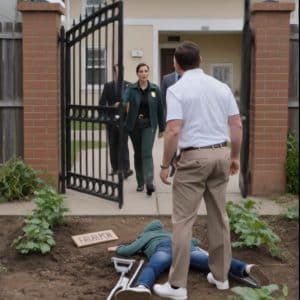
He stepped away from the tasting glasses and kicked the seventy-three-year-old gardener hard in the chest. Walter fell against the grape crate, sending fruit across the dirt while his pruning shears slid beneath the table.
His hand struck the broken edge of the wood. A thin red mark appeared across his palm as he curled beside the scattered grapes, breathing hard.
“It was only one drop…”
Calvin looked toward the investor, the secretary, and the legal assistant.
“Trash. You stained the contract.”
The pages inside the folder were untouched.
The juice had marked only the removable cover.
Still, Calvin stepped over Walter and struck him twice more while winery employees and tasting guests backed away in silence.
“You’re fired before they sign.”
The investor rose from the table.
Elliot Grant did not inspect the folder first. He crossed the dirt, crouched beside Walter, and helped him away from Calvin. His secretary closed the investment documents with one sharp motion.
Then Elliot looked at the winery owner.
“You just fired the wrong judge.”
Calvin froze.
“Judge?”
Walter had once served as the chief adjudicator of the Western Viticulture Council, the independent body responsible for resolving disputes over vintage claims, regional origin, and reserve classifications across several states.
He had retired from public work eight years earlier.
After his wife died, he returned quietly to the vines, taking seasonal gardening jobs because the work gave shape to his days.
Calvin had hired him without asking about his past.
Elliot knew exactly who he was.
The investment group had requested Walter’s confidential evaluation before purchasing a controlling interest in Pierce Ridge Winery. Walter had agreed to examine the vineyard as an ordinary worker, without special treatment or staged presentations.
His report was supposed to remain sealed until after the tasting.
But the drop of grape juice had revealed something Walter had already noticed.
The color spreading across the folder was too dark for the pale grapes stacked beside the table.
It matched the imported concentrate hidden inside the winery’s blending shed.
And the contract described every bottle as estate-grown.
Act II
Pierce Ridge Winery built its reputation on scarcity.
Calvin claimed the vineyard produced only a limited number of reserve bottles each year from grapes grown on the surrounding hills. The labels carried hand-numbered vintages, embossed seals, and a statement that every stage—from vine to barrel to bottle—occurred on the estate.
Collectors paid hundreds of dollars for a single bottle.
Restaurants competed for allocations.
Investment firms viewed the winery as a luxury brand capable of expanding internationally without losing its image of small-scale authenticity.
The numbers did not support the story.
Walter noticed that during his first week.
The vineyard contained enough healthy vines to produce a respectable harvest, but not enough to fill the thousands of reserve cases listed in warehouse records.
Calvin explained the difference through exceptional yield.
Walter had spent most of his life around vineyards.
Exceptional yield did not create twice as many grapes without leaving evidence in the vines, soil, labor hours, irrigation, or harvest weights.
The estate’s records showed perfect seasons even when nearby growers suffered heat damage, smoke exposure, or heavy rain.
Every year became a triumph.
Every vintage earned glowing tasting notes.
Every bottle appeared to come from the same limited rows.
Walter began keeping private field notes.
He counted vines by block.
He recorded cluster density.
He compared pruning cuts with reported harvest volume.
He watched trucks enter through the service gate after midnight.
Some carried unlabeled tanks rather than grape crates.
The loads came from a bulk-wine broker operating near a coastal shipping terminal.
Pierce Ridge purchased inexpensive finished wine, grape concentrate, and blending alcohol from several regions. Some shipments were domestic.
Others entered through importers.
Using outside wine was not inherently wrong.
Many reputable wineries blended grapes or finished wine from different sources and labeled the bottles accurately.
Calvin did not.
He added bulk wine to estate production, adjusted color and flavor with concentrate, and bottled the mixture beneath reserve labels claiming exclusive vineyard origin.
The fraud required more than false labels.
Vintage records had to match.
Pierce Ridge used a digital barrel-management system that assigned every barrel a location, grape block, fill date, testing history, and expected bottling schedule.
Walter compared the system with the cellar floor.
Several barrels appeared in two locations at once.
One supposedly contained estate wine from a harvest three years earlier.
Its metal band carried a manufacturing date from the current year.
Another barrel was listed as resting undisturbed for twenty-eight months, yet fresh forklift marks crossed the dust beneath it.
The winery created historical barrels shortly before investor visits.
Workers filled new oak with bulk wine, added dust to the exterior, and attached older inventory tags.
The system then generated years of fictional temperature checks, sampling notes, and cellar movements.
Calvin called the process archival reconciliation.
It was manufactured age.
Walter found the strongest evidence in the pruning shed.
Discarded label backing sheets showed that reserve bottle numbers were printed in repeating sequences. The same supposedly unique number appeared on cases shipped to different states.
One rare bottle became several rare bottles as long as collectors never compared them directly.
The duplicated labels supported auction prices.
When one numbered bottle sold for thousands, every hidden duplicate gained value.
Elliot’s investment group had been invited to finance a major expansion based on those prices.
The contract promised new tasting rooms, international distribution, and a private wine fund backed by reserve inventory.
The fund would allow investors to purchase shares in bottles stored beneath the estate.
Many of those bottles did not yet exist.
Others contained bulk wine worth a fraction of the stated value.
Walter’s secret evaluation threatened everything.
But Calvin’s deception went deeper than counterfeit vintages.
The land beneath the vines was protected by a conservation agreement that prohibited the commercial development promised inside the investment folder.
And Walter had written the original ruling that created it.
Act III
Thirty years earlier, Pierce Ridge belonged to several farming families.
A developer attempted to convert the hillside into luxury housing. The families challenged the plan, arguing that the land contained historic agricultural terraces, shared water channels, and soils essential to the region’s wine identity.
Walter was a young land-use judge at the time.
He issued the decision preserving the vineyard corridor.
The ruling allowed private ownership and profitable agriculture, but major development required review by an independent land trust. Hotels, luxury villas, event complexes, and permanent commercial structures could not simply replace working vines.
Calvin’s father later purchased much of the property under those conditions.
Calvin inherited both the winery and the restrictions.
For years, he complained that the conservation agreement trapped valuable land beneath low-yield agriculture.
Then Pierce Ridge’s wine brand became successful.
Calvin found a way to make the restriction work for him.
He promoted the protected landscape as proof of authenticity.
Advertising described untouched hills, historic vines, and generations of stewardship.
The conservation status increased the bottle price.
Privately, Calvin planned to weaken the farming operation until commercial development appeared necessary for survival.
The investment agreement contained plans for hillside villas, a private club, an underground event hall, and luxury residences disguised as seasonal agricultural lodging.
The documents described the project as vineyard preservation through hospitality revenue.
Most of the historic vines would be removed.
A decorative strip would remain around the buildings.
The investment group had been told that all land approvals were already secure.
They were not.
Calvin submitted altered maps that excluded several protected terraces. He used outdated survey boundaries and renamed residential structures as harvest-support buildings.
He also manipulated vineyard productivity reports.
The estate appeared to produce enormous quantities of reserve wine while physical grape yields were recorded as declining.
Those conflicting stories served different audiences.
Investors saw a powerful luxury brand requiring expansion.
The land trust saw aging vines and weak agricultural performance requiring economic rescue.
The winery used bulk wine to maintain bottle sales while making the actual vineyard appear less important.
If the vines could be portrayed as symbolic rather than productive, development became easier to justify.
Walter recognized the pattern from older land cases.
A protected agricultural property could be hollowed out slowly, then declared unsustainable.
The owner created the failure used to demand release from the restriction.
His field notes documented healthy blocks that Calvin had classified as nonviable.
Several rows marked for removal carried strong fruit.
Workers had been instructed to under-prune nearby sections, reducing future yield.
Irrigation repairs were delayed in areas planned for construction.
The vineyard was being weakened deliberately.
Elliot’s legal assistant secured the investment folder, land maps, barrel files, label inventories, shipping records, and Walter’s notes under independent supervision.
The grape-juice stain became part of the evidence, but not because it damaged the contract.
Laboratory testing showed that the color came from a concentrate used in the winery’s blending room.
The crate beside Walter contained pale estate grapes.
The concentrate had leaked onto the crate earlier that morning from a transfer hose.
The drop linked the public tasting display to the hidden blending operation.
Calvin had placed estate grapes around the signing table to create a visual story.
The crate itself had already passed through the building where imported concentrate was mixed into bulk wine.
Then investigators examined the reserve vault.
Pierce Ridge had insured the same bottle collections through several companies under different ownership entities.
The counterfeit vintage operation had become a financing machine.
Act IV
Wine can function as both a product and an asset.
Rare bottles rise in value when supply is limited, provenance is strong, and storage history is trusted. Collectors lend against them. Funds purchase them. Insurers protect them.
Pierce Ridge exploited every weakness in that system.
Calvin created separate companies for production, storage, distribution, and investment.
One company bottled the wine.
Another claimed to own the reserve inventory.
A third stored it in the cellar.
A fourth sold participation interests to investors.
The same cases appeared on several balance sheets.
A collection listed as collateral for a bank loan also appeared as inventory inside the proposed wine fund. Some bottles were insured separately as winery stock and private-investor property.
Duplicated serial labels made the overlap difficult to detect.
Two cases in different storage rooms could carry the same bottle numbers.
Digital photographs showed them as distinct collections because the backgrounds changed.
The wine inside came from the same bulk tanks.
Calvin used auction results to increase valuations.
A broker connected to Pierce Ridge purchased selected bottles at unusually high prices. Those sales became public market evidence.
Appraisers then raised the estimated value of every matching vintage.
The buyer’s money returned through consulting agreements.
The auction looked independent.
The price was staged.
Pierce Ridge borrowed against the higher valuation.
The proposed investment would have brought fresh money into the system before lenders discovered the overlap.
Elliot’s group believed it was purchasing growth.
In reality, part of its capital would repay loans secured by counterfeit bottles and fund construction the land trust had never approved.
The workers understood only fragments.
Cellar staff knew labels were reprinted.
Shipping clerks knew case numbers repeated.
Vineyard crews knew harvest totals looked too large.
Accountants knew ownership entities moved bottles between themselves.
Calvin kept each department separate so no ordinary employee saw the whole structure.
Walter had moved through the vineyard without authority, which allowed people to speak honestly around him.
They assumed the old gardener could not affect the deal.
That made him the only person seeing the business from the soil upward.
His dismissal exposed Calvin’s belief that expertise came only in suits, folders, and tasting rooms.
An independent administrator suspended the investment and secured the reserve inventory. Legitimate wine sales continued where origin and vintage could be verified.
Outside wine was labeled according to its true source.
Blended products remained sellable when honest.
Estate claims required physical reconciliation between acreage, harvest weight, fermentation volume, barrel records, and bottles produced.
Unique bottle numbers became truly unique.
A reserve label could not be reprinted without creating a visible cancellation trail.
Auction houses required disclosure of connected buyers and sellers.
Appraisals could not rely on transactions arranged by the owner whose inventory gained value from the sale.
Wine funds gained independent custody.
The company storing the bottles could not be controlled secretly by the company selling investment shares.
Physical inspections had to reconcile every bottle with ownership, insurance, and collateral records.
The conservation trust reopened the vineyard’s land file.
Healthy rows were protected from strategic neglect. Agricultural viability would be measured by independent growers and soil experts, not by the owner seeking permission to replace the vines.
Development proposals required honest maps and direct public review.
Then Walter’s old judicial archive revealed one final restriction.
If the vineyard owner intentionally undermined agricultural use, control of the protected acreage could pass to a stewardship board.
Calvin had not merely endangered his investment.
He had placed the land itself beyond his control.
Act V
The original conservation ruling anticipated sabotage.
Walter had seen landowners elsewhere drain fields, remove irrigation, or neglect crops until protected farms appeared worthless. His decision included a safeguard.
An owner could operate the property for profit.
The trust could not dictate ordinary business choices.
But deliberate destruction of agricultural capacity triggered independent stewardship.
The land would not be seized for someone else’s private gain.
Its management would shift temporarily to a board representing workers, neighboring growers, conservation experts, and the ownership estate until compliance returned.
Calvin’s records showed intent.
He delayed irrigation repairs in the blocks closest to the planned villas.
He ordered healthy vines categorized as diseased without testing.
He reduced pruning crews, then cited falling productivity.
He bought bulk wine to keep brand revenue high while starving the land that justified the brand.
The luxury expansion was not rescuing the vineyard.
It was replacing a vineyard Calvin had weakened on purpose.
The stewardship provision activated.
Calvin lost operational control over the protected acreage while court proceedings examined the fraud. The winery buildings and brand entered separate restructuring.
Workers did not lose their jobs because the owner had corrupted the business.
Vineyard crews restored neglected rows.
Cellar employees helped identify legitimate barrels.
Accountants reconstructed which investors, insurers, and lenders held claims against the same bottle collections.
Calvin faced consequences for attacking Walter, falsifying origin records, manipulating investment assets, and attempting to defeat the conservation agreement.
Brokers, appraisers, attorneys, cellar consultants, and financial partners were reviewed according to what they knew and controlled.
Ordinary workers were not blamed because duplicated labels or altered logs passed through their hands under instruction.
Several had preserved discarded tags, transfer orders, and unexplained inventory changes.
Their evidence rebuilt the vintages.
Collectors received accurate information.
Some bottles lost most of their estimated value when the estate origin proved false.
The wine itself was not poured away for symbolism. Verified blends were relabeled and sold honestly, with proceeds preserved for restitution.
Authentic estate vintages remained valuable because their histories could finally be trusted.
The investment group withdrew from the luxury-development deal.
Elliot later supported a smaller financing plan focused on vineyard restoration, transparent production, and lawful visitor facilities.
He did not give Walter ownership as a dramatic reward.
Walter had never asked for the estate.
He accepted a temporary seat on the stewardship board because the workers requested his help interpreting the conservation ruling.
He stepped down once the new system was stable.
The permanent board included vineyard employees, neighboring growers, land-trust representatives, and community members.
Months later, another contract was signed at an outdoor table.
The documents described a modest distribution agreement based on verified production.
A grape split against a nearby crate.
One drop landed on the folder cover.
A secretary wiped it away with a cloth.
No one shouted.
No worker was blamed.
Nothing dramatic happened.
That ordinary moment mattered more than Elliot closing the first folder.
Walter’s dignity existed before anyone learned he had been a judge.
“It was only one drop…”
The statement should have ended the incident.
Calvin answered from a world where a stained cover mattered more than the man standing beside it.
“Trash. You stained the contract.”
The contract had already been stained by false maps, invented vintages, and bottles promised to several owners.
“You’re fired before they sign.”
Calvin believed firing Walter would remove the problem.
Instead, it revealed that he saw workers as disposable scenery around the story he sold.
After the audit, Pierce Ridge produced fewer reserve bottles.
Its revenue fell.
Its international expansion disappeared.
The vineyard looked smaller without bulk imports hidden beneath estate labels.
What remained was real.
Harvest totals matched the vines.
Barrel ages matched the wood.
Bottle numbers matched physical inventory.
The hills no longer needed to produce impossible quantities to justify their survival.
The original stained folder stayed in evidence until the investment case closed.
The grape mark spread across only one corner.
Beneath it sat plans for villas disguised as farm buildings and financial schedules built on duplicated wine.
Beside the folder rested Walter’s pruning shears and field notebook.
One bulk shipment became an estate vintage.
One numbered bottle became several investment assets.
One neglected vineyard became proof that farming no longer worked.
One elderly gardener became the easiest person to remove before the signatures dried.
Then the secretary closed the folder.
The tasting glasses went untouched.
And the winery owner who thought one drop had endangered his future discovered that the oldest man in the vineyard had already judged the only thing that mattered.
Not the stain.
The truth beneath it.