Act I
“I won’t sell my land.”
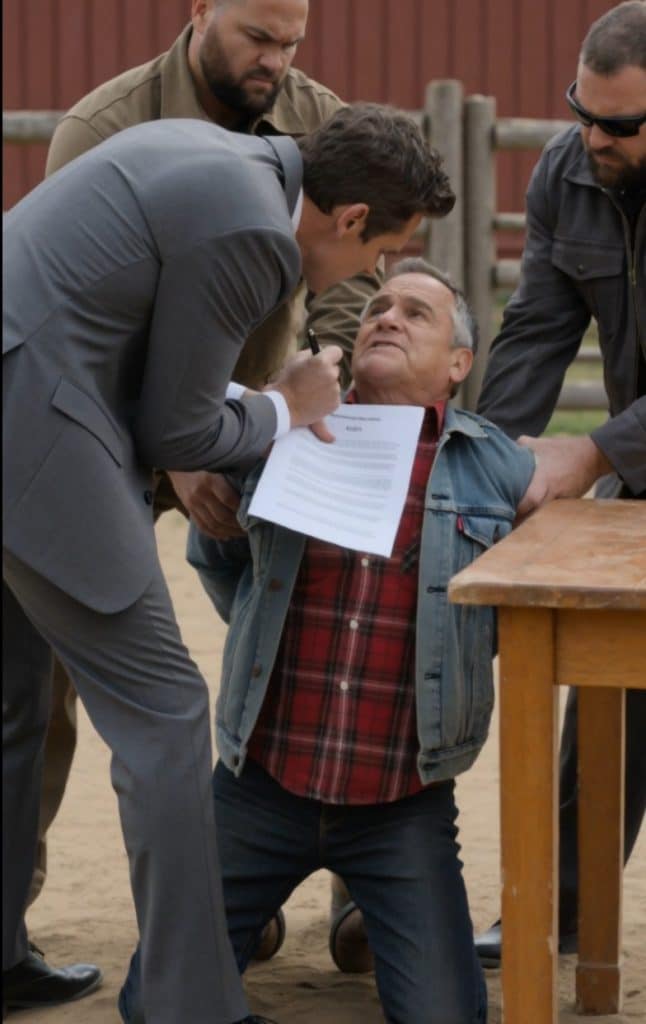
Walter Hale was already on both knees in the dirt.
Two enforcers held his arms behind him while a farm-sale contract pressed against the edge of the wooden table. A silver pen hovered inches from his trembling hand.
Behind him stood the red barn his father had built.
Beyond it stretched 140 acres of wheat stubble, grazing fields, and dry irrigation channels that had carried water through the valley for generations.
Adrian Voss leaned over the old farmer in an expensive gray suit.
“Trash. Sign it.”
Walter was seventy-six. His red plaid shirt was worn thin at the elbows, and dust covered the knees of his jeans.
He was frightened.
He was also certain.
The farm had survived drought, debt, storms, and three generations of men who promised Walter that selling was the sensible thing to do.
Adrian had made the same promise.
Then he brought enforcers.
When Walter refused again, Adrian attacked him.
The elderly farmer was thrown back against the wooden table. The brief violence that followed left him half-curled beside its legs, overwhelmed and struggling to focus while the contract dropped into the dirt.
The bystanders near the fence went silent.
Adrian picked up the papers.
“This farm is mine now.”
Engines roared beyond the gate.
A convoy of black SUVs rushed into the yard and stopped in a cloud of dust. Doors opened almost together, and men in dark suits moved outward before a tall figure stepped from the center vehicle.
Elias Grant was fifty-eight, dressed in a black suit beneath a long charcoal coat.
His face showed no panic.
Only control.
“Let him go. Give me the contract.”
The bodyguards separated the enforcers from Walter and formed a shield around the old man. Medical help was called as Elias took the dirt-streaked papers from Adrian’s hand.
Adrian stared at him.
“Who are you?”
Elias looked first at the sale price.
It was less than half the farm’s appraised value.
Then he examined the final page.
A notary seal appeared beneath the signature block.
The document stated that Walter had appeared voluntarily, confirmed his identity, and signed the contract the previous afternoon.
Walter’s signature line was still blank.
The contract had been notarized before he ever touched the pen.
Elias turned to the attached property schedule.
The agreement did not transfer only the farmhouse, barn, and fields.
It transferred all groundwater, recharge, irrigation, mineral, carbon, access, and future environmental rights connected to the parcel.
One line identified Walter’s acreage as the controlling property of the Cedar Basin Reserve.
Adrian had not come for an old farm.
He had come for the valve beneath it.
And if Walter signed, seventeen neighboring farms would lose control of their water before sunrise.
Act II
Walter’s family had owned the land since 1919.
The soil had never made them rich.
Some years produced good wheat. Other years barely covered seed, fuel, and property taxes.
The real value of the farm remained mostly invisible.
Beneath the north field ran an old limestone channel that collected runoff from the surrounding hills. Walter’s grandfather and neighboring farmers expanded it during the drought years, connecting the natural basin to a network of wells and irrigation lines.
The main control gate sat beneath Walter’s red barn.
Legally, the water did not belong to Walter alone.
A covenant recorded in 1938 required the farm’s owner to protect access for the rest of the valley. Walter maintained the gate, paid for repairs, and kept handwritten usage records at the kitchen table.
No farmer could sell the shared water without the others.
At least, that was what everyone believed.
Then Adrian Voss arrived with Meridian Rural Capital.
The company presented itself as a rescue fund for struggling agricultural communities. It offered emergency loans, crop insurance assistance, and drought-recovery financing.
The brochures showed family farms surviving beneath clear skies.
The contracts told a different story.
Meridian’s loans included a land-conversion clause triggered by agricultural instability.
A farm did not need to miss a payment.
It only needed to receive a high enough risk score.
Those scores came from FieldMetric, an agricultural analytics company owned through the same investment network as Meridian.
FieldMetric analyzed satellite images, rainfall, soil color, crop density, machinery movement, and energy use. Its reports predicted which farms were likely to fail.
Banks trusted the numbers.
County officials used them when distributing drought aid.
Farmers with poor scores paid higher rates and received fewer options.
Adrian controlled the model.
Whenever a landowner rejected Meridian’s purchase offer, FieldMetric often detected sudden deterioration.
Healthy fields became severely stressed.
Working wells became unreliable.
Stable farms became likely defaults.
The changes looked scientific because they arrived with maps and percentages.
Few people walked the actual land.
Meridian then offered a solution.
The farmer could surrender the property voluntarily, erase the loan, and remain as a tenant for one season.
Many signed.
Some believed they had no choice.
Others discovered too late that the sale included rights they never knew had been separated from the land.
Adrian acquired nine farms around Cedar Basin in eighteen months.
He did not plant them.
He removed their water allocations from agricultural use and transferred the credits into a private water bank.
Those credits could be sold to industrial developments outside the county.
A warehouse complex bought enough for cooling and sanitation.
A private residential project purchased guaranteed drought reserves.
A proposed data-processing campus wanted more water than the nine farms could legally supply.
Walter’s property was the missing piece.
The control gate beneath his barn connected the basin records. Whoever owned the controlling parcel could petition to reorganize the shared system.
Adrian’s lawyers planned to describe the neighboring farms as inactive users.
Once the petition passed, Meridian could consolidate the water rights, close the old irrigation network, and sell access through long-term private contracts.
The farms remaining in the valley would face dry wells or crushing new fees.
Walter knew none of the corporate details.
He knew only that Adrian’s offers kept increasing and neighboring fields kept going quiet.
Then a Meridian representative brought him a drought-risk report.
It claimed the north field had suffered permanent soil failure.
Walter had grown wheat there that season.
The company claimed satellite evidence outweighed his observation.
He refused the loan.
He refused the sale.
Soon county records showed a debt attached to the farm.
Walter had never borrowed the money.
The filing used an electronic authorization from a crop-insurance form he had signed years earlier. Meridian converted that old signature into approval for a new secured loan.
When Walter challenged it, the company scheduled a private resolution meeting in his yard.
Adrian arrived with the contract, the pen, and two men who had no reason to be there.
But Walter had done one thing Meridian did not expect.
Three weeks earlier, he mailed copies of the original 1938 water covenant to the Western Land Preservation Trust.
Its chairman was Elias Grant.
And Elias recognized Walter Hale’s name long before the convoy turned through the farm gate.
Because forty years earlier, Walter had saved Elias’s family farm without asking for anything in return.
Act III
Elias grew up seven miles from the Hale property.
During the farm crisis of the 1980s, his father fell behind on equipment payments. The bank prepared to seize their land during harvest.
Walter organized neighboring farmers to finish the crop before the auction.
He stored their grain without charge and found the missing language in an old cooperative agreement that delayed the foreclosure long enough for the family to refinance.
Elias was eighteen.
He never forgot the sight of Walter standing beside his father at the county office.
Years later, Elias became a land attorney.
Then he built the Western Land Preservation Trust, which purchased conservation easements, defended family farms, and challenged predatory land acquisitions.
The black SUVs did not arrive because Walter had a powerful friend waiting nearby.
Elias had been investigating Meridian for months.
Walter’s envelope contained the first complete copy of the Cedar Basin covenant.
It proved that the water rights were communal and that the controlling farm could not legally transfer them through an ordinary sale.
The contract in the dirt proved Adrian knew that.
A hidden attachment attempted to terminate the covenant by declaring the other farms abandoned.
The declaration listed seventeen landowners.
Four were dead.
Six still farmed every week.
One name belonged to a twelve-year-old girl who had inherited acreage from her grandmother.
The document claimed every one of them had waived notice.
No waivers existed.
Investigators searched Adrian’s vehicle under the authority of an emergency preservation order Elias had obtained earlier that day.
They found prepared deeds for several farms Meridian did not yet own.
Each contained completed notary sections and blank signature lines.
The company planned to obtain signatures later—or manufacture them after the landowners were removed.
Walter’s contract also included a personal occupancy clause.
It allowed him to remain in the farmhouse for six months after the sale.
Another paragraph permitted immediate removal if he interfered with surveys, water infrastructure, or development planning.
The promise that he could stay was designed to make surrender feel temporary.
Meridian could have evicted him the moment he entered his own barn.
Inside the red structure, Elias found the original water ledger in a metal box beneath the workbench.
Walter had recorded every irrigation release since taking over from his father.
Dates, field numbers, gallons, repairs, and signatures filled hundreds of pages.
The ledger proved the neighboring farms continued using the shared system.
It also revealed that Meridian properties were consuming water after the company declared them inactive.
Adrian had been pumping from the basin, selling the credits elsewhere, and counting the same water twice.
The private water bank claimed it had conserved billions of gallons by retiring agricultural use.
In reality, Meridian continued pumping through unregistered lines at night.
The company sold conservation that had never occurred.
Those false savings supported environmental permits for developments across the state.
One paper water credit could justify real construction.
Factories, warehouses, and luxury subdivisions had been approved on the promise that Cedar Basin used less water.
The basin was not using less.
The records had simply stopped counting what Meridian took.
FieldMetric helped hide the withdrawals.
Satellite images of wet fields would have revealed continued irrigation. The company altered vegetation classifications so watered acreage appeared to be dry scrubland.
The same algorithm that pushed farmers toward default concealed Meridian’s own use.
Then investigators opened the farm-sale payment records.
Adrian’s company had already transferred Walter’s property into a preliminary asset portfolio.
Investors were shown a map with the Hale farm marked acquired.
The water gate beneath the barn appeared as Meridian infrastructure.
The proposed data campus had paid a nonrefundable reservation fee for access.
Adrian had promised water he did not own.
If Walter refused, the entire development agreement could collapse.
That explained the enforcers.
It explained the pre-notarized contract.
It explained why Adrian wanted the signature before anyone examined the debt.
But one more document changed the investigation completely.
Meridian had received county drought-relief money to preserve family agriculture.
The fund paid the company to prevent forced sales.
Adrian used that money to finance the purchases.
He was paid by the public to keep farms operating while privately preparing to strip them of water and remove their owners.
Walter’s farm was not the first coercive acquisition.
It was supposed to be the last one Meridian needed.
And before the sun set, the company attempted to file his deed electronically—without his signature.
Act IV
Elias’s legal team reached the county recorder before the false deed entered the permanent index.
The electronic filing carried an image of Walter’s signature taken from the old crop-insurance document.
Its metadata showed it had been inserted that afternoon.
The recorder froze every Meridian transfer connected to Cedar Basin.
A judge issued an emergency order blocking land sales, water transfers, new liens, and destruction of company records.
The next morning, farmers began arriving at Walter’s barn.
They brought loan notices, appraisal reports, default letters, insurance forms, and copies of purchase agreements.
For years, each family believed its problem was private.
Placed across Walter’s wooden table, the documents revealed a pattern.
The same risk language appeared repeatedly.
The same notary approved transactions across distant counties on days she could not have attended them.
The same valuation firm lowered appraisals before Meridian offers.
The same FieldMetric model produced sudden deterioration after owners refused to sell.
Investigators did not rely on one emotional accusation.
They walked the fields.
Agricultural specialists tested soil Meridian had classified as permanently damaged.
Water engineers inspected the basin.
Surveyors traced the illegal pipes.
Digital analysts compared satellite images with the altered classifications.
The farms were not perfect.
Some carried debt.
Some needed repairs.
Several owners had made mistakes.
None of that turned fraud into rescue.
A court-appointed receiver took control of Meridian’s agricultural portfolio.
The receiver separated lawful purchases from coerced or falsified transfers.
Farmers who had knowingly sold land at fair value remained bound by those agreements.
Families deceived through false debts, forged documents, or manipulated scores received a path to recover their property.
The process did not promise an easy return.
Some fields had been neglected.
Equipment had been sold.
Homes had been damaged.
Justice could restore title more quickly than it could restore a harvest.
FieldMetric’s model underwent independent review.
Analysts found that refusal to accept a Meridian loan had been included as a risk factor.
The algorithm treated independence as evidence of instability.
Farmers who questioned the company became less creditworthy because they had questioned it.
The county drought board faced its own failure.
It had distributed preservation funds through a company buying the land it was paid to preserve.
It trusted dashboards showing acres protected without checking who still owned those acres.
A farm remained green on the map after its family disappeared.
The county counted land.
It did not count control.
Elias refused to let the investigation become a story about one powerful man rescuing one helpless farmer.
Walter’s letter mattered because the system finally received it.
The other farmers had sent complaints too.
Those reports had been divided between banks, county offices, insurers, and private platforms until no one saw the full pattern.
The reforms began there.
Agricultural risk firms could provide analysis.
They could not be owned by lenders or buyers acting on the score.
No land sale could rely on a notary connected financially to the purchaser.
Electronic signatures required transaction-specific verification rather than images copied from older forms.
Farmers over a protected age received an independent review period for sales involving a primary residence, active agricultural land, or shared water rights.
Water covenants had to appear clearly on county parcel records.
They could not remain buried in century-old deed books while investors claimed ignorance.
Conservation payments would follow actual water measurements.
A company could not sell credit for reducing use while pumping through an unregistered pipe.
Walter was offered a formal seat on the new basin authority.
He declined permanent control.
The water had never belonged to him alone.
Each participating farm would appoint a representative, and independent engineers would verify the records.
The old ledger would remain evidence.
It would not become the only system standing between the valley and another theft.
Before the receiver left the barn, Elias placed the blank contract beside the original covenant.
One document treated the farm as a collection of assets that could be separated and sold.
The other treated land, water, and neighbors as obligations carried forward.
Only one had required Walter’s family to protect people they might never meet.
Act V
Adrian Voss lost control of Meridian Rural Capital.
Investigators opened cases involving forged land transfers, fraudulent liens, coercion, misuse of public funds, and manipulation of environmental records.
The two enforcers faced consequences for their actions in Walter’s yard.
Adrian’s wealth did not turn refusal into consent.
The farm was not his because he had written it into an investor presentation.
Walter’s false debt was removed.
The attempted deed was cancelled.
His title remained in his name, subject to the original water covenant that had protected the valley for generations.
Several neighboring families recovered land.
Others chose financial settlements because returning was no longer practical.
One widow sold voluntarily after receiving an independent appraisal and legal advice.
The reform did not assume every sale was betrayal.
It made sure a sale was truly a choice.
The proposed data campus lost its Cedar Basin water reservation.
Its developers could redesign the project, find a lawful supply, or build elsewhere.
Economic development did not require a fictional surplus.
The private water bank corrected its accounts.
Credits based on double-counted pumping were cancelled.
Projects that had relied on them underwent new review.
Some permits changed.
Some construction slowed.
The cost remained with the companies that purchased certainty without verifying where it came from.
The county rebuilt its drought-relief program.
Farmers could apply directly.
Loan decisions and land-purchase offers were separated.
No rescue fund could place a lien on a family farm through a form signed for another purpose.
Risk models had to disclose the factors affecting a score.
Rejecting an investor could not become proof that a farmer was failing.
Walter returned to the yard after recovering.
The wooden table was repaired, but one edge still carried a shallow mark from the day of the assault.
He did not replace it.
The table had held birthday cakes, seed invoices, tax forms, and meals during harvest.
One violent afternoon did not get to define it.
Elias visited without the convoy several months later.
He arrived in an ordinary truck and left his coat in the cab.
He and Walter walked to the red barn, where engineers had installed a secure meter on the old water gate.
The system recorded every release.
Each farm could see the same numbers.
No private company could make water disappear by changing a category.
Walter never treated Elias as a savior.
Elias never asked him to.
Years earlier, Walter had helped a frightened farming family because it was the right thing to do.
Decades later, Elias used the authority he had built for the same reason.
Neither act created the other man’s dignity.
It only proved that protection could travel forward.
Months later, another investor visited a neighboring farm with a purchase offer.
The owner reviewed it with an independent attorney during the required waiting period.
The water rights appeared clearly on the first page.
No enforcers stood in the yard.
No pen was forced into anyone’s hand.
The farmer declined.
The investor left.
Nothing dramatic happened.
That ordinary refusal mattered more than Adrian’s fear.
Walter continued farming on a smaller scale.
He leased part of the acreage to a young couple who wanted to grow wheat and raise cattle but could not afford land of their own.
The agreement gave them security without hiding a transfer of water, minerals, or future rights.
Walter’s granddaughter helped digitize the old ledger.
She scanned every page, then returned the original to its metal box.
The computer copy made the records easier to share.
The paper reminded them where the responsibility began.
Adrian had said the farm was already his.
Meridian’s documents used more polished language.
Strategic consolidation.
Drought adaptation.
Resource optimization.
The meaning was the same.
The company believed possession could be created through paperwork before consent existed.
But Walter’s dignity did not begin when the SUVs crossed his gate.
It did not depend on the water beneath his barn or the powerful man who remembered his kindness.
The attack was wrong when Walter was simply a seventy-six-year-old farmer refusing to sell his home.
The neighboring families mattered before the ledger proved their claims.
The valley mattered before developers calculated the price of its water.
Every landowner mattered before an algorithm decided that independence looked like failure.
One year later, late-afternoon light settled over the Hale farm.
Dust moved across the yard.
The old wooden fence had been repaired, and the red barn doors stood open toward the fields.
Walter sat at the farm table reviewing the basin report.
Seventeen farms appeared on the page.
Each water release matched the meter.
Each representative could challenge an error.
No blank signature waited beneath a completed notary seal.
Near the table leg, Walter found the silver pen Adrian had dropped in the dirt.
It had remained inside an evidence bag until the case no longer required it.
Walter removed it and tested it on a scrap of paper.
The ink still worked.
He carried it into the barn and placed it beside the water ledger.
A pen could sign away a farm.
It could also record a promise kept.
Outside, the fields waited for rain.
The land remained dry, difficult, and his to protect.
For once, refusal had been allowed to mean no.