Act I
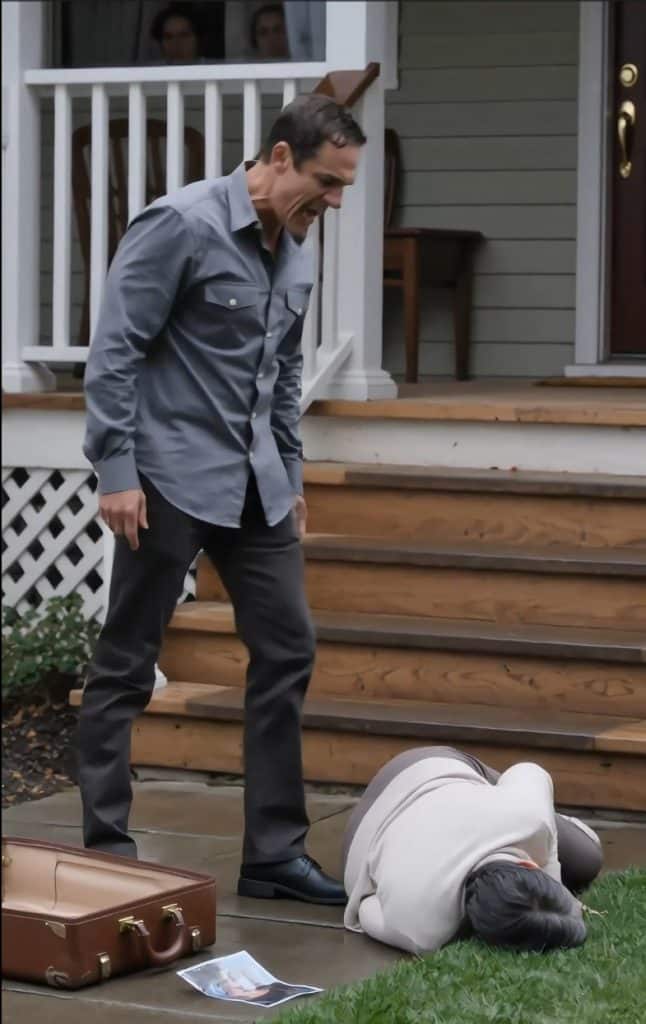
The suitcase burst open before Helen Mercer hit the grass.
Old sweaters, medicine bottles, and family photographs scattered across the wet front yard. One picture slid beneath a trash can. Another landed face-down beside the white fence.
Helen fell from the porch steps with one hand pressed against her stomach.
At sixty-seven, she no longer moved quickly. Her scraped palm sank into the damp grass as she tried to steady herself, but pain folded her forward.
Standing above her was her only son.
Evan Mercer’s shirt was wrinkled, his face red, and his breathing heavy with the kind of anger that had been building long before that morning.
“This is my house now,” he said. “You’re nothing but trash in the way.”
Helen looked toward the open front door.
She had carried Evan through that doorway when he was three days old.
She had painted his bedroom twice, waited beside him through childhood fevers, and worked double shifts after his father died so the mortgage would never go unpaid.
Now her medicine bag lay open in the yard.
Evan stepped down from the porch.
“You heard me.”
Helen tried to rise.
He struck her again, forcing her back into the grass while the neighbors watched from behind their curtains.
No one came outside.
Evan knew they were watching.
That was part of the humiliation.
He wanted them to see her belongings beside the curb. He wanted them to believe she had lost the right to remain in the house.
“Crawl back to wherever you came from.”
Helen’s lips trembled, but she did not beg.
“This is where I came from.”
The answer stopped him for half a second.
Then he laughed.
“Not anymore.”
He reached for a framed photograph lying beside her. It showed Helen as a young woman standing with her husband, Thomas, in front of the house when it was still unfinished.
Behind them was her younger brother, Ray, holding a hammer and grinning at the camera.
Evan lifted the photograph by one corner.
“You really think an old picture proves anything?”
Helen held out her hand.
“Give that back.”
Instead, he threw it into the grass.
Then an engine roared at the end of the street.
A black pickup turned sharply into the driveway, struck two trash cans, and broke through the small wooden gate beside the fence.
The truck stopped near the porch.
Ray Dawson stepped out wearing an old sheriff’s jacket. Two deputies emerged behind him.
Ray saw his sister on the ground.
His face went still.
He crossed the yard, knelt beside Helen, and placed the photograph back into her hands.
Only then did he look up at Evan.
“Take your foot off my sister.”
The color left Evan’s face.
“Uncle Ray…?”
But Ray had not come because a neighbor called.
He had come because Helen sent him proof that Evan was trying to steal far more than a house.
Act II
Ray helped Helen sit against the porch railing.
One deputy called paramedics. The other secured the front yard and asked the neighbors to remain available as witnesses.
Evan recovered enough to point toward the house.
“This is a family dispute.”
Ray looked at him.
“You assaulted my sister in front of six witnesses.”
“She refused to leave.”
“Leave what?”
“My property.”
Helen closed her eyes.
There it was.
The lie Evan had repeated for three months.
He claimed Helen signed the house over to him after a recent hospital stay. He told neighbors she had become confused, that she could no longer manage her finances, and that moving into assisted living was her own decision.
Helen had signed nothing.
The first time she learned of the supposed transfer was when a property-tax notice arrived under Evan’s name.
She confronted him.
He said it was only temporary paperwork.
Then he began taking control of everything else.
Her bank card.
Her medication schedule.
Her mail.
He changed the lock on her bedroom and moved her clothes into the guest room. He told relatives she was becoming forgetful whenever she questioned him.
Soon, he stopped allowing visitors inside.
Ray had called repeatedly.
Evan always answered.
Helen was sleeping.
Helen was at a medical appointment.
Helen did not want company.
Ray believed him longer than he wanted to admit.
Then Helen found a prepaid phone hidden inside a grocery bag delivered by Mrs. Alvarez from across the street.
Ray had arranged it after noticing his sister’s voice disappear from every conversation.
Helen used that phone to photograph documents from Evan’s desk.
A property deed.
A power-of-attorney form.
A medical declaration stating she lacked the capacity to make decisions.
All carried her signature.
None had been signed by her.
Ray forwarded the copies to the county fraud unit.
The preliminary review revealed that the notary listed on the deed had died eight months before the document was supposedly witnessed.
That morning, Ray received confirmation that investigators had enough evidence to execute a search warrant.
He drove to the house immediately.
He arrived minutes after Evan began throwing Helen’s belongings outside.
The paramedics checked her stomach and scraped hand. Ray remained beside her while rainwater gathered along the curb.
Evan stood near the door with his arms folded.
“You can’t search without proper authority.”
One deputy held up the warrant.
“We have it.”
Evan’s confidence faltered.
Helen looked toward her suitcase.
“My medicine.”
A deputy found the bag, but several prescription bottles were missing.
Evan shrugged.
“She takes too much. I control the doses.”
The paramedic examined the remaining labels.
Two medications had been refilled repeatedly in recent weeks.
Helen said she had received neither.
Ray turned toward his nephew.
“Where are the pills?”
“I don’t know.”
Inside the house, investigators found the answer.
The missing medication had been sold through a man connected to Evan’s gambling circle.
The forged deed was only one part of the scheme.
Evan had been stealing from his mother for nearly a year.
And someone in the family had helped him make every document look legitimate.
Act III
Evan had not always been cruel.
As a child, he followed Helen everywhere.
He waited at the kitchen table while she came home from work and asked whether they could build model airplanes together. After Thomas died, Evan slept beside her bedroom door for weeks because he was afraid she would disappear too.
Helen protected him from every consequence she could.
When he failed college courses, she paid for another semester.
When his first business collapsed, she covered the debt.
When his marriage ended, she let him move back into the house without asking how long he planned to stay.
She called it helping.
Ray called it rescuing.
They argued about it for years.
“He’s my son,” Helen always said.
Ray answered the same way.
“That doesn’t make every choice harmless.”
Evan’s gambling began quietly.
Sports apps.
Private card games.
Loans from friends.
By the time Helen understood the amount, he owed more than one hundred thousand dollars.
He told her he had stopped.
Then he discovered the value of the house.
The neighborhood had changed since Helen and Thomas purchased the lot decades earlier. New developments surrounded the original homes. Investors began offering large sums for properties close to the highway expansion.
Helen’s house was worth nearly a million dollars.
She refused to sell.
“This is where your father planted the maple tree,” she told Evan. “Money cannot replace every place.”
Evan heard only the word million.
He contacted his cousin, Melissa Crane, who worked as a legal assistant in a small estate-planning office.
Melissa had access to templates, signatures, and client records.
She also owed Evan money from a failed investment.
Together, they created the documents.
The forged deed transferred the property to a company registered under Evan’s name. The power of attorney gave him control over Helen’s finances.
The medical declaration came from a retired doctor Melissa knew through her office.
The doctor never examined Helen.
He signed after being told she suffered severe memory loss.
Evan then began building the story around the paperwork.
He told neighbors Helen wandered at night.
He told relatives she accused people of stealing.
He canceled her appointments and later claimed she forgot them.
When Helen challenged him, he recorded only the moments after provoking her, using her anger as evidence of instability.
He was not simply taking her property.
He was manufacturing a version of her no one would believe.
The plan was nearly complete.
A developer had offered Evan a deposit for the house. The final sale required the property to be vacant.
That was why her suitcase sat near the curb.
He planned to take her to an unlicensed care home outside the county that afternoon.
The facility had no connection to Helen’s doctors or family.
Its owner was another gambling associate.
Once Helen was inside, Evan intended to tell everyone she had chosen privacy.
Ray discovered the arrangement through a payment listed in the forged records.
The name of the care home appeared beside the words permanent placement.
At the hospital, Helen listened while Ray explained what investigators found.
She did not cry.
She stared at the old photograph in her lap.
“I kept thinking he would stop,” she said.
Ray sat beside her.
“When?”
“When he saw what it was doing to me.”
Ray looked away.
Helen understood the silence.
“You warned me.”
“That doesn’t matter now.”
“It matters.”
“No. What matters is what happens next.”
Helen touched the image of Evan as a little boy standing beside the porch.
“I still remember when he was kind.”
Ray nodded.
“You are allowed to remember that.”
“Does remembering make me weak?”
“No.”
“What does?”
“Letting the memory decide what he can do to you now.”
Helen closed her eyes.
For the first time, she allowed herself to understand that protecting Evan from consequences was not the same as loving him.
Then an investigator entered the room carrying a sealed envelope found inside the house.
It contained Thomas Mercer’s original will.
And it proved Evan had been trying to steal an inheritance that was never his to control.
Act IV
Thomas’s will had been missing for eleven years.
After his death, the family relied on a copy prepared by an attorney who later retired. That copy left the house to Helen and named Evan as the eventual beneficiary.
The original contained an additional provision.
If Evan attempted to pressure, deceive, or remove Helen from the property, his right to inherit the house would end immediately.
Thomas had added the clause after Evan’s first major gambling debt at nineteen.
Helen never knew.
Thomas had told Ray, but the brothers-in-law agreed not to burden her unless the provision became necessary.
Ray believed the original had been destroyed in a basement flood.
Instead, Evan found it in a locked cabinet.
He hid it because the clause could ruin his plan.
Now investigators had it.
Evan’s attorney argued that the provision might not be enforceable. The deed fraud and assault charges, however, did not depend on the will.
Evidence continued accumulating.
Bank records showed unauthorized withdrawals.
Pharmacy records confirmed missing medication.
Messages between Evan and Melissa discussed how long Helen might remain credible.
One message read:
Once she’s out of the house, everyone will assume she’s confused.
Another came from Evan:
She still thinks being my mother means I won’t finish this.
Helen read that sentence only once.
She placed the page face-down.
The criminal case moved forward alongside proceedings to void the forged deed and restore her accounts.
Melissa agreed to cooperate.
The retired doctor admitted signing the medical declaration without an examination.
The supposed care-home placement was canceled before Helen could be taken there.
Evan was ordered to remain away from her and the property.
Still, the court allowed him to speak during the hearing.
He arrived in a dark suit, looking smaller than he had on the porch.
His attorney described him as a desperate son overwhelmed by debt and caregiving responsibilities.
Evan apologized for “losing control.”
Helen watched from the front row.
He spoke about stress.
He spoke about addiction.
He spoke about believing the house would eventually become his anyway.
Then he looked toward her.
“You always said everything you had was for me.”
Helen’s expression changed.
Evan seemed encouraged.
He continued.
“You said a mother sacrifices for her child.”
Helen stood slowly.
The judge allowed her to respond.
“I sacrificed sleep,” she said. “I sacrificed money. I sacrificed years when you needed another chance.”
Her voice remained calm.
“I did not sacrifice my right to exist.”
Evan lowered his eyes.
“You confused my love with permission.”
The room became silent.
Helen held the old family photograph against her chest.
“That house became yours in your mind because you stopped seeing the person living inside it.”
Evan’s attorney tried to interrupt.
The judge raised one hand.
Helen continued.
“You threw my medicine into the grass. You put my photographs beside the trash. You stood over me and said I had come from somewhere else.”
She looked directly at her son.
“I came from that house. I paid for it. I kept it after your father died. I kept it while raising you.”
Her hand trembled, but her voice did not.
“You were welcome there because I loved you.”
She paused.
“You did not own it because I did.”
The forged transfer was voided.
Helen’s legal ownership was restored.
Evan faced prosecution for assault, fraud, financial exploitation, and offenses connected to the medication.
But Helen made one request the court did not expect.
She did not want the house returned to the way it had been.
She wanted it placed beyond the reach of anyone who might ever treat another elderly person as property.
Act V
Helen created the Mercer Home Trust.
Under its terms, she retained the right to live in the house for the rest of her life. Afterward, the property would not pass to Evan.
It would become temporary housing for older adults escaping family exploitation.
The decision spread through the neighborhood.
Some people praised her.
Others whispered that disinheriting her only son was cruel.
Helen heard the whispers.
She had spent years allowing that word—cruel—to control her.
Cruel to refuse money.
Cruel to set boundaries.
Cruel to let Evan face consequences.
She finally understood that people often called a mother cruel when she stopped allowing her love to be used against her.
Ray helped repair the broken gate.
Mrs. Alvarez washed the mud from the family photographs and arranged them across Helen’s dining table to dry.
Several neighbors apologized for remaining behind their curtains.
One man admitted he had seen Evan shout at her weeks earlier.
“I thought it wasn’t my business.”
Helen looked toward the yard.
“It became everyone’s business when no one came outside.”
He lowered his head.
She did not humiliate him.
“Next time, make a different choice.”
The neighborhood formed a volunteer check-in program for elderly residents living alone. The sheriff’s department created a direct reporting line for suspected financial exploitation.
Ray insisted it was not named after Helen.
She would have refused.
The house changed too.
Evan’s room became a legal-support office for the future residents of the trust. The locked cabinet where he hid Thomas’s will was moved into the hallway.
Helen kept it empty.
The porch steps were repaired, but she asked the carpenter to preserve one small scrape in the wood.
Ray questioned her.
“You don’t need a reminder.”
“It isn’t for me.”
“Then who?”
“The next person who thinks a family name gives them ownership over someone else.”
Months later, Evan sent a letter from custody.
He wrote that he was receiving treatment for gambling addiction. He accepted responsibility for forging the documents but claimed the violence had happened during panic.
He asked Helen to visit.
She sat at the kitchen table with the letter unopened for three days.
Then she brought it to her counselor.
“I don’t know what a good mother is supposed to do.”
The counselor looked at her.
“What does a safe woman need to do?”
The question changed everything.
Helen did not visit immediately.
She wrote one sentence in response:
I hope you change, but I will not be the place where you practice hurting people.
She did not promise forgiveness.
She did not promise reconciliation.
She left the future dependent on truth, time, and Evan’s choices.
Ray read the line only because Helen showed him.
“You always were better with words,” he said.
“You were better with gates.”
The new gate stood crooked.
Ray looked offended.
“It works.”
“So did the old one.”
“The old one was broken by a county vehicle.”
“Driven by the sheriff.”
“During an emergency.”
Helen smiled.
It was the first time they laughed about that day.
The medicine bag returned to its place beside the kitchen cabinet. Her photographs went back onto the walls.
She did not remove every picture of Evan.
Ray noticed.
“You’re keeping those?”
“He was my son in those moments too.”
“Does it hurt?”
“Yes.”
“Then why look at them?”
“Because loving who he was does not require me to lie about who he became.”
The first resident of the Mercer Home Trust arrived the following spring.
Her name was Dorothy Wells.
She was seventy-two and had spent months sleeping in a niece’s basement after being pressured to sign over her savings.
Dorothy entered carrying one suitcase.
At the threshold, she hesitated.
“How long can I stay?”
“As long as the program says you need.”
“What if I’m in the way?”
Helen looked toward the porch.
“You are not in the way.”
Dorothy began to cry.
Helen took the suitcase from her.
Together, they carried it inside.
The front yard looked ordinary again.
Trash cans stood beside the curb. The white fence had been repainted. Flowers grew near the steps where Helen had once fallen.
But one image remained in her mind.
The old suitcase bursting open.
The photographs scattered across wet grass.
Evan standing over her and announcing that the house belonged to him.
Then Ray’s pickup came through the gate.
Uncle Ray?
That was the moment Evan became frightened.
Not when his mother fell.
Not when her medicine scattered.
Not when the neighbors saw.
He became frightened only when someone with authority arrived.
Helen refused to let that become the lesson of her story.
She did not tell people that safety came from having a sheriff in the family.
She told them that abuse remained abuse even when no powerful relative appeared.
She had deserved help before Ray reached the yard.
She had deserved it when the curtains moved.
She had deserved it when her son first took her mail.
She had deserved it when he called control caregiving and theft inheritance.
Being his mother did not make her his property.
Loving him did not cancel her ownership of herself.
Years later, visitors to the Mercer Home would sometimes notice the old family photograph near the entrance.
Thomas and Helen stood in front of the unfinished house. Ray held a hammer behind them.
In one corner, someone had written a sentence in fading ink.
A home is not the place one person controls.
It is the place where no one is made afraid to stay.
Helen never discovered whether Thomas wrote it or Ray did.
The identity no longer mattered.
She had spent most of her life building that meaning into the house.
And when her own son tried to throw her away with the trash, she finally learned that protecting a home sometimes meant closing the door on the person who believed love would keep it open forever.