Act I
The mop handle struck the old man before the basketball stopped rolling.
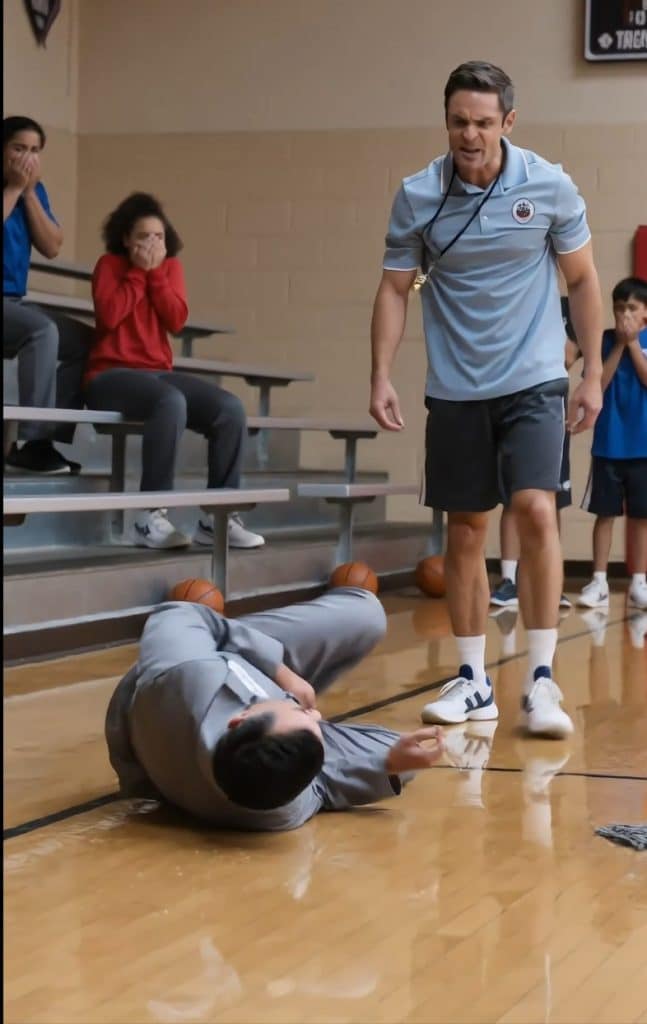
Seventy-year-old Arthur Bennett had been clearing a patch of water near the sideline when Coach Derek Sloan tore the mop from his hands and swung it at him.
The wooden handle caught Arthur near the hairline.
He staggered, stunned, as a thin red line appeared above his forehead. Before he could protect himself, Derek drove a foot into his stomach.
Arthur flew backward into the lowest row of bleachers.
The metal seats shook beneath the impact. His bucket overturned, spilling gray water across the court while loose basketballs rolled toward the baseline.
Children stopped mid-drill.
Parents rose from the stands.
No one seemed to know whether to run forward or pretend they had not seen it.
Derek stood over Arthur with the whistle still hanging around his neck.
“Trash. People like you clean after winners.”
Arthur pressed one trembling hand against the court. His back burned where it had struck the bleachers, and every breath tightened the pain in his stomach.
Still, he looked toward the wet floor.
“One of the boys nearly slipped,” he said.
Derek’s face twisted.
The practice had already started twelve minutes late. A storm had leaked through the aging roof, and Arthur refused to let the children continue until the water was cleared.
Derek saw caution as disobedience.
He stepped across the spill and struck Arthur again while the old man tried to rise.
Several children flinched.
One boy began crying.
“Stay off my court,” Derek said.
The words echoed through the gym.
Derek Sloan had coached the Northside Falcons for six years. Under him, the team had won three city championships and sent several players into elite private-school programs.
Parents wanted their children on his roster.
Sponsors wanted their logos behind his bench.
City officials wanted photographs beside his trophies.
Derek knew exactly how much power that gave him.
He decided who played.
He decided who received travel scholarships.
And when parents complained about his temper, he reminded them that winning required discomfort.
Arthur reached for the overturned bucket.
Derek kicked it farther away.
Then the double doors at the far end of the gym flew open.
City Sports Association Chairman Malcolm Price entered with two security officers and a group of parents scheduled for a funding meeting.
He saw the water first.
Then the rolling basketballs.
Then Arthur on the floor.
Malcolm ran across the court.
He dropped beside the injured man and supported him carefully by the shoulders.
“Mr. Bennett, can you hear me?”
Arthur nodded.
Only after making sure he was conscious did Malcolm turn toward Derek.
The coach straightened.
He expected a warning about the delay.
Instead, Malcolm pointed toward the bronze plaque mounted above the bleachers.
Arthur’s name was engraved across the top.
“Coach,” Malcolm said, “that man paid for this gym.”
Derek’s face drained.
“He paid for this…?”
But Arthur Bennett had not returned in a janitor’s uniform simply to inspect the building he had funded.
He had come because children were disappearing from the program he created.
Act II
Arthur had grown up three blocks from the gym.
There had been no polished court then.
Only a cracked outdoor lot behind a closed factory, where neighborhood children played beneath one working streetlight. Arthur learned basketball using a rim with no net and a ball repaired with tape.
The court gave him somewhere to go after school.
More importantly, it gave him adults who noticed when he stopped showing up.
One of those adults was Raymond Cole, a machinist who volunteered as a coach. Raymond never cared who scored the most points. He cared whether the older boys walked younger children home.
“Winning is what happens on the scoreboard,” he used to say. “Character is what happens after everyone leaves.”
Arthur carried that lesson into adulthood.
He built a regional construction company, made more money than he had ever expected, and eventually sold it. When the city announced plans for a youth sports center, Arthur donated nearly twelve million dollars.
He had one condition.
The gym had to remain affordable.
No child would be denied because a parent could not pay. Equipment, transportation, and league fees would be covered through the Bennett Youth Fund.
For the first decade, the program flourished.
Then Arthur’s wife became ill.
He withdrew from public life to care for her, trusting the sports association to protect the mission.
After she died, Arthur returned quietly.
He did not announce himself.
He did not want speeches, banners, or a ceremonial tour. He wanted to see what the gym had become when no one believed the donor was watching.
Malcolm arranged for him to spend two weeks assisting the maintenance crew under the name Art Bennett.
Only senior administrators knew.
Derek did not.
Neither did most parents.
That anonymity revealed more than Arthur expected.
He saw children wearing uniforms two sizes too small while sponsor money purchased new office furniture. He saw scholarship families asked for unofficial “commitment fees” before tournaments.
He also noticed which children were missing.
The old team photographs showed dozens of local players from low-income families.
The current roster was different.
Most came from wealthy suburbs.
Parents paid for private training, travel packages, and priority evaluation sessions. Several children from the neighborhood had been moved into a recreation group that practiced late at night with old equipment.
When Arthur asked why, Derek laughed.
“Some kids are built to compete. Others are built to participate.”
Arthur began speaking with parents.
A mother named Keisha Howard said her son Jamal had received a full scholarship, then lost it after she refused to pay a separate travel fee.
Another father said his daughter was removed from the elite program after reporting that Derek screamed at younger players.
Families were told the decisions were based on performance.
The records told a different story.
Children whose parents bought expensive training packages advanced.
Children relying on the Bennett Fund disappeared.
Arthur asked Malcolm to begin an audit.
Before it could start, someone emptied the scholarship office and removed three years of payment records.
Then a teenage assistant slipped Arthur a photograph.
It showed Derek accepting a thick envelope from a private sports agent beside the equipment room.
On the back, someone had written:
He is selling access to the children.
Arthur concealed the photograph inside his maintenance locker.
That morning, he overheard Derek telling an assistant that two twelve-year-old players would be moved into an unauthorized showcase game. Their parents had not agreed.
Arthur stepped onto the wet court to delay practice while he contacted Malcolm.
Derek saw him holding a copied roster.
That was why the assault began.
And when Malcolm helped Arthur from the floor, Derek realized the “janitor” had already seen everything.
Act III
The gym was locked down.
Malcolm asked parents to remain while security preserved camera footage and called paramedics. Derek immediately objected.
“You cannot hold families here because an employee fell.”
A parent near the bleachers raised her phone.
“He didn’t fall.”
Her recording showed Derek taking the mop and striking Arthur.
A second video captured the kicks that followed.
Derek’s confidence flickered, but only briefly.
“He threatened the players with that handle.”
The children stared at him.
One finally spoke.
“He was cleaning.”
Another added, “Coach told us to keep running through the water.”
Malcolm looked toward Derek.
“You ordered children onto a wet court?”
“It was barely damp.”
Arthur lifted his head.
“One boy already slipped.”
Derek glanced toward the players, searching for support.
None came.
Then Arthur asked for the copied roster.
It had been inside his uniform pocket before the attack.
Now it was gone.
Derek folded his arms.
“The old man is confused.”
A girl on the bench pointed toward the coach’s leather clipboard case.
“He put paper in there.”
Derek turned on her.
“You should be careful accusing adults.”
The girl shrank back.
Arthur saw it.
So did Malcolm.
Security secured the case while the sports association’s attorney contacted police. Inside were roster sheets, cash envelopes, and private evaluation forms.
Each child had been assigned a market score.
Speed.
Height.
Family income.
Sponsor potential.
Compliance.
Arthur stopped at the final category.
“What does compliance mean?”
Derek said nothing.
The assistant coach answered.
“It means whether the parents question decisions.”
The room went still.
High-scoring children were sent to invitation-only showcases attended by private-school recruiters and sports agents. Their families paid thousands in hidden fees.
Children funded by the Bennett program were used to fill practices, scrimmages, and promotional photographs—but rarely received real opportunities.
Some were removed just before major tournaments and replaced by paying players.
The scholarship program had become advertising.
The children themselves had become products.
Malcolm examined the cash envelopes.
Several carried initials belonging to parents in the bleachers.
One father stood abruptly.
“I paid for extra coaching.”
The assistant coach shook his head.
“You paid to guarantee your son a starting position.”
The father sat back down.
Then paramedics found a small flash drive taped beneath Arthur’s watchband.
He had hidden it there after copying files from the scholarship computer the night before.
The drive contained bank records showing Bennett Youth Fund money being transferred into a company called Victory Path Consulting.
Derek’s wife owned the company.
The payments were labeled player-development services.
No such services had been provided.
Hundreds of thousands of dollars meant for uniforms, transportation, and fees had disappeared.
But one file was worse.
It contained medical information about the children.
Injury histories.
Growth projections.
Family financial problems.
Private notes from counselors.
Derek had been sending them to outside recruiters without parental permission.
Arthur looked toward the children.
They had believed the gym was a safe place.
Instead, adults had been pricing their futures in secret.
Then Malcolm opened one final message.
It came from someone inside the city sports association.
Keep Bennett away from the records until the property transfer is complete.
Derek was stealing from the program.
But someone above him was preparing to steal the gym itself.
Act IV
The message led to Victor Hale, the association’s chief financial officer.
Victor had managed the Bennett donation from the beginning. He handled maintenance budgets, insurance agreements, and property records.
He was also the person who recommended Derek for the coaching position.
Investigators found Victor attempting to leave the city with two external drives and a signed real-estate agreement.
The agreement transferred the gym’s parking lot, training wing, and surrounding land to a private development partnership.
That partnership was controlled by Derek’s largest sponsor.
Their plan was simple.
Make the community program appear financially unsustainable.
Drain scholarship funds.
Reduce neighborhood enrollment.
Then claim the gym could survive only through private investment.
The main court would remain for publicity.
Everything around it would become luxury apartments, private training suites, and a members-only sports club.
The children Arthur built the gym for would be priced out of it.
Victor had already prepared reports blaming declining participation on “lack of community ambition.”
Arthur read the phrase from his hospital bed.
His head required several stitches, and doctors insisted he remain overnight for observation. The injuries were painful but not life-threatening.
Malcolm sat beside him.
“I should have seen it.”
Arthur looked through the window toward the city lights.
“You saw reports.”
“I should have seen people.”
That was the harder truth.
Malcolm had trusted winning seasons, donation numbers, and polished presentations. He attended championship games but rarely visited ordinary practices.
Derek gave him trophies.
Victor gave him clean spreadsheets.
Families gave him complaints.
He believed the first two.
The scandal reached the city council by morning.
Victor’s allies urged officials to separate the assault from the property deal. They argued that Derek’s behavior, however unacceptable, did not invalidate a financially necessary redevelopment.
Arthur attended the emergency hearing with a bandage at his hairline.
Derek appeared through his attorney and claimed the gym had become unsafe under poor maintenance. The spilled water, he argued, proved the facility needed private control.
Arthur almost laughed.
The roof had been scheduled for repair twice.
Both payments appeared in the records.
The work had never occurred.
Victory Path Consulting had received the money.
The leak Derek used to justify redevelopment existed because he helped steal the repair budget.
Yet the developers still believed the transfer could survive.
The association held the deed.
The council had approved the agreement.
Then Arthur asked Malcolm to bring the original donation contract.
Forty years of legal language filled the pages.
Near the end was a condition Victor had apparently overlooked.
If the property ceased serving open community youth programs, ownership would not remain with the association or transfer to a private company.
It would pass into a public trust governed by neighborhood families.
The redevelopment agreement was void.
The gym could not be sold.
Arthur had written the clause himself after watching developers erase the outdoor court where he grew up.
Victor had stolen money.
Derek had sold access.
But neither man had ever owned the future they were trying to take.
The court remained silent as Malcolm read the clause aloud.
Then Arthur asked for the microphone.
“This gym was never a reward for winners,” he said. “It was built so children could discover they had value before anyone handed them a trophy.”
Parents lowered their eyes.
Some had paid Derek.
Others had remained silent because their own children benefited.
Arthur looked toward them.
“A corrupt coach cannot build a corrupt program alone.”
The words struck harder than shouting would have.
Because everyone in that room understood the system had survived through fear, ambition, and convenient silence.
The arrest of two men would not be enough.
The entire idea of winning had to change.
Act V
The Northside Falcons canceled the remainder of their season.
Some parents called it unfair to the children.
Arthur disagreed.
Continuing as though nothing happened would teach them that schedules mattered more than truth.
The investigation identified more than two million dollars in stolen or misused funds. Derek and Victor faced charges connected to assault, fraud, unlawful use of private records, and conspiracy.
Several sponsors withdrew.
Others were removed after auditors discovered they had paid for influence over team selections.
Malcolm resigned as chairman.
Arthur did not ask him to.
Malcolm said leadership required accepting responsibility for what he failed to see, not only what he personally approved.
He later returned as an unpaid volunteer on the neighborhood trust, with no control over finances.
Parents elected the new board.
Half its members had to come from scholarship families. Two seats belonged to former players, and one rotated among current teenagers.
All financial records became public.
Travel teams could no longer charge hidden fees. Playing time was never guaranteed by donations. Medical and counseling information remained private unless families gave informed consent.
The Bennett Youth Fund was rebuilt with recovered money.
Keisha Howard’s son Jamal returned.
So did several children Derek had pushed aside.
But Arthur refused to restore the old elite program immediately.
For one year, every team trained under the same schedule and used the same equipment.
Coaches were evaluated not only by wins, but by retention, safety, conduct, and whether children still wanted to play at the end of the season.
The first new coach was Raymond Cole’s granddaughter.
Her name was Dana.
She removed the word winners from the locker-room wall.
In its place, she painted:
Leave the court better than you found it.
Some parents complained that the program was becoming soft.
Dana invited them to attend practice.
They watched children run hard, defend fiercely, and compete without being humiliated.
Discipline remained.
Cruelty did not.
Arthur recovered slowly.
For weeks, sudden movement near his head made him tense. He refused public sympathy and ignored requests for interviews.
What troubled him most was not the blow.
It was the sight of children watching an adult attack someone they believed was powerless.
Several had frozen.
One had laughed nervously.
Another had looked toward Derek before deciding whether the violence was wrong.
Arthur asked the trust to create a program teaching children how to recognize abuse by authority figures and seek help safely.
He did not ask them to become heroes.
He asked adults to build systems where courage would not leave a child standing alone.
Three months later, Arthur returned to the gym.
The roof no longer leaked.
The donor plaque remained above the bleachers, though Arthur had requested that his name be made smaller.
The trust refused to remove it completely.
Instead, they added the names of maintenance workers, coaches, families, and neighborhood volunteers who had kept the center alive.
Arthur stood before the wall for a long time.
Then he changed into a gray work shirt.
Dana found him near the baseline with a mop.
“You know we have staff for that.”
Arthur looked toward a damp patch beside the bench.
“And yet the floor is wet.”
She smiled.
Together, they cleared it.
A group of ten-year-olds waited nearby with basketballs tucked under their arms.
No one complained about the delay.
One boy asked Arthur why he still cleaned when he could afford to hire anyone.
Arthur leaned on the mop.
“Because the floor doesn’t care who paid for the building.”
The boy considered that.
Then he grabbed a towel and helped.
Soon three more children joined him.
Practice began four minutes late.
No one was injured.
That season, the Falcons did not win the city championship.
They lost in the semifinal by one point.
The children cried.
Dana let them.
Then she asked who wanted to help stack chairs for the younger team’s game.
Every player stayed.
Arthur watched from the bleachers.
For the first time in years, the gym felt like the place he had imagined.
Not a factory for trophies.
Not a marketplace for children.
A community.
Derek had pointed at an elderly janitor and said people like him cleaned after winners.
He never understood that Arthur Bennett had spent his life cleaning away the barriers powerful people placed in front of children.
The plaque revealed who paid for the gym.
His actions revealed why he built it.
And the old man Derek ordered off the court became the reason every child in the neighborhood was finally allowed to stand on it.