Act I
The cane hit the gravel before Mr. Grant’s glasses did.
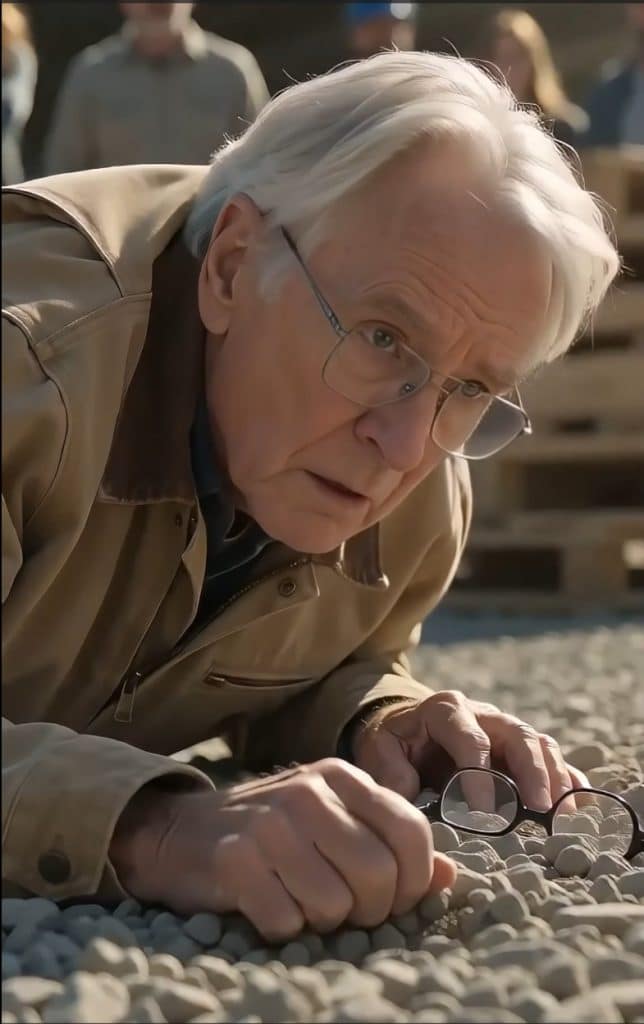
He lurched forward in the hardware yard, one shaking hand reaching for balance as the woman yanked his cane away like it was clutter blocking her path. His prosthetic foot caught against the uneven gravel, and he went down beside a stack of cedar boards with a hard, breathless sound.
Then she shoved the board away from him.
The small plank slid across the gravel and struck a bag of cement. His glasses fell near it, one lens dusted with sawdust, while customers turned from metal shelves, pallets, work gloves, and loading carts in stunned silence.
The woman above him did not apologize.
She smiled.
Her name was Victoria Langford, and everything about her looked new: premium denim jacket, spotless leather boots, sunglasses, styled brown hair that belonged more to a resort brochure than a Montana hardware yard. She owned half the new hillside development outside town, and she carried herself like that meant she owned every person standing beneath the hardware store sign.
Mr. Grant stayed on one knee.
He was seventy, silver-haired, thin beneath his old khaki jacket, his hands trembling from age and years of hard work. Gravel had scratched one palm. His breathing was tight. Without his glasses, his eyes narrowed against the bright afternoon light.
Still, he reached for the plank first.
Victoria laughed.
She kicked the cane farther away.
A forklift driver killed the engine. A contractor lowered a bundle of pipe. A local woman holding paint samples covered her mouth as sawdust drifted through the quiet yard.
Victoria leaned over him, eyes wide with cruelty.
“That fake foot, those shaking hands, and you think you can build something?” she said. “Hardware trash like you should stay out of the yard.”
The words stopped everyone.
Even the wind seemed to pause against the metal shelves.
Mr. Grant did not answer.
He found his glasses by touch, lifted them slowly, and looked up at her through dust-streaked lenses. Pain remained in his face. Humiliation too.
But beneath it came something older.
A builder’s patience.
The kind that measures a cracked beam before deciding how to take the whole weight off it.
Then the forklift roared from the back lane.
It came fast over the gravel and braked hard beside Victoria, close enough to make her scream and fall backward near the lumber rack. The forks dropped with a metal thud that shook the yard.
The driver climbed down.
It was the store owner, Sam Kepler, wearing a work vest, a radio at his shoulder, and an expression so cold the crowd stepped back without being told.
He walked past Victoria.
Straight to Mr. Grant.
Act II
Kepler Hardware had been standing in Briar Falls, Montana, long before the town had a coffee shop with chalkboard menus or vacation homes with heated driveways.
It was built low and wide against the wind, with a gravel yard out back and sawdust in the air most days. Contractors came for lumber. Ranchers came for fence posts. Grandmothers came for drawer pulls. Teenagers came for summer work and learned quickly that hardware yards had their own language: load limits, straight edges, grain, torque, weather, patience.
Mr. Grant knew that language better than anyone alive in town.
His full name was Henry Grant.
Decades earlier, before his hair turned silver and his hands began to shake, he had been the best builder in three counties. He framed houses that still stood square after forty winters. He rebuilt porches after storms, barns after fires, and school ramps before anyone in town knew the word accessibility belonged in every plan.
He was not flashy.
He signed his work in pencil on the inside of beams where nobody would see it unless something broke and had to be opened.
That was how he liked it.
The prosthetic foot came after a job site accident when he was forty-nine. A wall section shifted in wind, a young worker froze, and Henry pushed him clear before the weight came down. He never told the story unless someone else forced it out of him.
After the accident, some people assumed he would stop building.
Henry learned new balance.
He changed his stance. Changed his tools. Built jigs that held boards steady when his hands did not. He taught himself to measure twice in ways younger carpenters never considered because his body no longer allowed careless speed.
He became slower.
Then better.
That was the part Victoria Langford could not understand.
To her, building was ownership. Land deals. renderings. glossy signs. ribbon cuttings. She had come to Briar Falls with investors, bought hillside acreage, and announced a luxury lodge project that promised jobs, tourism, and “elevated rural living.”
The town split over it.
Some people needed the work.
Some feared being priced out of the place their grandparents had built.
Henry said little in public, but when the old community hall roof failed that spring, he came to the town meeting with a set of drawings rolled beneath his arm. The hall had hosted weddings, winter food drives, school plays, storm shelters, funerals, and birthday parties for people too proud to ask neighbors for help and too loved to be left alone.
The town had money for materials, barely.
Not for a full construction firm.
Henry proposed a community build.
Volunteers. retired tradesmen. apprentices. local suppliers. donated labor. A new hall with a workshop wing where young people could learn carpentry, electrical basics, tool care, and how to fix what life would otherwise make them throw away.
The council voted yes.
They named Henry Grant as project lead.
Victoria hated that.
Her company had offered to “help” by funding a modern event pavilion near her development instead, one that would host public functions when not reserved for private guests. She wanted the town’s gratitude. The council’s goodwill. The newspaper photo.
Henry’s project threatened all of that because it proved Briar Falls could still build for itself.
So when she saw him in the hardware yard that afternoon, inspecting cedar boards with shaking hands and a cane beside him, she did not see the man holding the town project together.
She saw an obstacle.
A frail old man slowing down a lumber order she wanted redirected to her lodge site.
A body she thought could be moved.
And by putting him on the gravel, she made the whole yard see exactly what her version of “development” meant.
Act III
Sam Kepler crouched beside Henry without grabbing him.
“Mr. Grant,” he said, voice formal and clear, “the town project is waiting.”
The sentence moved through the yard like a hammer striking clean wood.
Grant.
A contractor near the cement bags took off his cap. The forklift driver’s assistant went pale. Someone behind the paint shelves whispered, “That’s Henry Grant?”
Victoria froze on the gravel.
“Town project…?” she breathed.
Henry reached for the cane.
Sam picked it up, then stopped and held it out rather than placing it in Henry’s hand without permission. Henry accepted it, planted it carefully, and retrieved his glasses. The frame was bent slightly. He adjusted it with a slow thumb.
Then he stood.
It took time.
The prosthetic foot settled against the gravel. His hand shook against the cane. His jacket was dusty at one shoulder.
No one rushed him now.
When Henry finally straightened, the hardware yard seemed to remember what it was.
Not a showroom.
A place where work was respected.
Sam turned toward the cashier at the loading office.
“Lock the yard cameras. Print the order logs. Nobody moves that board until we photograph where it fell.”
Victoria scrambled upright, anger fighting panic.
“This is insane. He was blocking my contractor’s materials.”
Henry looked at her.
“I was checking the grain.”
The simplicity of it made several workers shift.
A young carpenter stepped forward.
“He was checking the boards for the community hall order.”
Victoria snapped, “They’re just boards.”
Henry’s eyes sharpened.
“No. They’re roof braces.”
That landed differently.
The crowd looked at the cedar stack. At the small plank on the gravel. At the old man whose hands had been shaking not from weakness alone, but from measuring the one detail careless people never see until something fails.
Sam faced Victoria.
“Mrs. Langford, you assaulted the lead builder for the Briar Falls community hall restoration.”
Her sunglasses hid her eyes, but not the way her mouth parted.
“I didn’t know who he was,” she said.
Henry wiped dust from one lens.
“That is why the town should be careful with what you build.”
The yard went silent.
Victoria’s face flushed.
“You people are overreacting.”
A forklift driver spoke from behind Sam.
“I saw her yank the cane.”
A contractor added, “I saw the shove.”
The woman with paint samples lifted her phone.
“I recorded after he fell.”
Victoria looked around, finding no smooth surface to reflect her confidence back to her.
Sam stepped between her and Henry.
“Your lumber hold is canceled pending review.”
“My company has a priority account.”
“Not in my yard,” Sam said.
For the first time, Victoria looked at Henry as if he might be more dangerous standing quietly with a bent pair of glasses than she had ever been with money, boots, and contempt.
Henry picked up the small board.
He ran his thumb once along the grain.
Then he looked at Sam.
“Bring this one,” he said. “It’ll hold.”
Act IV
The emergency project meeting happened in the loading shed at the back of the yard.
It smelled of sawdust, engine oil, rain on pallets, and paper invoices. A workbench became the table. Cement bags became seats for people who arrived late. Contractors, council members, store staff, volunteers, and two apprentices gathered beneath hanging lights while Victoria Langford stood near the open bay door with dust on her boots and fury in her face.
Henry placed three things on the bench.
His cane.
His bent glasses.
The small cedar board she had kicked away.
Nobody spoke for a moment.
Then Sam played the security footage from the yard monitor.
There was no music. No softening angle. Just Victoria taking the cane, Henry falling, the shove, the board sliding, the insult cutting through the speakers.
Hardware trash like you should stay out of the yard.
When it ended, Victoria looked toward the council chair.
“This has nothing to do with the project.”
Henry looked at the board.
“It has everything to do with the project.”
The council chair leaned forward.
“Explain.”
Henry tapped the cedar plank.
“This board came from the upper half of the stack. Straight grain. Tight rings. No split through the end. Better for the north roof brace where snow load collects.”
A young apprentice looked at the plank as if seeing it for the first time.
Henry continued.
“Mrs. Langford’s contractor tried to reserve the same stack this morning for decorative beams at the lodge.”
Victoria stiffened.
“So? We pay market rate.”
Sam opened an invoice folder.
“Your account placed a priority hold using the town project discount code.”
The shed went colder.
Victoria’s head snapped toward him.
“That is a clerical error.”
Sam’s expression did not change.
“No. It is three clerical errors across two weeks.”
A council member picked up the invoice.
Victoria’s polished voice began to fray.
“My development supports this town. I was told local sourcing would be encouraged.”
Henry looked at her.
“Local sourcing is not taking public-discount materials from a community hall.”
The words settled over the workbench.
Public-discount materials.
A town already stretching every dollar.
A roof that had to hold snow.
Children who would learn to build beneath it.
Victoria had not simply mocked an old man.
She had tried to redirect the bones of a public place into private decoration.
Sam placed another document on the bench.
“Mrs. Langford’s team also requested that the workshop wing be removed from the town design to reduce ‘redundant training space’ near her development’s proposed recreation center.”
Henry’s hands trembled harder.
Not from fear.
From restraint.
“That workshop wing stays.”
Victoria scoffed.
“You think a handful of kids with hammers will save this town?”
Henry looked at the apprentices near the door.
“No,” he said. “But teaching them their hands matter might.”
One of the apprentices, a seventeen-year-old girl named Mara who had been quiet all afternoon, stepped forward.
“Mr. Grant taught me how to square a frame last winter,” she said. “My dad lost work. I was going to leave town after graduation. Now I’m applying for a trade program.”
Another apprentice added, “He fixed my grandmother’s ramp for free.”
A contractor near the shelves nodded.
“He rebuilt my shop roof after the storm and made me pay him in coffee for six months.”
Soft laughter moved through the shed, but it carried grief too.
The kind that appears when people realize how close they came to letting a valuable person be treated as disposable.
Victoria folded her arms.
“This is sentimental.”
Henry looked at her for a long time.
“No,” he said. “It is structural.”
The council chair closed the invoice folder.
“Langford Development is suspended from all town project partnerships pending investigation into misuse of purchasing codes and material interference.”
Victoria’s face went pale.
“You cannot do that.”
Sam’s voice was ice.
“They just did.”
Henry picked up the bent glasses and put them back on.
The world sharpened imperfectly.
Good enough.
He turned to the apprentices.
“Load the cedar.”
Then he looked once at Victoria.
“Carefully. Some things only look old until you need them to hold weight.”
Act V
Victoria Langford was escorted out through the gravel yard she had treated like a private driveway.
No one cheered.
Montana towns remember too well that humiliation can become its own kind of ugliness if people enjoy it too much. They watched instead, silent and steady, as Victoria walked past the pallets, metal shelves, cement bags, and customers who no longer looked impressed by spotless boots.
At the gate, she turned back.
“This town needs investment,” she said.
Henry stood beside the cedar stack, cane in hand, glasses crooked, old khaki jacket dusty from the fall.
“It does,” he said. “But not the kind that kicks the foundation away.”
Victoria had no answer.
She left in a white SUV that threw gravel behind it.
The yard stayed quiet for only a moment.
Then Sam clapped once.
“Back to work.”
That was how the town healed best.
Not by speeches.
By lifting together.
The cedar boards were loaded onto the flatbed. Henry checked each one before it went on. The apprentices watched his hands, learning that shaking did not mean careless, and slow did not mean weak. A contractor showed Mara how to brace the stack. The forklift driver moved with extra patience, as if the whole machine had learned respect.
By evening, the lumber reached the old community hall.
The roof sagged at the north corner. Paint peeled from the siding. The front steps leaned. To an outsider, it might have looked ready for demolition.
To Henry, it looked like a promise under repair.
Work began the next morning.
People arrived with tool belts, coffee, gloves, ladders, thermoses, and stories. Retired carpenters argued about measurements. Teenagers swept sawdust badly until Henry taught them to do it right. A grandmother brought biscuits. A mechanic fixed the generator. Sam donated fasteners and refused to let anyone call it charity.
Henry supervised from a folding chair when his foot hurt too much.
Then stood when the work required it.
He never pretended pain was noble.
Pain was information. Rest was a tool. Pride was useful only if it kept you honest.
The investigation into Langford Development took weeks. The town found enough to cancel partnerships and recover misused discounts. Victoria’s lodge still had money behind it, but the shine had come off. Investors dislike scandal, especially the kind that reveals a developer willing to steal from a community hall while mocking the man rebuilding it.
Her public apology used careful words.
The yard footage used clearer ones.
Hardware trash.
Fake foot.
Shaking hands.
Stay out of the yard.
People remembered.
But Henry tried not to let them remember only that.
He wanted them to remember the other part.
The loading. the measuring. the apprentices. the cedar beams rising into place. the first time the repaired roof held through a storm and did not groan.
The cane Victoria kicked was repaired, but Sam asked if he could keep the cracked rubber tip.
Henry frowned.
“For what?”
“For the training wall.”
“What training wall?”
“The one I’m building before you tell me not to.”
Henry almost smiled.
So the rubber tip, the bent glasses frame, and a cut end from the cedar plank were mounted inside the new workshop wing after the hall reopened. Not in the main lobby. Henry refused that. He did not want visitors treating his fall like a tourist stop.
They placed it where students would see it before picking up tools.
The card beneath read:
The day the town remembered who taught it to build.
New apprentices heard the story on their first morning.
Sam told it plainly.
“A builder was knocked down. A yard froze. Workplaces don’t stay safe by accident.”
Henry approved of that.
Mostly.
He crossed out the word builder on the first draft and replaced it with neighbor.
“That’s the job,” he said.
Months later, the community hall reopened under a clear September sky.
No luxury stage. No velvet rope. No donor wall large enough to embarrass the people who cooked casseroles and hammered nails. Just a repaired hall, a workshop wing, a roof strong enough for Montana snow, and long tables where the town ate together for the first time in nearly a year.
The apprentices built the benches.
Henry inspected every one.
Mara’s bench was the best, though he did not tell her until she found the small pencil mark beneath it.
H.G. approved.
She cried in the storage room and denied it afterward.
The first class in the workshop was basic home repair.
How to patch drywall. fix a hinge. read a tape measure. check a load-bearing wall before doing anything foolish. Henry taught from a stool with his cane beside him and his prosthetic foot resting on a wood block.
His hands shook when he demonstrated cuts.
The students leaned closer, not away.
That mattered.
One boy asked, “Mr. Grant, how do you build if your hands shake?”
Henry looked at the saw.
“By respecting the shake.”
The boy frowned.
“What does that mean?”
“It means I clamp what needs holding. I measure when my hands are steady. I ask for help before pride ruins the piece.”
The room went quiet.
Then Henry added, “And I don’t let people who mock weakness design anything meant to carry weight.”
The students wrote that down even though it was not on the worksheet.
Winter came hard.
Snow stacked on the new roof. Wind pressed against the hall walls. The town waited through the first storm like parents listening for a child’s breathing.
The roof held.
Henry sat in his kitchen that night with a cup of coffee, listening to weather hit the windows, and allowed himself one small nod.
The next morning, Sam called.
“Well?”
Henry looked out at the snow.
“It’ll do.”
Sam laughed.
That was the highest praise Henry gave anything.
The following spring, Briar Falls held a youth build day in the hardware yard.
The same gravel. Same pallets. Same metal shelves. Same sawdust in the air.
But something had changed.
Staff watched more carefully when older customers moved through the yard. Forklift lanes were marked clearer. Benches were added near the lumber racks. Canes, walkers, braces, prosthetics, shaking hands, slow steps—none of them were treated as reasons to hurry people out of the way.
They were treated as part of the workday.
Henry arrived in his old khaki jacket with the cane in one hand and a bundle of small boards under his arm.
Mara, now accepted into trade school, walked beside him.
“You sure you want to teach birdhouses to twelve-year-olds?” she asked.
Henry looked at the crowd of children waiting near the pallets.
“Everybody starts somewhere.”
A boy near the front stared at Henry’s prosthetic foot, then looked embarrassed.
Henry saved him the trouble.
“Want to know how it works?”
The boy nodded.
Henry explained it simply, then handed him a board.
“Now you explain grain direction to me.”
The boy looked terrified.
Mara grinned.
Henry’s eyes warmed.
The day went well.
Not perfectly. One birdhouse roof was crooked enough to offend physics. Someone spilled nails. A little girl painted her project purple and declared it better than wood color, which Henry did not dispute because she was probably right.
At the end of the afternoon, Sam found Henry standing near the spot where he had fallen the year before.
“You thinking about it?”
Henry looked at the gravel.
“Some.”
“Still mad?”
Henry considered that.
“At her? Less.”
“At what, then?”
“At how quickly people decide a damaged thing can’t be useful.”
Sam said nothing.
Henry watched the children carry their crooked birdhouses toward waiting parents.
Then he added, “But they’re learning.”
That was enough.
Victoria Langford had called him hardware trash in front of everyone.
But by the time the community hall roof held through winter, every person in Briar Falls knew the truth.
Mr. Grant had never needed permission to stand in the hardware yard.
He was the reason the town still knew how to build.