Act I
The metal tray hit the concrete before the ribs left the smoker.
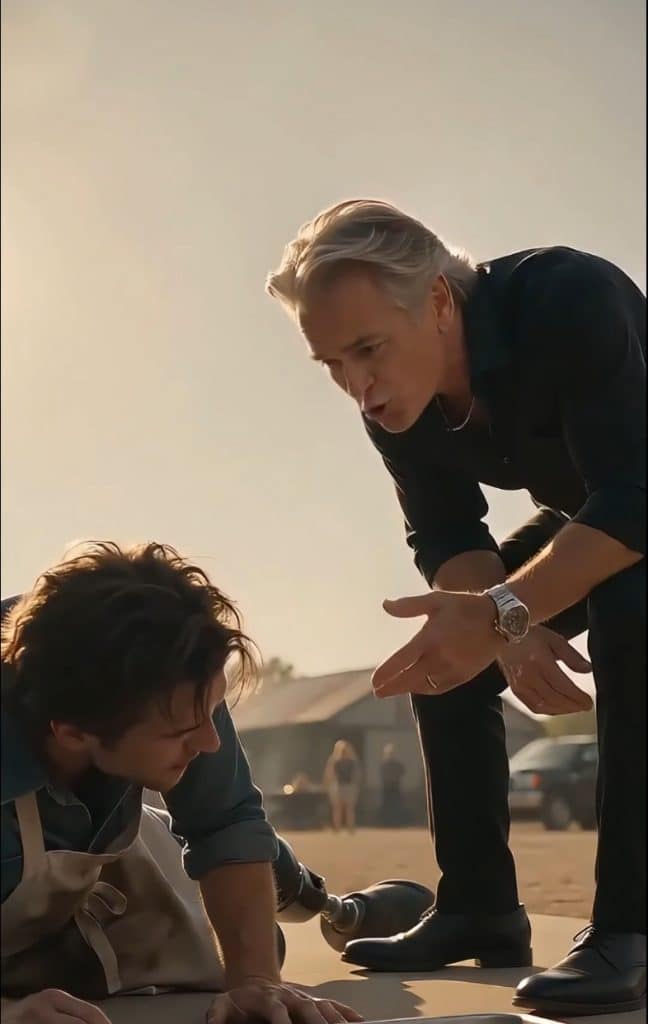
Mr. Walker folded forward beside the cook line, one gloved hand catching the edge of a prep table as the first punch knocked the air out of him. Smoke rolled behind him in thick blue ribbons, carrying hickory, pork fat, pepper bark, and the sudden metallic clatter of barbecue tools scattering across the yard.
The second punch sent him down.
His smoke-stained apron twisted beneath him. His prosthetic leg struck the concrete with a hard, hollow sound that made one young cook flinch like he had been hit too. A towel slid through a puddle of sauce near the smoker, and the tray spun toward the picnic tables where customers had gone completely still.
Nobody chewed.
Nobody laughed.
A mother pulled her daughter back from the fence. A dishwasher froze with both hands full of plates. Two cook-off judges standing near the faded restaurant sign stared at the man on the ground as if the whole Tennessee yard had turned into a courtroom.
The wealthy man above him looked satisfied.
Calvin Royce wore an expensive black shirt, polished leather shoes, and a silver watch that flashed every time he moved. His salt-and-pepper hair looked arranged for cameras. His face carried the wide-eyed contempt of someone who believed skill was only real when it came in a franchise brochure.
He kicked the tray away.
It scraped across the concrete and slammed into the leg of a picnic table.
Mr. Walker stayed on one knee.
He was thirty-nine, with messy hair from grill smoke, an old denim shirt beneath his apron, and calm focused eyes that did not belong to a man afraid of fire, pain, or rich men pretending to know barbecue.
His lip was marked. His palm scraped the concrete.
Still, he did not beg.
He reached for the towel.
Calvin stepped on it.
“Metal leg, filthy apron, and you think you run a kitchen?” Calvin said, loud enough for every customer to hear. “Backyard trash like you should stay behind the smoke.”
The smokers hissed.
The yard went silent.
Mr. Walker slowly lifted his eyes.
Pain was there.
So was humiliation.
But underneath both, something colder began to settle. Not rage. Control. The kind a real pitmaster learns after watching fire for twelve hours and knowing the smallest mistake can ruin everything.
Then engines roared from the road.
A convoy of black pickups tore into the BBQ yard and braked hard near Calvin. Gravel snapped beneath the tires. Calvin stumbled backward, slipped on the concrete edge, and fell with his hands out like a man who had never expected the ground to answer him.
The lead truck door opened.
An older man stepped out in a black apron and cowboy hat, a judge badge pinned to his chest, his face carved into ice.
He looked first at Mr. Walker.
Then at Calvin Royce.
And every person in the yard knew the smoke had changed direction.
Act II
Walker’s Roadside BBQ had never looked like a place wealthy men fought over.
It sat off a Tennessee highway between a tire shop and a field that flooded every spring. The sign was faded red. The picnic tables leaned slightly from years of weather. The smokers were blackened from so many long nights that no amount of scrubbing could make them look new.
People came anyway.
Truck drivers stopped before dawn. Families came after church. Construction crews ate from paper trays with sauce on their sleeves. College kids drove an hour for brisket because somebody’s uncle swore it was worth the gas.
It was not fancy food.
That was the lie outsiders told.
Real barbecue was not simple because it was easy. It was simple because everything false burned away. Fire, salt, smoke, patience, meat, weather, wood, and hands that understood when not to interfere.
Mr. Walker understood those hands.
His full name was Jonah Walker.
His father had started the restaurant with one smoker, a folding table, and a recipe written on butcher paper. Jonah grew up sleeping in a booth while his parents worked overnight, waking to the smell of hickory and his mother’s voice telling him not to touch anything unless he planned to clean it.
By fifteen, he could trim brisket better than grown men.
By twenty-two, he was winning regional competitions.
By twenty-eight, people in barbecue circles knew his name even if they had never seen his face.
Then came the accident.
A gas line fault in a catering trailer. A young prep cook trapped inside. Jonah went back through heat and smoke because the kid had frozen near the door. He got him out. He also lost his leg below the knee and spent the next year learning how to stand in front of a smoker without letting pain turn him bitter.
People wanted to turn him into a story.
He refused.
“I didn’t save barbecue,” he told one local reporter. “I saved a boy. The barbecue still has to be cooked right.”
That was Jonah.
Proud, but not performative.
Hard, but not cruel.
When his father died, the restaurant nearly went under. Medical bills, repair costs, bad loans, and a highway expansion that cut off part of the parking lot all hit at once. Jonah kept the smokers running until exhaustion became part of his posture.
That was when Calvin Royce appeared.
Royce owned FireLine BBQ, a glossy restaurant chain with neon signs, identical menus, and a marketing team that used words like authentic in rooms where nobody smelled like smoke. He wanted Walker’s name, Walker’s sauce, Walker’s story, and most of all Walker’s location, because the highway traffic was coming back after the new exit opened.
He did not want Jonah.
Not really.
He wanted the legend without the person who protected it.
Calvin offered a buyout. Jonah refused. Calvin offered partnership. Jonah refused again. Then Calvin’s lawyers found old debt tied to the property and began circling through investors, lenders, and city contacts.
The Tennessee Heritage Smoke-Off was supposed to settle part of it.
A donor group had created a preservation grant for independent restaurants with historic culinary value. The winner would receive enough money to secure the property, modernize safely, and remain independent for five years. FireLine entered through a technical loophole, arguing that its “heritage brand expansion” qualified.
Calvin planned to win in front of cameras.
Jonah planned to cook.
Quietly.
No announcement. No interviews. No special treatment.
He entered under his father’s old competition code: Table Seven.
The judges knew.
The senior pitmaster knew.
Calvin did not.
To him, Jonah looked like a pit worker guarding a smoker Calvin believed should soon belong to him.
So when Jonah refused to let FireLine staff move a tray of ribs before they had rested, Calvin lost the patience he had never truly possessed.
He saw an apron.
A prosthetic leg.
Smoke in the hair.
A man he thought could be knocked down without consequence.
And he made his mistake in front of the very judges who had come to taste the truth.
Act III
The older pitmaster crossed the concrete like a storm that had learned manners.
His name was Earl Boone, and every serious cook in the South knew him. He had judged Memphis, Nashville, Austin, Kansas City, and half the roadside contests that mattered more than televised trophies. He could smell dirty smoke from twenty yards away and could tell, with one bite, whether a cook had rushed the wrap.
He crouched beside Jonah Walker without touching him too quickly.
“Mr. Walker,” he said, voice formal and clear, “the cook-off judges are ready.”
The gasp moved through the yard.
Walker.
A waitress near the order window whispered, “That’s Jonah?” A young cook covered his mouth. One of the FireLine assistants went pale as he looked from the man on the concrete to the restaurant sign over the smokers.
Calvin Royce froze where he had fallen.
“I… I didn’t know,” he said.
Jonah reached for the towel.
Earl picked it up, then stopped and held it out rather than wiping Jonah’s face himself. Jonah took it with a small nod, pressed it briefly to his lip, and pushed himself upright.
It took effort.
Everyone saw that.
The prosthetic leg shifted beneath him. His palm hurt. His breath still had not fully settled from the hit. But when he stood, the yard seemed to straighten with him.
He picked up the metal tray.
Then he looked at Calvin.
No threat.
No shouting.
Just a cold, controlled stare that made Calvin’s polished shoes look ridiculous beside the smokers.
Earl turned toward the competition coordinator.
“Preserve the security footage. Nobody touches Table Seven’s entry. Nobody moves those tools until we document what happened.”
Calvin stood quickly, panic covering itself with anger.
“Document?” he snapped. “He interfered with my kitchen.”
Jonah’s eyes narrowed slightly.
“Your kitchen?”
The words were quiet.
That made them dangerous.
Calvin pointed toward the smokers.
“I’m the largest sponsor here.”
Earl’s face turned colder.
“You’re a sponsor. Not a pitmaster. Not an owner. And after putting hands on a competitor, maybe not even that for much longer.”
The crowd murmured.
A FireLine manager stepped back from Calvin as if distance could save him from association.
Calvin tried to laugh.
“Competitor? This guy?”
Jonah lifted the tray onto the prep table and checked the meat resting beneath foil. Even now, after being hit, he looked at the ribs first. Not because he cared more about food than dignity.
Because craft was dignity.
“They needed four more minutes,” Jonah said.
A judge near the table stepped forward.
“That’s why he stopped your staff.”
Calvin’s expression faltered.
The judge continued. “Your team tried to move his entry.”
Calvin’s jaw tightened.
“I was managing flow.”
Earl looked at the smokers.
“No. You were trying to put your hands on another man’s fire.”
In barbecue, that meant more than it sounded like.
It meant trespass.
It meant disrespect.
It meant a man who did not know the craft thought money made him immune to its rules.
Jonah untied the apron slowly, then retied it tighter.
“Let the judges taste,” he said.
Calvin stared at him.
“You still think you can compete after this?”
Jonah looked at the smoke rising behind him.
“I’ve cooked through worse than you.”
Act IV
The judging table was moved into the open yard.
That was Earl Boone’s decision.
No back room. No private sponsor tent. No place for Calvin Royce to turn violence into a misunderstanding and humiliation into a footnote.
The judges sat beneath a white canopy near the smokers. Customers remained at the picnic tables, silent now, paper trays forgotten. Young cooks stood in a line near the prep area, watching the adults decide whether barbecue still belonged to people who respected fire or people who bought enough signs.
Jonah placed Table Seven’s entry before the judges.
His hands were steady.
That mattered more than the bruise forming near his mouth.
The ribs were dark at the edges, mahogany through the center, bark set but not burnt. No glossy fake shine. No sugar shell hiding impatience. The smoke ring was clean. The sauce was brushed lightly enough to complement, not bury.
Earl looked at Calvin before tasting.
“You may stay silent while the judges work, or you may be removed now.”
Calvin’s face reddened.
He stayed silent.
For once.
The judges tasted.
No one spoke at first.
Good barbecue creates a private room inside the mouth before it becomes public opinion. Salt, smoke, fat, pepper, vinegar, heat, memory. You either know what you are tasting, or you start making noise to hide that you don’t.
Earl set down the rib bone.
His expression did not change, but one young cook near the smoker began to smile because he had seen that look before.
Recognition.
The next entry was FireLine’s.
It looked perfect.
Too perfect.
Heavy lacquered sauce. identical cuts. smoke added like decoration, not history. A rib built for a billboard, not a person who had waited all morning under Tennessee heat.
The judges tasted.
This time, silence meant something else.
Earl wiped his hands.
“Before scores are announced,” he said, “we need to address conduct.”
Calvin’s eyes widened.
“I apologized.”
Jonah looked at him.
“No. You panicked.”
A few customers shifted, the truth making them braver.
The competition coordinator opened a folder.
“FireLine staff submitted a protest this morning claiming Table Seven used unauthorized equipment.”
Jonah looked toward the FireLine tent.
Earl’s face hardened.
“Unauthorized equipment?”
The coordinator held up a printed photo.
“Mr. Walker’s modified standing brace near the smoker.”
The yard went colder.
Jonah’s jaw tightened for the first time.
Calvin looked away too quickly.
Earl stared at him.
“You filed a complaint against a cook’s adaptive support equipment?”
Calvin lifted his chin.
“I filed a safety concern.”
Jonah’s voice cut through the smoke.
“You filed it after I refused your buyout.”
That silence was different.
Deeper.
The preservation grant officer, who had been standing near the judges, stepped forward.
“Is there documentation of a buyout attempt?”
Jonah nodded toward his sister, who ran the register and had been crying quietly since the attack.
She brought a folder from the office.
Emails. offers. pressure letters. notes from lenders suddenly contacted by FireLine representatives. A proposal that described Walker’s Roadside BBQ as “a heritage acquisition opportunity with founder narrative potential.”
Founder narrative.
Jonah almost laughed when Earl read it aloud.
His father had not been a narrative.
His mother’s hands washing trays at midnight had not been a narrative.
The years of smoke in his lungs, the pain in his leg, the kid he had dragged from the trailer, the cooks he had trained, the customers who came after funerals and graduations and long shifts because the food tasted like somebody had stayed awake for them—none of it was a narrative.
It was work.
Calvin’s face drained as the documents passed between the judges and grant officials.
Earl turned to him.
“You wanted his name, his story, his smoker, and his land. But you couldn’t stand the man himself.”
Calvin’s voice cracked.
“This is business.”
Jonah stepped closer to the table.
“No,” he said. “This is barbecue. Business just keeps trying to sit at the head of the table.”
The preservation grant officer closed the folder.
“FireLine BBQ is disqualified from the Tennessee Heritage Smoke-Off pending ethics review.”
Calvin staggered back.
“You can’t disqualify me. My company funded half this event.”
Earl’s eyes were ice.
“Then we’ll refund the part that came with your hands on another cook.”
The yard erupted—not in cheers, but in a wave of breath, disbelief, and relief. The kind that comes when people realize the person with money has finally heard a word he cannot buy around.
Calvin turned toward Jonah.
“You think this makes you a legend?”
Jonah looked at the smokers.
“No,” he said. “Standing here tomorrow will.”
Act V
Calvin Royce was escorted past the picnic tables while smoke drifted over the yard.
His polished shoes stepped through sauce, ash, and wet concrete. His silver watch still flashed in the Tennessee sun, but no one admired it now. FireLine staff avoided his eyes. Customers stared openly.
At the edge of the lot, he turned back.
“You’ll regret embarrassing me,” he said.
Jonah stood beside the smoker, apron stained, hair messy from smoke, one hand resting near the tray.
“You embarrassed yourself,” he replied. “I just kept the fire steady.”
Calvin opened his mouth.
Nothing came out.
He left beneath the faded sign of the restaurant he had tried to turn into a brand asset.
The Smoke-Off resumed.
Not immediately. Good work needed a moment after ugliness. The young cooks cleaned the tools. Jonah’s sister fixed the table. Earl checked on Jonah once and accepted only a nod as proof the man was stubborn enough to continue.
When the final scores were read, Table Seven won.
Jonah did not celebrate the way cameras wanted him to.
He closed his eyes.
For one second, he was a boy again, sitting in the corner booth while his father opened the smoker door and said, “Don’t rush what smoke is still teaching.”
Then the yard applauded.
Loudly.
Messily.
Customers stood. Staff cried. The young prep cook Jonah had once saved, now grown and working the line beside him, put both hands over his face and turned away so nobody could see him break.
The preservation grant saved Walker’s Roadside BBQ.
But it did more than that.
It required the restaurant to remain independent, train local cooks, and preserve its original pit process without turning Jonah’s injury into marketing. Jonah insisted on that last clause himself.
“No hero posters,” he said. “No metal-leg branding. No pity ribs.”
Earl Boone laughed so hard he had to sit down.
FireLine issued a statement two days later about a “heated disagreement at a regional culinary event.” The security footage made the statement useless. Sponsors pulled back. Food writers asked harder questions. Former employees came forward about cut corners, fake smoke systems, and pit crews replaced by reheating protocols while advertisements showed imaginary old men tending imaginary fires.
Calvin Royce did not vanish.
Men like him rarely do.
But he became less dangerous in that corner of Tennessee.
His money still existed. His arrogance probably did too. But now people knew what it looked like when stripped of lighting, slogans, and sauce.
At Walker’s, the damaged tray and towel were not thrown away.
Jonah wanted to toss them in the scrap bin. His sister stopped him.
“People need to remember what almost got kicked away,” she said.
So the tray was mounted inside the smokehouse, near the staff entrance, not the customer wall. The towel hung beside it, washed but still marked at one edge.
The card beneath read:
The day the smoke outlasted the insult.
New cooks saw it before their first shift.
Jonah told the story plainly.
“A man thought dirty work meant disposable people. Don’t ever cook for someone who teaches you that.”
Then he handed them gloves and made them clean the pits.
Because respect in a smokehouse did not live in speeches.
It lived in maintenance.
Months passed.
The restaurant changed slowly. A new roof over the cook area. Safer flooring near the smokers. Better access around the line so Jonah and anyone else with mobility needs could work without pretending discomfort was dedication. A training program for young cooks who could not afford culinary school. A rule that nobody touched another cook’s station without asking.
The food did not change much.
That was the point.
One evening after closing, Jonah sat alone beside the smoker while the last fire settled into coals. The yard was quiet. Picnic tables empty. Highway lights glowing beyond the trucks.
Earl Boone walked up with two sweet teas and handed him one.
“You know,” Earl said, “people are calling you the best pitmaster in Tennessee.”
Jonah took the tea.
“People say a lot when they’re full.”
Earl smiled.
“They’re not wrong.”
Jonah looked at the smoker.
The heat shimmered at the edge of the door.
“I used to think winning meant getting everybody to admit my father was right.”
“And now?”
Jonah leaned back, leg aching, hand still faintly scarred from the concrete.
“Now I think winning means the next kid on this line doesn’t have to get punched before people believe he belongs here.”
Earl nodded.
That was a better trophy than any plaque.
The following summer, Walker’s hosted its first youth pit day.
No cameras. No sponsors with speeches. Just teenagers in aprons learning how to stack wood, trim fat, test heat with patience, and listen when older cooks corrected them. One boy stared at Jonah’s prosthetic leg too long, then looked embarrassed.
Jonah tossed him a towel.
“Ask the question or get back to work.”
The boy swallowed.
“Does it hurt to stand by the smoker all day?”
“Sometimes.”
“Why do you still do it?”
Jonah looked at the smoke rolling low and blue from the stack.
“Because pain tells me when to rest. It doesn’t tell me what I love.”
The boy nodded like he did not fully understand yet.
That was fine.
Smoke teaches slowly.
Later that day, a customer asked if the famous tray was real.
Jonah glanced toward the smokehouse door.
“Real enough.”
“Did you forgive him?”
Jonah wiped sauce from his hands.
“No.”
The customer looked startled.
Jonah shrugged.
“I moved on. That’s different.”
Then he turned back to the smoker, where the next rack needed checking.
By the next Tennessee Heritage Smoke-Off, Walker’s Roadside BBQ was not just surviving. It was busier than ever, but not slicker. The sign was still faded. The smokers were still blackened. The picnic tables still leaned. The difference was in the people.
Young cooks stood taller.
Customers waited without complaining when the line slowed.
Judges came early, not for politics, but for breakfast biscuits Jonah’s sister made before the official event.
Calvin Royce did not attend.
Nobody missed him.
At noon, Earl Boone walked through the yard, judge badge on his chest, and found Jonah beside the smoker exactly where he belonged.
“Mr. Walker,” he said, with the same formal respect as the day everything changed, “the judges are ready.”
Jonah looked at him.
This time, he smiled.
“Then don’t keep the ribs waiting.”
The crowd laughed, and the sound moved through the yard like sunlight through smoke.
Calvin Royce had called him backyard trash in front of everyone.
But by the time the next fire burned low, every cook in that Tennessee yard knew the truth.
Mr. Walker had never been hiding behind the smoke.
He was the reason the smoke still meant something.