Act I
The mission ID skidded across the exhibit floor before Dr. Mercer hit the ground.
It slid beneath the silver light of the capsule display, spinning past champagne shoes, polished dress boots, and the feet of billionaires who had gathered to toast the future as if they had personally invented the sky.
Then Daniel Mercer landed hard beside the prototype vehicle.
The gala froze.
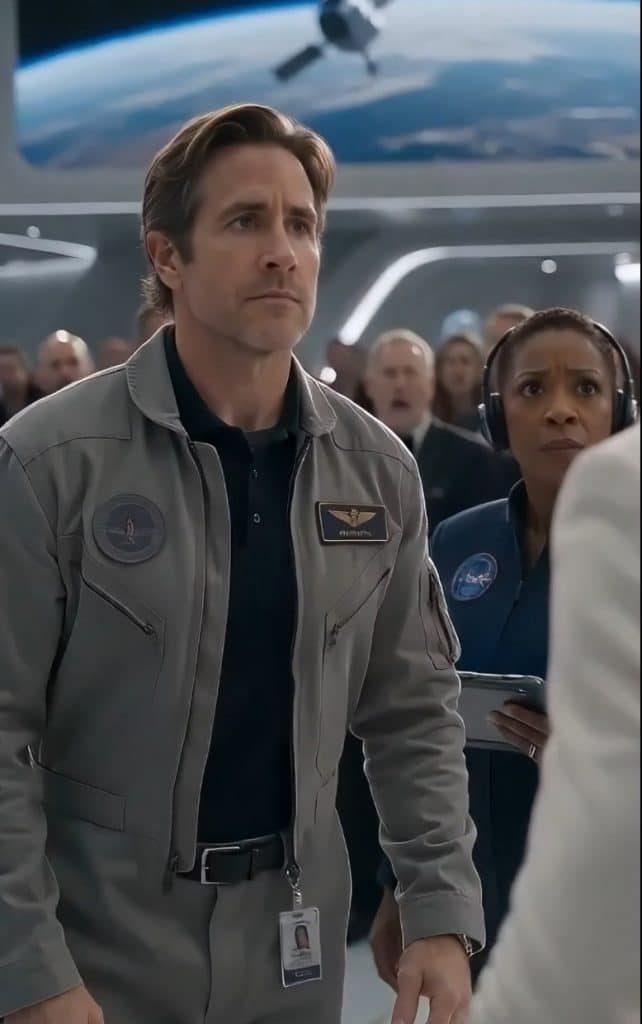
Orbital screens glowed above the room, showing animated spacecraft circling Earth in clean blue lines. A capsule model stood beneath glass like a holy relic. Investors in designer suits turned from their champagne tables. Engineers stopped whispering near the telemetry wall. Cameras lifted, then lowered, unsure whether they had just captured scandal or history.
Above Daniel stood Ethan Vale.
Thirty-two years old. White designer suit. Black shirt. Luxury watch. A tech-billionaire smirk that had sharpened into something cruel.
He had punched Daniel once in the stomach, then again across the face when Daniel buckled.
Now Daniel was on the floor, one hand pressed against the exhibit surface, breath tight, a faint mark near his lip. His old gray engineering jacket had twisted at the shoulder. The mission ID that had been clipped to his belt lay several feet away, face down beneath the glow of a screen showing launch countdown graphics.
Ethan looked down at him and laughed.
Not loudly.
Worse.
Like the whole room should have understood the joke.
“You people always forget your place,” Ethan said.
Daniel lifted his eyes.
They were deep gray, steady despite the pain.
“I told you the guidance lockout was still unresolved,” he said.
That was all.
No insult. No plea. No fear.
Just a technical fact, spoken from the floor to a man who had mistaken physics for a public relations problem.
Ethan’s expression hardened.
The gala had been built around him. His company, Vale Orbital, was raising its final private round before its first crew-rated demonstration launch. Reporters called him the young face of commercial space. Investors called him inevitable. He called himself the man who would “democratize the stars,” though every seat on the first mission cost more than most families would earn in several lifetimes.
And Daniel Mercer, in an old jacket and black shirt, had quietly refused to authorize the launch sequence.
At a fundraiser.
In front of investors.
So Ethan stepped closer, his shadow falling across Daniel’s chest.
“Space belongs to billionaires,” he said, voice cutting through the silver-lit room. “Garage trash like you doesn’t get to look upward.”
A gasp moved through the crowd.
Someone whispered, “Ethan.”
An engineer looked sick.
Daniel did not answer. His hand moved toward the fallen mission ID, but Ethan kicked it farther away with the side of his shoe.
The badge slid again, stopping near the wheel of the autonomous prototype vehicle.
Then the vehicle came alive.
Its lights flashed white.
It surged forward from the exhibit line and braked sharply three feet from Ethan Vale, forcing him to stumble backward in front of everyone.
The side hatch opened.
Commander Ava Rhodes stepped out with a command tablet in one hand and fury in her face.
Act II
Ava Rhodes did not enter rooms.
She took command of them.
She had flown test aircraft before most of the investors in that gala had learned how to perform confidence for cameras. She had survived failed simulations, budget fights, engine fires, and men who called recklessness vision until she made them read the failure reports aloud.
That night, in her navy aerospace suit, short hair neat beneath her headset, she crossed the exhibit floor without looking at Ethan first.
Her eyes went straight to Daniel.
“Dr. Mercer,” she said, voice formal and controlled, “launch authorization is waiting.”
The room changed around the title.
Dr.
Not mechanic.
Not garage help.
Not some anonymous technician who had wandered too close to the billionaires’ future.
Dr. Daniel Mercer.
The name moved through the engineers first. A few of them straightened as if someone had restored oxygen to the room. Then the investors began murmuring. Then the reporters checked their notes, suddenly aware that the man on the floor might matter more than the man in the white suit.
Ethan’s face tightened.
“Dr… Mercer?” he said.
Daniel slowly rose.
He did not take Ava’s hand immediately. He picked up his mission ID first, wiped it with his thumb, and clipped it back to his belt with a precision that felt almost ceremonial.
Only then did he stand fully.
His breath was still uneven, but his face had gone cold. Not angry in the way Ethan understood anger. Not theatrical. Not wounded for the cameras.
Mission-focused.
Ava stepped beside him, not in front of him. That detail mattered. She was not rescuing a helpless man. She was standing with the person the mission needed.
Ethan forced a laugh.
“This is ridiculous,” he said. “He was interfering with a shareholder event.”
Ava looked at him.
“He was preventing you from turning a shareholder event into a launch failure.”
The words cut cleanly.
Several investors went still.
Behind them, the capsule model rotated slowly beneath museum lighting. Its clean white shell reflected the crowd as fractured shapes, like a future already beginning to crack.
Ethan’s jaw flexed.
“You work for me, Commander.”
“No,” Ava said. “I command the mission. There is a difference.”
Daniel looked toward the orbital screens.
The countdown animation was still running, decorative but dangerous in its implication. Guests had been told tonight would include a ceremonial live authorization, a dramatic moment in which Ethan Vale would press a glowing button and announce that Vale Orbital was officially cleared for its final launch window.
Only a few people knew the truth.
Ethan did not have the authority to clear it.
He had the money.
Daniel had the lock.
And Ava had the command.
That separation existed for a reason.
Space did not care who funded it. It did not care who appeared on magazine covers or who raised another billion before dessert. It punished arrogance with math.
And Daniel Mercer had spent his entire life respecting math.
Act III
Daniel built his first engine in a garage that flooded every spring.
Not a romantic garage with perfect lighting and a founder story waiting to be sold. A real one, behind a rented house in Ohio, with cracked concrete, rusted shelves, and a space heater that tripped the breaker if his mother used the microwave at the same time.
His father repaired farm equipment.
His mother taught middle school science.
They had no investors, no family office, no last name that opened doors. But Daniel had a sky above the driveway, a library card, and a father who believed broken things could teach patience if you listened before forcing them back together.
When Daniel was sixteen, his father took him to watch a rocket launch on an old television in the kitchen. The signal froze twice. The picture blurred. Daniel still remembered the lift, the flame, the impossible calm before the machine disappeared into cloud.
His father said, “The best engineers are the ones who know what happens if they are wrong.”
Daniel never forgot it.
Years later, he earned degrees no one in his family knew how to pronounce. He worked on guidance systems, autonomous abort logic, and fault isolation software for high-risk vehicles. He became the kind of engineer companies wanted in the room but rarely wanted on stage.
Because Daniel said no.
No to shortcuts hidden behind schedule pressure.
No to simulations labeled acceptable when they had not been rerun under stress conditions.
No to executives who believed safety margins were negotiable if the valuation was high enough.
That reputation made him inconvenient.
It also made him essential.
Vale Orbital brought him in after a near-failure during an uncrewed test. The official report blamed “sensor instability.” The internal logs told a more frightening story: the vehicle had misread a navigation drift and nearly accepted a correction that would have put it outside safe recovery range.
Daniel found the flaw.
Then he found the deeper one.
The guidance software had been patched too quickly after investor pressure pushed the launch timeline forward. It worked beautifully in presentations. It worked well enough in standard simulations. But under a rare combination of sensor lag, thermal noise, and communication delay, the system could briefly trust the wrong data.
Only briefly.
But in flight, briefly was enough.
Daniel designed the lockout.
No final launch authorization could proceed unless he personally signed off that the fault path had been eliminated, tested, and independently verified.
Ethan agreed to it when the board was watching.
Then he spent three months trying to get around it.
He offered Daniel bonuses. Then threatened his contract. Then surrounded him with executives who used phrases like mission confidence and acceptable exposure. Daniel answered with test results.
That made Ethan hate him.
Not because Daniel was wrong.
Because Daniel could not be bought into silence.
The gala was Ethan’s trap.
He invited Daniel publicly, dressed the event as a celebration, filled the room with cameras and investors, then announced that final authorization would happen live. He assumed Daniel would not embarrass him in front of the money.
Daniel did anyway.
Quietly.
He stepped near the exhibit floor, told Ava the lockout remained active, and refused to let ceremonial theater become operational permission.
Ethan heard him.
Then rage did what money had failed to do.
It exposed him.
Act IV
Ava lifted her command tablet.
The orbital screens changed instantly.
The glossy animation vanished.
In its place appeared a technical status panel, stark and unforgiving.
FINAL AUTHORIZATION: HOLD
GUIDANCE LOCKOUT: ACTIVE
AUTHORITY: DR. D. MERCER / COMMANDER A. RHODES
A murmur spread through the gala.
Investors leaned forward. Engineers stopped pretending to look calm. Reporters began recording openly now.
Ethan stared at the screen.
“Turn that off,” he snapped.
No one moved.
Ava’s eyes stayed on him.
“This launch is on hold pending final safety verification.”
Ethan laughed, but the sound had lost its shape.
“You don’t understand what’s at stake.”
Daniel looked at him.
“That is exactly why you are not cleared to command it.”
The room went silent.
For the first time, Ethan Vale looked less like the future and more like a man standing too close to the machine he had claimed to own.
His voice dropped.
“Do you know how many people are invested in this?”
Daniel’s expression did not change.
“I know how many people would be inside the capsule.”
That sentence ended the argument for everyone who still had a conscience.
Ava stepped closer.
“Mr. Vale, you assaulted the mission safety authority in front of witnesses. You attempted to pressure a live authorization process for financial reasons. Security will preserve all footage. The board will be notified immediately.”
“The board?” Ethan said.
His eyes flicked toward the champagne tables.
Several board members were already standing.
Not approaching him.
Standing away from him.
That frightened him more than Ava’s command voice.
One of the senior engineers, a woman with silver hair and shaking hands, stepped forward.
“Commander,” she said, “Guidance Team confirms Dr. Mercer’s hold recommendation.”
Another engineer followed.
“Propulsion supports hold.”
Then another.
“Flight systems supports hold.”
The words came one by one, like bolts locking into place.
For months, Ethan had made them afraid individually. In that moment, Daniel’s refusal gave them permission to become a system.
Ethan’s mouth twisted.
“You’re all replaceable.”
Ava’s voice turned ice cold.
“Then you do not understand what you built.”
Daniel picked up the mission ID from his belt and held it in his palm. The badge was scratched now from sliding across the floor. His name, photo, and clearance level were visible beneath the silver light.
He looked at Ethan.
“You said space belongs to billionaires.”
Ethan said nothing.
Daniel’s voice stayed quiet.
“Space belongs to no one. That is why the people who enter it have to be better than ownership.”
The prototype vehicle behind Ava powered down with a soft mechanical hum.
The room seemed to exhale.
A board representative in a dark suit approached with security beside him.
“Mr. Vale,” she said, “pending emergency review, you are suspended from all launch-related decision authority.”
Ethan’s face drained.
“You can’t suspend me from my own company.”
Ava looked at the screen.
“From the company, maybe not tonight,” she said. “From the mission, yes.”
Ethan turned toward Daniel.
For a brief, wild second, he looked as if he wanted to strike him again.
Security moved before he could decide.
This time, no one hesitated.
Act V
By morning, the gala video had reached every corner of the tech world.
At first, people shared the punch.
The billionaire in white. The engineer on the exhibit floor. The mission ID skidding under silver lights. Ethan Vale’s voice saying, “Space belongs to billionaires. Garage trash like you doesn’t get to look upward.”
Then came the reversal.
The autonomous prototype braking inches away.
Commander Ava Rhodes stepping out.
Her formal line.
“Dr. Mercer, launch authorization is waiting.”
And Ethan’s final stammer.
“Dr… Mercer?”
The clip became a symbol before the facts finished arriving.
Some called it karma. Some called it class war. Some called it the end of genius-founder culture, though the end of such things is always announced too early by people hoping headlines can replace consequences.
Daniel called it a safety incident.
That was all.
He refused interviews for three days and spent those three days inside the verification room with the guidance team, rerunning the fault path under conditions harsher than the ones that had triggered the lockout. His lip healed. His ribs ached when he leaned too long over the console. He ignored both until Ava ordered a medical check and threatened to remove him from the room if he argued.
He did not argue.
Ethan Vale did.
Through lawyers. Through friendly investors. Through private calls to board members. Through carefully worded statements about “emotional intensity during a historic fundraising milestone.”
But the footage was too clear.
The technical logs were clearer.
The board found that Ethan had repeatedly pressured mission staff to accelerate launch readiness, misrepresented safety status to investors, and attempted to stage a symbolic authorization without operational clearance.
His authority over launch operations was permanently revoked.
Within two weeks, he resigned as CEO under pressure and remained only a minority shareholder with no command access, no safety override, and no role in crew approval.
He still had money.
But money was no longer allowed near the button.
That was the real punishment.
Not public shame.
Separation from control.
Vale Orbital changed its name three months later.
Not to erase the scandal, though some investors wanted that. Ava refused.
“You don’t get clean by repainting the hull,” she said.
Instead, the company became Meridian Flight Systems and published a new mission charter. Safety authorities would be independent of fundraising leadership. Engineering holds would be protected by contract. Launch readiness reports would be disclosed to crew and regulators before investor announcements. No founder, executive, or donor could override mission command.
Daniel helped write the charter.
He insisted on one line near the top.
No timeline outranks physics.
The phrase appeared on the wall of the new control room in black letters.
Engineers photographed it quietly.
Some printed it on stickers and put it on laptops.
Six months after the gala, the launch finally happened.
Not at a fundraiser. Not beneath champagne lights. Not with billionaires performing destiny for cameras.
It happened before dawn on a cold coastal morning, with the sky still dark and the ocean moving like steel beyond the pad.
Daniel stood at the guidance console wearing the same old gray engineering jacket. The mission ID had been replaced, but he kept the scratched one in his desk drawer.
Ava stood at command.
The crew was already strapped inside the capsule.
No speeches.
No theatrics.
Just checklists, breath, telemetry, and the terrible humility of doing something dangerous as carefully as human beings can.
“Guidance?” Ava asked.
Daniel watched the final simulation values settle green.
He thought of his father in the kitchen, the frozen television signal, the sentence that had shaped his life.
The best engineers are the ones who know what happens if they are wrong.
Then he looked at the console.
“Guidance is go,” he said.
Ava nodded.
“Launch authority?”
Daniel entered his code.
This time, the lock released.
“Authorized.”
The rocket rose six minutes later.
Flame opened beneath it. The ground shook. The sky accepted nothing; it merely allowed the machine to pass because the math was finally honest.
In mission control, no one cheered until the capsule reached stable orbit.
Then the room erupted.
Engineers cried openly. Technicians hugged. Ava closed her eyes for one second, then opened them before anyone could see too much.
Daniel stayed seated.
Not because he felt nothing.
Because he felt the weight of every held decision, every delayed milestone, every uncomfortable no that had made the yes mean something.
Ava came to stand beside him.
“You looked upward,” she said.
Daniel glanced at her.
“So did the garage.”
She smiled.
Later, when the crew returned safely, the press asked Daniel what he thought about Ethan Vale’s claim that billionaires owned the future.
Daniel took a long moment before answering.
“The future is not owned,” he said. “It is inherited by everyone who survives our decisions.”
That line traveled farther than the video.
It was quoted in engineering schools, safety conferences, and angry comment sections beneath articles about companies that wanted applause before accountability.
Daniel returned to work the next day.
The scratched mission ID stayed in his drawer, not as a trophy, but as evidence. A reminder that humiliation could happen in rooms full of brilliant people if money made them hesitate. A reminder that systems were only as strong as the people willing to stop them.
Years later, young engineers at Meridian would hear the story of the gala.
Some would ask if Daniel had been afraid.
He would say yes.
Not of Ethan.
Of being the last person in the room willing to say no.
Then he would point them toward the guidance console, the test logs, the mission charter, and the wall where the words remained:
No timeline outranks physics.
Outside, rockets still rose.
Investors still wanted speed.
Founders still loved stages.
But inside that control room, under Ava Rhodes’s command and Daniel Mercer’s authorization, the future moved only when the work was worthy of it.
And somewhere beyond the atmosphere, where no bank account could breathe and no ego could negotiate with gravity, the truth remained as cold and clean as starlight.
Space had never belonged to billionaires.
It belonged to the careful.